What happens during a roof replacement?
The crew takes the old roof off down to the wood deck, replaces any rotten decking, then puts down underlayment, an ice barrier where the code calls for one, new flashing, vents and shingles. The job ends with cleanup and, where a permit was pulled, a final inspection. Before any of it, Virginia requires a signed written contract.
Free to ask. Local shops send quotes, and you pay only when you book one.
By Kasra Taheri, Founder, LoclisPublished
Researched and drafted with AI, then checked claim by claim against the sources listed below before it was published. Prices and rules change; the dates beside each source say when it was last checked.
This is a job for a licensed pro in Virginia
This page explains what the work involves, the permits, what a licensed pro does and what drives the cost. It does not give step-by-step instructions, because this work needs a licence, a permit or both, and doing it wrong can injure someone. Before you hire, check the licence on Virginia's DPOR record.
A roof replacement takes the old roof off down to the wood deck, repairs whatever is rotten underneath, and builds a new roof system on top: underlayment, ice barrier where the code calls for one, flashing, vents and shingles. It is different from a roof recover, which lays a new covering over the existing one without removing it.
Whether yours needs a full tear-off depends on what is up there now, what your local building department allows and what the shingle warranty requires. Many roofers prefer a tear-off so the deck can be checked and the whole system is new, and some manufacturer warranties demand one (see below). Here is what a full replacement looks like, in the order it happens.
Before work starts: the contract and the permit
In Virginia, the contract has to be in writing and signed by you and the contractor before work starts or any payment is accepted.[4] Among other things it must list the specified materials and work, the total cost, the schedule of progress payments with the down payment stated, and a statement that the contractor will comply with local requirements for building permits, inspections and zoning.[4] Any change to the cost, materials, work or completion date has to be in writing and signed by everyone.[4] Ask for the shingle brand, line and color in writing, and include complete cleanup and removal of debris and materials[5] in the contract.
On most houses the permit question is simple: replacing any amount of roof covering on a one- or two-family house or townhouse needs no permit, unless the house is in an area where the nominal design wind speed is greater than 100 miles per hour.[3] There are exceptions: the building official may require a permit for replacement roofing on a house in a historic district designated by the locality, and for otherwise exempt work in a special flood hazard area.[3] Replacing more than 256 square feet of roof decking falls outside the exemption, and work on any structural component needs a permit.[3] See do you need a permit to replace a roof for the details. When one is needed, the contractor should apply for and obtain any necessary building permits, and the contract should say so.[5]
For the deposit, Virginia's Board for Contractors suggests a deposit of no more than 10% of the total price or $1,000, whichever is less, unless the job needs custom-made items or special orders.[5] On delivery day, expect shingle bundles and a dumpster or trailer near the house. Moving cars out of the driveway and taking fragile things off walls is worth doing, because tear-off is loud and shakes the house.
Tear-off
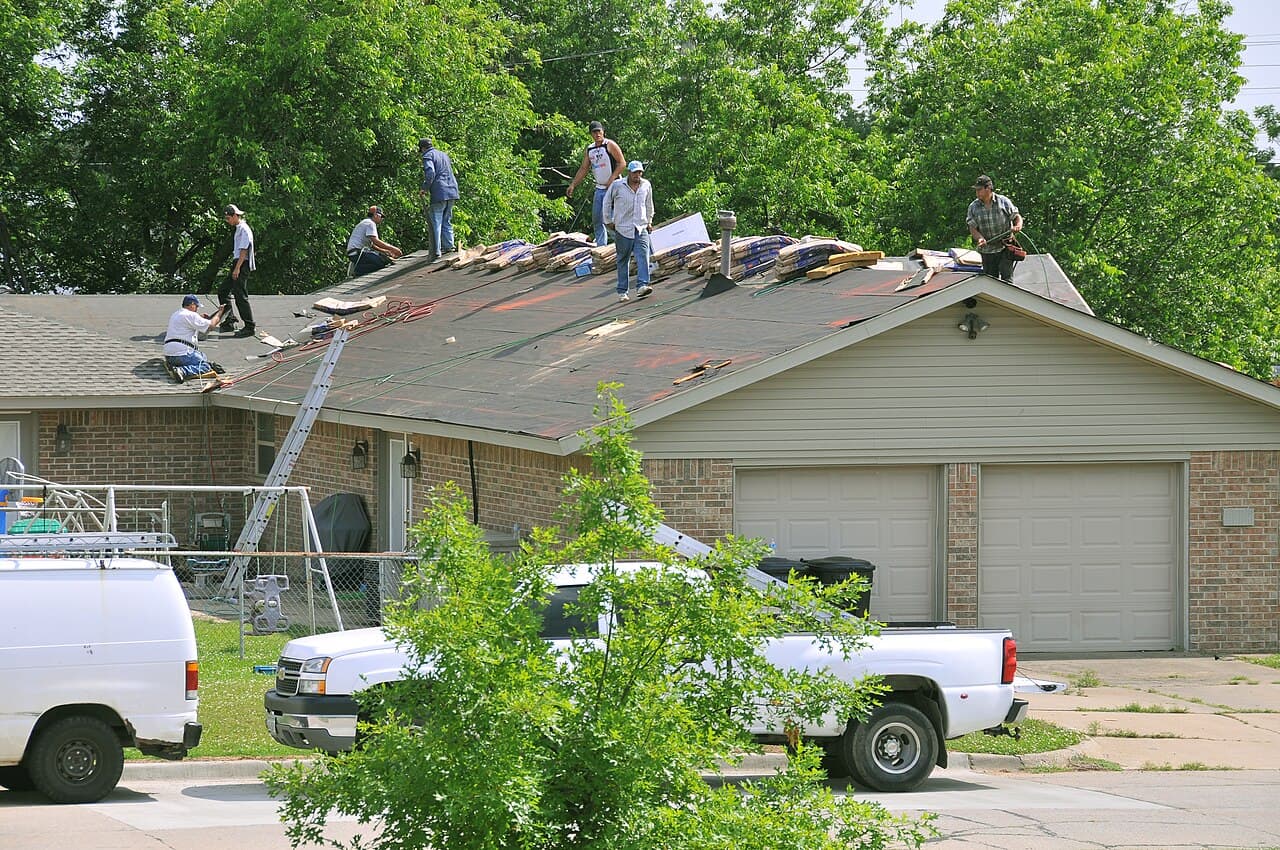
The crew strips the roof down to the deck. Some manufacturer warranties require it: Owens Corning's System Protection warranty, for example, requires the new roof to be installed over a clean roof deck with all existing roofing material and debris removed, including old felt, ice and water membrane, raised nails, and the flashing around chimneys, skylights, pipe boots and vents.[1] Good crews usually tarp shrubs and windows below and sweep the yard for nails at the end of each day.
Deck inspection and repairs
With the deck bare, the roofer looks for rotted or warped wood and large gaps between deck boards, and bad boards are replaced before new shingles go on. Owens Corning's System Protection warranty, for example, requires repairs to any damaged areas, such as rotten wood decking.[1] This is the one part of the price nobody can know for certain in advance, which is why a good quote names a price per sheet of replacement decking. If the roof sags along the ridge or between rafters or trusses, have a licensed structural engineer look at the structure before the job goes further.
Small decking repairs stay permit-free. Replacing 256 square feet or less of roof decking on a house needs no permit, unless that decking had to be fire-retardant-treated or otherwise protected to form a fire-rated wall termination when the house was built.[3] In Prince William County, if a permit was obtained and roof sheathing was replaced, the inspector needs access to the attic.[2]
Underlayment, ice barrier, flashing and vents
Next comes the layer under the shingles. Prince William County's building division notes that the Virginia code requires an ice barrier along the eaves in areas where there has been a history of ice forming along the eaves and backing up water, as designated in the code's Table R301.2(1), running from the lowest edges of the roof to a point at least 24 inches inside the exterior wall line of the house.[2] On roofs with a slope of 8 in 12 or steeper, it also has to extend at least 36 inches along the roof slope from the eave edge.[2] Your local building department can tell you whether your area is designated. The county also notes that the code does not prescriptively require drip edge, but if the shingle manufacturer requires it, it has to be installed.[2]
New flashing goes in at walls, chimneys, valleys and pipes, and the vents are set up. Shingle warranties often depend on this part: the Owens Corning warranty requires a ventilated roof deck and a code-approved underlayment.[1] Attic ventilation works best with air coming in low, at the soffit or eave, and leaving at or near the ridge. Moisture in poorly ventilated attics promotes decay of the wooden roof sheathing and rafters.[8]
The new shingles
Shingles go on from the eaves up, finished with ridge caps. They do not reach full strength the day they are installed: the sealant on the shingles needs direct warm sunlight for several days to seal properly.[1] Shingles installed in cool weather may not seal until the weather warms, and until they seal they are more vulnerable to blow-offs and wind damage.[1]
Ask the crew to leave the leftover bundles. Extra shingles are useful for future repairs, and if none are left, knowing the color name and the year the roof was installed helps a roofer find a match.
Cleanup, inspection and paperwork
The last day is cleanup, a magnet sweep for nails and a walk-around with you. Where there was a permit, Prince William County, for example, calls for a final inspection once the work is complete, and a signed Energy Envelope and Roof Covering Certification at that inspection.[2] Other localities have their own forms, so ask yours.
Make sure the shingle warranty is registered. For Owens Corning's System Protection warranty, the contractor has to register it within 60 days of installation,[1] and it does not cover other makers' components such as flashing, fasteners, pipe boots and wood decking,[1] so ask what workmanship warranty the roofer gives on those. On the money side, DPOR's advice is plain: "Don't pay 100% of the bill until the work is 100% complete and you are satisfied with the job."[6] The contractor has to keep a complete copy of the contract and any change orders for five years,[4] and you should too.
When to call a licensed pro
A replacement is a job for a roofing contractor from start to finish. Roof work is dangerous, and a roof that is half torn off when the weather turns is a problem for the whole house.
Virginia law requires a contractor's licence for a single job over $1,000, and the class has to fit the price: Class C covers single jobs over $1,000 and under $30,000, and Class B covers jobs from $30,000 to under $150,000.[7] DPOR's 2017 consumer guide puts the line at "$1,000 or more";[5] where the two differ, the statute governs. For roofing-only work you may want a contractor licensed in that specialty.[5] Check both using DPOR's License Lookup or by calling (804) 367-8511,[6] or follow how to check a contractor's licence.
Not sure you need a new roof yet? See how to know if you need a new roof and what a new roof costs in Virginia, or browse more exterior answers. Loclis lists licensed businesses from Virginia's DPOR register with each one's licence number and class: browse roofing contractors or exterior contractors in Blacksburg.
When you are ready, describe your roof replacement once and licensed local roofers send quotes or offer an estimate visit.
Common questions
- Do roofers always tear off the old shingles?
- Not always. A single flat layer of shingles over sound decking can sometimes be covered instead, though many roofers prefer a full tear-off so the whole system is new. A tear-off is usually needed when the deck is rotten or warped, there are already several layers, or the old shingles are too distorted to lie flat. Whether a recover is allowed on your house is a building-code and warranty question, so have the roofer confirm it with your local building department.
- Do I need to be home during a roof replacement?
- Usually not for the whole job, but be reachable. The crew may find rotten decking after tear-off, and any change to the cost or work has to be agreed in writing and signed before it is done. Moving cars out of the driveway and fragile items away from walls and the attic is sensible, since tear-off is noisy and shakes the house.
- Does a roof replacement need a permit in Virginia?
- On most houses, no. The statewide building code exempts replacing any amount of roof covering on one- and two-family houses and townhouses unless the house is in an area where the nominal design wind speed is over 100 mph. The same code lets the building official require a permit for reroofing in a locally designated historic district or a special flood hazard area, and replacing more than 256 square feet of decking or any structural component falls outside the exemption.
- Why are some new shingles lifting in the wind?
- New shingles rely on a sealant that needs several days of direct warm sun to bond. A roof put on in cool weather may not seal until it warms up, and until then it is more open to blow-offs. Mention any lifted shingles to the roofer, who can check them while the job is fresh.
- What paperwork should I have when the roof is done?
- Keep the signed contract and any change orders, proof of payment, the permit and final inspection if there was one, the shingle maker's warranty with its registration, and the brand, line and color of the shingles. Hang on to any leftover bundles the crew leaves too, for matching repairs later.
Sources
- [1] System Protection Limited Lifetime Warranty, Owens Corning Roofing and Asphalt, LLC. Checked October 26, 2026.
- [2] Residential Roof Replacements (FAQ, version 2021-06-24), Prince William County Department of Development Services, Building Development Division. Checked October 26, 2026.
- [3] 13VAC5-63-80, Virginia Uniform Statewide Building Code, Section 108 Application for permit, Virginia Administrative Code, Legislative Information System. Checked October 26, 2026.
- [4] 18VAC50-22-260, Filing of charges; prohibited acts, Virginia Administrative Code, Legislative Information System. Checked October 26, 2026.
- [5] What You Should Know Before You Hire a Contractor, Virginia Board for Contractors, DPOR. Checked October 26, 2026.
- [6] Disaster Recovery: Avoiding Fraud, Virginia Department of Professional and Occupational Regulation. Checked October 26, 2026.
- [7] § 54.1-1100. Definitions (contractor classes), Code of Virginia, Legislative Information System. Checked October 26, 2026.
- [8] Overview of Roofing Materials for Forest Service Facilities (March 2000), USDA Forest Service, Missoula Technology and Development Center. Checked October 26, 2026.
Want a pro to handle it?
Describe the job once. Licensed local businesses send quotes, and you pay only when you book one.
Get a quote for Roofing