How much does duct repair cost in Virginia?
There is no single Virginia price. The bill depends on how much ductwork is damaged, whether it runs through a tight attic or crawl space, whether sections are sealed or replaced, insulation, testing, old asbestos wrap and any permit. Where a permit is needed it is a small part: Spotsylvania County's packet, updated August 2025, lists $147 for an HVAC replacement. Get a written, itemised quote.
Free to ask. Local shops send quotes, and you pay only when you book one.
By Kasra Taheri, Founder, LoclisPublished
Researched and drafted with AI, then checked claim by claim against the sources listed below before it was published. Prices and rules change; the dates beside each source say when it was last checked.
This is a job for a licensed pro in Virginia
This page explains what the work involves, the permits, what a licensed pro does and what drives the cost. It does not give step-by-step instructions, because this work needs a licence, a permit or both, and doing it wrong can injure someone. Before you hire, check the licence on Virginia's DPOR record.
Duct repair in Virginia has no standard price, because no two jobs are the same size. A single fallen run in an open basement is a small job; sealing every joint in a cramped attic or crawl space, re-insulating and testing before and after is a much bigger one. What you can control is the quote: know what drives it, and ask for each piece in writing.
What drives the price
How much of the system is damaged. Ducts are often hidden in walls, ceilings, attics and crawl spaces, and the contractor has to find the problems before fixing them. ENERGY STAR's checklist for a contractor's duct job includes inspecting the whole system, attic and crawlspace included; evaluating supply and return balance; repairing damaged and disconnected ducts; sealing leaks with mastic, metal tape or an aerosol-based sealant; sealing registers and grilles to the ducts; insulating ducts in unconditioned areas to R-6 or higher; a new filter and an airflow check; and a combustion safety test for gas or oil-burning appliances.[1] A quote that covers all of that costs more than a patch, and is worth more.
Supply side, return side or both. Return leaks are harder to find than supply leaks because return ducts run at lower pressure and draw air in,[3] so a job that tackles the returns properly takes longer. A return that is simply too small is a bigger change; many systems have return ducts that are too small.[1]
Access. A walk-in basement is quicker than a low crawl space or a hot attic with ducts buried in insulation. If a duct is wrapped in insulation, the insulation may have to come off to seal the joints, depending on how much it leaks.[4]
Repair or replace. Sealing and reconnecting existing ducts uses mostly labour and mastic. Replacing torn flex runs, crushed sections or rusted metal adds material, and replacing ducts can trigger a permit.
Insulation. Re-insulating exposed ducts to R-6 or more adds material and time, especially where the old wrap is torn or wet.
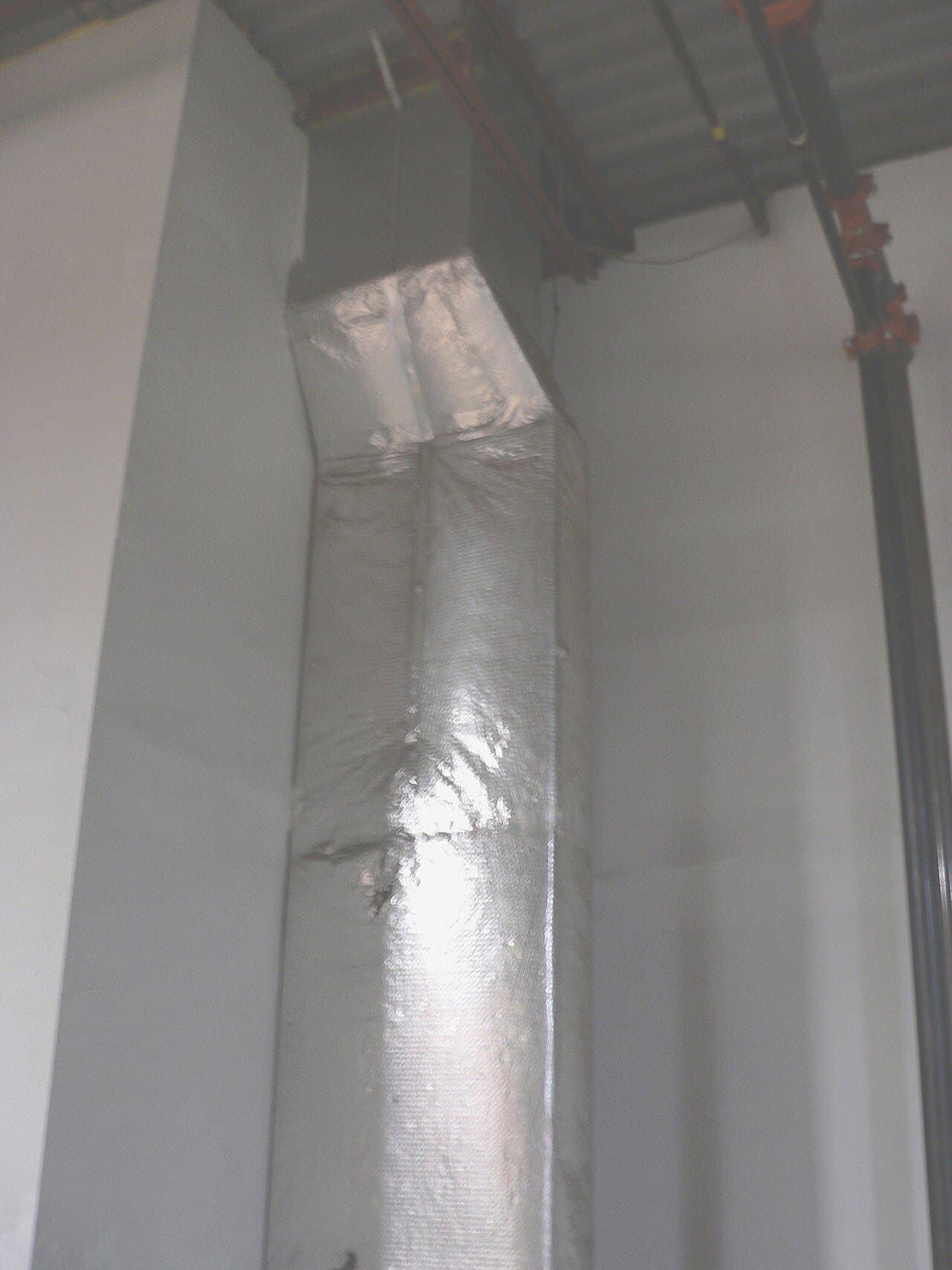
Old wrap. In older homes, old crawl spaces may have asbestos-based insulation wraps on ductwork, and if one is found, a certified asbestos abatement firm has to be hired to inspect it and decide how to treat it.[4] That is a separate contractor and a separate bill, and it comes first.
Testing. Some utilities and home energy raters offer blower door, duct blaster and pressure pan tests to find leaks a homeowner can't easily see.[3] Testing adds to the bill but shows you what you paid for.
Permit fees
Whether you need a permit depends on the job and your locality. Where a permit is needed, the fee is a small part of the bill. Spotsylvania County's residential permit packet, marked updated 8-2025, listed $100 per trade plus a 2% building surcharge and a $45 processing fee, $147 in all, for an HVAC or furnace replacement or a new unit in an existing house, when we checked on October 27, 2026. It does not list a separate fee for duct repair, so ask your locality.[5] For new ductwork, the same packet requires an HVAC design worksheet at the time of inspection and offers duct testing by an approved testing agency, either at rough-in or after construction.[5] For the permit rules in more detail, see whether replacing ductwork needs a permit in Virginia.
What you get back
Leaky ducts can cut heating and cooling efficiency by as much as 20 percent, and sealing and insulating them can often pay for itself in energy savings.[2] Comfort usually improves too: fewer rooms that run hot in summer and cold in winter. When the damage is widespread or the ducts are near the end of their life, compare the repair quote against what new ductwork costs in Virginia and how long ductwork lasts.
Lower-cost and no-cost routes
Virginia's Weatherization Assistance Program, run through the Department of Housing and Community Development and a network of local nonprofit providers, lists repairing drafty duct systems among its typical services.[6] Dominion Energy's Income and Age Qualifying Energy Savings Program lists duct sealing among the measures it installs at no cost for qualifying customers in its Virginia service territory.[7] Both have eligibility rules, so check with the local provider or the utility before you pay for an assessment.
What to ask for in a written quote
Virginia's Board for Contractors expects residential contracting, other than routine maintenance or service contracts, to be covered by a written contract that includes when work begins and the estimated completion date, a statement of the total cost, the amounts and schedule of progress payments including the down payment, a list of the specified materials and work, a statement that the contractor will comply with local permit, inspection and zoning requirements, and the contractor's name, address, licence number and class.[8] Any change to the cost, materials, work or estimated completion date has to be in writing and signed by all parties.[8]
For a duct job, also ask the quote to spell out:
- which runs will be sealed, which reconnected and which replaced;
- the sealant, by type, rather than "tape";
- the insulation R-value on ducts in the attic, crawl space or garage;
- whether leakage will be tested before and after, and whether you get the numbers;
- the combustion safety test if you have a gas or oil furnace or water heater;
- who pulls the permit, if one is needed, and whether its fee is included.
When to call a licensed pro
In Virginia, no individual may do HVAC work for the public for pay unless licensed as a tradesman or working under the supervision of a licensed tradesman in that specialty.[10][11] For the business, the Board for Contractors requires a master tradesman licence as a condition of licensing an HVAC contractor.[9] Check the business on DPOR's License Lookup[12] before you sign. For what the visit itself involves, see what repairing damaged ductwork involves.
Getting quotes
Loclis lists DPOR-licensed HVAC businesses with their licence number and class. Find HVAC businesses in Blacksburg or another town, see duct repairs, or browse more HVAC repair answers.
To compare written prices for your own ducts, describe the job once and licensed local HVAC businesses quote it.
Common questions
- Why won't contractors give a duct repair price over the phone?
- Because the cost depends on things nobody can see from a phone call: how much of the system leaks, whether the damage is on the supply or return side, how hard the ducts are to reach, and whether old wrap has to be dealt with first. Expect an inspection, and ask for the quote in writing afterwards.
- Is duct sealing worth the cost?
- ENERGY STAR says leaky ducts can cut heating and cooling efficiency by as much as 20 percent and that sealing and insulating them can often pay for itself in energy savings. It also helps with rooms that are too hot or too cold and can reduce backdrafting risk from gas appliances.
- Does a permit add much to the cost?
- Not usually, where one is needed at all. Spotsylvania County's packet, updated August 2025, listed $147 for a residential mechanical trade permit when we checked on October 27, 2026. Other localities charge their own fees, and whether a repair needs a permit varies, so ask the contractor.
- Can I get duct repairs done for free in Virginia?
- Some households can. The state's Weatherization Assistance Program lists repairing drafty duct systems among its services, and Dominion Energy's Income and Age Qualifying Energy Savings Program lists duct sealing at no cost for qualifying customers. Both have eligibility rules; contact the local weatherization provider or Dominion to check.
- Does a duct repair contractor need a licence in Virginia?
- Yes for HVAC work done for pay: individuals need a tradesman licence or must work under a licensed tradesman, and a contracting business needs a Board for Contractors licence for jobs over $1,000. Check the licence on DPOR's License Lookup before you sign.
Sources
- [1] Hire a Professional Contractor for Duct Improvement Projects, ENERGY STAR, U.S. Environmental Protection Agency. Checked October 27, 2026.
- [2] Benefits of Duct Sealing, ENERGY STAR, U.S. Environmental Protection Agency. Checked October 27, 2026.
- [3] ENERGY SERIES: What About the Ductwork? (BSE-291NP), Virginia Cooperative Extension, Virginia Tech. Checked October 27, 2026.
- [4] Guide to Closing and Conditioning Ventilated Crawlspaces, ENERGY STAR, U.S. Environmental Protection Agency. Checked October 27, 2026.
- [5] Mechanical (HVAC Only) Application Packet, Spotsylvania County Building Safety Department. Checked October 27, 2026.
- [6] Weatherization Assistance Program (WAP), Virginia Department of Housing and Community Development. Checked October 27, 2026.
- [7] Save Energy & Money, Dominion Energy Virginia. Checked October 27, 2026.
- [8] 18VAC50-22-260, Filing of charges; prohibited acts, Virginia Administrative Code, Virginia General Assembly. Checked October 27, 2026.
- [9] Va. Code § 54.1-1100, Definitions, Code of Virginia, Virginia General Assembly. Checked October 27, 2026.
- [10] Va. Code § 54.1-1129, Necessity for licensure, Code of Virginia, Virginia General Assembly. Checked October 27, 2026.
- [11] Va. Code § 54.1-1128, Definitions, Code of Virginia, Virginia General Assembly. Checked October 27, 2026.
- [12] License Lookup, Virginia Department of Professional and Occupational Regulation. Checked October 27, 2026.
Want a pro to handle it?
Describe the job once. Licensed local businesses send quotes, and you pay only when you book one.
Get a quote for HVAC Repair