Why is my ductwork sweating in the summer?
Ducts sweat when humid air touches a duct surface colder than that air's dew point. In summer a supply duct carries cold air, so humid attic, crawl space or basement air condenses on any bare, thinly insulated or torn spot and around leaky joints. The usual fixes are sealing the leaks, restoring insulation with an intact vapor retarder, and drying out the space.
Free to ask. Local shops send quotes, and you pay only when you book one.
By Kasra Taheri, Founder, LoclisPublished
Researched and drafted with AI, then checked claim by claim against the sources listed below before it was published. Prices and rules change; the dates beside each source say when it was last checked.
This is a job for a licensed pro in Virginia
This page explains what the work involves, the permits, what a licensed pro does and what drives the cost. It does not give step-by-step instructions, because this work needs a licence, a permit or both, and doing it wrong can injure someone. Before you hire, check the licence on Virginia's DPOR record.
Ductwork sweats for the same reason a glass of iced tea does: humid air touches a surface colder than that air's dew point, and the water vapor in it turns to liquid. "Cold water pipes, air conditioning ducts and cold roof decks experience condensation, just like a cold drink sweats in the humid summer air."[1] On a duct system that is sealed and insulated properly, that cold metal never meets the humid air, so sweating is a sign that something in the duct, its insulation or the space around it needs attention.
What is happening
Warm air can hold more water vapor than cool air. When air cools to the point where it is saturated, at 100 percent relative humidity, the extra vapor condenses into liquid; that temperature is the dew point.[2]
In summer, your supply ducts carry the cold air from the air conditioner. EPA gives the example of a supply duct carrying 55°F air, which has a surface temperature near 55°F: if humid air leaking in has a dew point of 70°F, its moisture condenses on the outside of the duct and possibly on the supply diffuser.[1] On a humid summer day, an attic, crawl space or unconditioned basement can hold exactly that kind of air.
That points to the two ways out. Preventing condensation means either lowering the relative humidity of the air or raising the temperature of the surfaces it touches.[2] Insulation does the second; drying the space does the first.
The usual causes
Bare, thin or torn insulation. To keep moisture from condensation out of the system, ducts should be properly sealed and insulated in all non-air-conditioned spaces such as attics and crawl spaces.[3] If your ductwork is not insulated, Virginia Cooperative Extension suggests 1½ to 3 inches of insulation wrapped with an exterior vapor retarder,[4] and ENERGY STAR's standard for ducts in attics, crawlspaces and garages is duct insulation rated R-6 or higher.[5] A torn facing, a gap at a seam or a wrap that has slipped down lets humid air reach the cold metal, and that spot sweats while the rest stays dry.
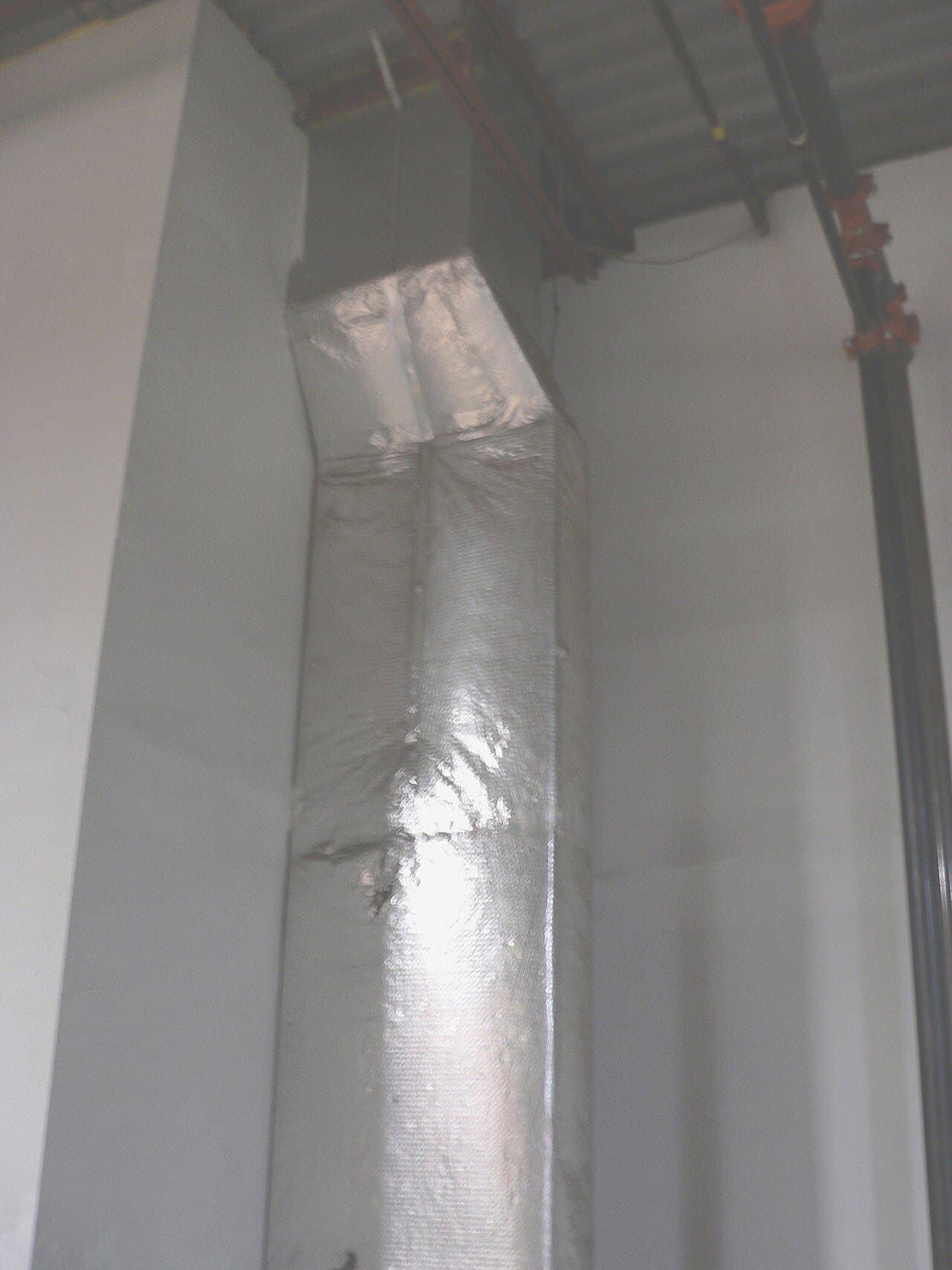
Leaky joints. Cold air leaking out of a joint can chill the metal and insulation around it. Sealed connections prevent condensation caused by supply air escaping through duct connections into unconditioned spaces.[1] Leaks on the return side work the other way, pulling humid attic or crawl space air into the system.
A humid crawl space. Research has found that vented crawlspaces in mixed or hot-humid climates tend to raise the moisture level in the space rather than keep it drier.[6] If a crawl space stays vented, the ductwork and hot water pipes that pass through it should be insulated.[7] A wet floor, a missing ground cover or standing water can make it worse; see why a crawl space gets wet.
Humid air indoors. An air conditioner that is too big cycles on and off frequently, which gives poor moisture removal, particularly where humidity is high.[3] When air conditioners do not run long enough to dehumidify, they cool the air without removing its moisture, raising the indoor dew point and the chance of condensation on cool surfaces.[1] If registers drip inside the house, this is a likely part of the story; see why the house is so humid in summer.
Water that is not condensation at all. Cooling coils remove water from the air and can be a major source of moisture in the system. The condensate pan should drain properly, and standing water or debris in it is a problem that needs immediate attention.[3] Water near the air handler is often a clogged condensate drain line, not a sweating duct.
Why not to leave it
Condensation keeps the duct, its insulation and everything under it wet all summer. Molds can grow on ductwork, among many other materials, wherever moisture is present.[8] Molds grow when the air is above 60 percent relative humidity.[2] In a crawl space the damage spreads to the house itself: moisture that builds up in a crawlspace condenses on the cooler wood framing and floor deck, promoting fungal growth and wood damage.[6]
What to note before the visit
You can help the technician without touching the ducts. Note where the water appears (supply ducts, returns, registers or the air handler), whether it happens only on the hottest, most humid days, whether the crawl space floor or attic insulation is damp, and what your indoor humidity reads if you have a meter. EPA's general advice on condensation or moisture collecting on surfaces is to act quickly to dry the wet surface and reduce the source of the moisture.[9] If you can see or smell mold around the ducts, mention it when you book: EPA advises not running an HVAC system you know or suspect is contaminated with mold, because it could spread mold through the house.[9]
What a pro does about it
A technician finds the cause rather than wiping the duct. That usually means sealing leaky joints, replacing torn or soaked insulation with wrap whose vapor retarder is continuous and sealed at the seams, checking whether the system is sized and set to dehumidify, and, where the crawl space itself is the source, dealing with its moisture. In older homes, mention any old duct wrap first: old crawl spaces may have asbestos-based insulation wraps on ductwork, which a certified asbestos abatement firm has to inspect.[6] See what repairing damaged ductwork involves for the full scope.
When to call a licensed pro
Call when the sweating comes back every summer, when water drips onto ceilings, insulation or the crawl space floor, when insulation on the ducts is torn, sagging or wet, or when you see mold on or near the ducts. In Virginia, no individual may do or offer to do HVAC work for the public for pay unless licensed as a tradesman or working under the supervision of a tradesman licensed in that specialty,[10][11] so check the business on DPOR's License Lookup[12] before you sign. For who handles crawl space and attic ducts, see who seals leaking ductwork in a crawl space or attic.
Getting it fixed
Loclis lists DPOR-licensed HVAC businesses with their licence number and class. Find HVAC businesses in Blacksburg or another town, see duct repairs, or browse more HVAC repair answers.
If your ducts sweat or drip in summer, describe what you see once and licensed local HVAC businesses quote the repair.
Common questions
- Is a little condensation on ductwork normal?
- Not on a properly sealed and insulated duct. The insulation keeps humid air away from the cold metal, so beads of water on the outside usually mean bare metal, a gap or tear in the wrap, a leaky joint, or very humid air around the duct. Find out which before the water causes mold or wood damage.
- Why do my ducts only sweat in summer?
- Summer is when the air inside the ducts is coldest relative to the air around them, and when attic, crawl space and outdoor air is most humid. In winter the same ducts carry warm air, so their surface stays above the dew point of the surrounding air.
- Can sweating ducts cause mold?
- Yes. The Virginia Department of Health lists ductwork among the materials mold grows on where moisture is present, and Virginia Cooperative Extension notes that molds grow in air over 60 percent relative humidity. Condensation that keeps wetting the duct, its insulation or the framing nearby is that moisture.
- Will a dehumidifier stop my ducts from sweating?
- It can help when the cause is humid air around the ducts, because lowering humidity is one of the two ways to stop condensation. It does not fix bare metal, torn insulation or leaky joints, which a contractor needs to seal and re-insulate.
- My vents drip water. Is that the same problem?
- Often. EPA notes that humid air can condense on the outside of a cold supply duct and possibly on the supply register. A dripping register can also point to very humid indoor air or a cooling system that does not run long enough to dehumidify, so mention both to the technician.
Sources
- [1] Moisture Control Guidance for Building Design, Construction and Maintenance, U.S. Environmental Protection Agency. Checked October 27, 2026.
- [2] ENERGY SERIES: What about Moisture? (2908-9020), Virginia Cooperative Extension, Virginia Tech. Checked October 27, 2026.
- [3] Should You Have the Air Ducts in Your Home Cleaned?, U.S. Environmental Protection Agency. Checked October 27, 2026.
- [4] ENERGY SERIES: What About the Ductwork? (BSE-291NP), Virginia Cooperative Extension, Virginia Tech. Checked October 27, 2026.
- [5] Hire a Professional Contractor for Duct Improvement Projects, ENERGY STAR, U.S. Environmental Protection Agency. Checked October 27, 2026.
- [6] Guide to Closing and Conditioning Ventilated Crawlspaces, ENERGY STAR, U.S. Environmental Protection Agency. Checked October 27, 2026.
- [7] Virginia Energy Savers Handbook, Virginia Tech. Checked October 27, 2026.
- [8] Mold, Virginia Department of Health. Checked October 27, 2026.
- [9] A Brief Guide to Mold, Moisture and Your Home, U.S. Environmental Protection Agency. Checked October 27, 2026.
- [10] Va. Code § 54.1-1129, Necessity for licensure, Code of Virginia, Virginia General Assembly. Checked October 27, 2026.
- [11] Va. Code § 54.1-1128, Definitions, Code of Virginia, Virginia General Assembly. Checked October 27, 2026.
- [12] License Lookup, Virginia Department of Professional and Occupational Regulation. Checked October 27, 2026.
Want a pro to handle it?
Describe the job once. Licensed local businesses send quotes, and you pay only when you book one.
Get a quote for HVAC Repair