Who seals leaking ductwork in a crawl space or attic?
Usually a licensed HVAC contractor: most heating and cooling contractors also repair ductwork, and in Virginia HVAC work for pay needs a licensed tradesman. Home energy auditors and weatherization providers also find and seal duct leaks, often with testing. Whoever you hire, check the licence on DPOR's lookup and ask for leakage testing and a combustion safety check.
Free to ask. Local shops send quotes, and you pay only when you book one.
By Kasra Taheri, Founder, LoclisPublished
Researched and drafted with AI, then checked claim by claim against the sources listed below before it was published. Prices and rules change; the dates beside each source say when it was last checked.
This is a job for a licensed pro in Virginia
This page explains what the work involves, the permits, what a licensed pro does and what drives the cost. It does not give step-by-step instructions, because this work needs a licence, a permit or both, and doing it wrong can injure someone. Before you hire, check the licence on Virginia's DPOR record.
In most Virginia homes, the person who seals leaking ductwork in a crawl space or attic is a licensed HVAC contractor. Virginia Cooperative Extension recommends having a licensed heating and air conditioning contractor repair duct leaks,[1] and most heating and cooling contractors repair ductwork as well.[2] Home energy auditors and the state's weatherization providers find and fix duct leaks too. Here is who does what, and how to choose.
A licensed HVAC contractor
This is the default choice, and in Virginia it is also the licensed one. Under the Code of Virginia, no individual may do or offer to do HVAC work for the public for pay unless licensed as a tradesman or working under the supervision of a tradesman licensed in that specialty.[6][7] The Board for Contractors' HVAC classification covers the installation, alteration, repair and maintenance of heating, ventilating and cooling systems.[8]
Two other kinds of business often get asked, and their licences are narrower. The residential building contractor classification does not provide for HVAC work,[8] and the insulation and weather stripping specialty "does not include the insulation of mechanical equipment and ancillary lines and piping".[9] If a builder or insulation crew offers to seal your ducts, ask what HVAC licence covers it.
Check any business on DPOR's License Lookup[12] before you sign, and look for the HVAC classification on the licence.
Home energy auditors and raters
Auditors are the people to call when you suspect leaks but don't know where they are. Some utilities and home energy raters offer energy audits and diagnostic tools such as blower door, duct blaster and pressure pan tests to detect leaks a homeowner can't easily see.[1] ENERGY STAR suggests looking for NATE or BPI certified contractors, and notes that a local utility may have pre-screened contractors and service discounts for its customers.[3] An auditor who finds the leaks may also seal them, or may hand you a report to take to an HVAC contractor; ask which before you book.
Weatherization programs
If your household qualifies, the work may cost nothing. Virginia's Weatherization Assistance Program lists repairing drafty duct systems among its typical services, delivered by a network of local nonprofit providers; you apply to the provider where the home is located.[10] Dominion Energy's Income and Age Qualifying Energy Savings Program includes duct sealing at no cost for qualifying customers in its Virginia service territory, with the assessments and installations done by local weatherization service providers.[11] Dominion tells customers to ask to see the provider's weatherization service provider identification before letting anyone in.[11]
What a crawl space job needs
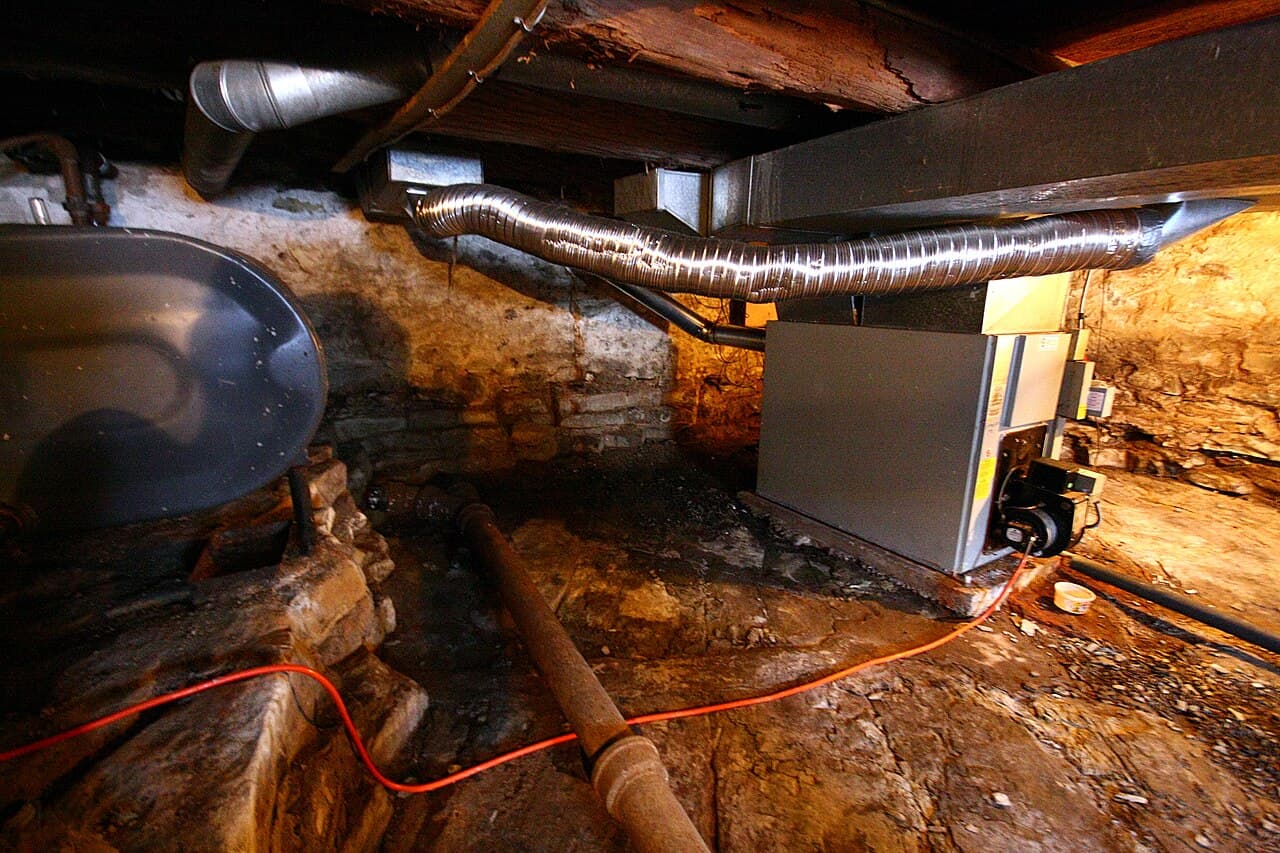
Crawl spaces are cramped, often damp and full of the system's return ducts. Sealing the return leaks is the more critical part, because they can cause back-drafting of atmospherically vented equipment in the crawlspace.[4] Sagging flex is part of the job too: flexible duct strapped at 3-foot intervals stops sagging and delivers more air.[4] And in older houses, look at the wrap before anyone disturbs it. Old crawl spaces may have asbestos-based insulation wraps on ductwork and pipes, and a certified asbestos abatement firm has to inspect them if found.[4] For the moisture side of a crawl space, see how to lower humidity in a crawl space.
What an attic job needs
Attic ducts sit in the hottest air in the house in summer and the coldest in winter. Ducts that run through an unconditioned attic, basement, garage or crawl space lose energy when they are poorly insulated.[1] Ducts in unheated attics, basements and crawl spaces should be insulated and tightly sealed, and the duct leakage should be tested by a professional before and after sealing.[5] Attic work usually means moving through deep insulation in summer heat, so the job can take longer than its size suggests.
Questions to ask before you hire
- What is your DPOR licence number, and does it carry the HVAC classification?
- Will you inspect the whole system, returns included, and not just the run I pointed out?
- What will you seal with? Mastic, metal tape or an aerosol-based sealant are the right materials, and any sealant should carry the UL 181 rating for that type of duct.[2][1] Virginia Cooperative Extension's test is simple: "If you see the contractor bringing in duct tape, hire someone else."[1]
- Will you insulate the ducts in unconditioned areas such as attics, crawlspaces and garages to R-6 or higher?[2]
- Will you test leakage before and after, and give me the numbers?
- If you have gas or oil-burning appliances: will you run a combustion safety test after the ducts are sealed?[2]
- Who handles the permit, if the job needs one?
When to call a licensed pro
Call one when rooms upstairs or at the far end of the house never get comfortable, when you see a duct lying on the crawl space floor or a flex run flattened in the attic, when ducts sweat or drip in summer, or when you have a gas furnace or water heater and suspect the returns leak. For what the visit involves, see what repairing damaged ductwork involves; for the price, how much duct repair costs in Virginia.
Finding one
Loclis lists DPOR-licensed HVAC businesses with their licence number and class. Find HVAC businesses in Blacksburg or another town, see duct repairs, or browse more HVAC repair answers.
To have your crawl space or attic ducts looked at, describe the job once and licensed local HVAC businesses quote it.
Common questions
- Can a general contractor or handyman seal my ducts?
- Duct work is HVAC work. Virginia's residential building contractor classification does not provide for HVAC work, and individuals doing HVAC work for pay need a tradesman licence or must work under a licensed tradesman. Hire a business that holds the HVAC classification, and check it on DPOR's License Lookup.
- Can an insulation company insulate my attic ducts?
- Virginia's insulation and weather stripping specialty "does not include the insulation of mechanical equipment and ancillary lines and piping." Ask an insulation company whether it also holds an HVAC licence before it touches the ducts, or have the HVAC contractor seal and insulate them together.
- Is an energy audit worth it before hiring someone to seal ducts?
- It can be. Utilities and home energy raters can run blower door, duct blaster and pressure pan tests that find leaks you can't see, and a before-and-after test shows whether the sealing worked. Ask whether the auditor also does the repairs or refers them to a licensed HVAC contractor.
- Who seals ducts for free in Virginia?
- Eligible households can get duct work through the state's Weatherization Assistance Program, run by local nonprofit providers, and Dominion Energy's Income and Age Qualifying Energy Savings Program lists duct sealing at no cost for qualifying customers. Contact the provider for where the home is located to check eligibility.
- Why does the crawl space make the job different?
- Crawl spaces are tight, often damp, and in older homes may hold asbestos-based duct wrap. ENERGY STAR's crawlspace guide also stresses sealing the return leaks there, because they can cause back-drafting of atmospherically vented equipment in the crawlspace.
Sources
- [1] ENERGY SERIES: What About the Ductwork? (BSE-291NP), Virginia Cooperative Extension, Virginia Tech. Checked October 27, 2026.
- [2] Hire a Professional Contractor for Duct Improvement Projects, ENERGY STAR, U.S. Environmental Protection Agency. Checked October 27, 2026.
- [3] Duct Sealing with ENERGY STAR (fact sheet), ENERGY STAR, U.S. Environmental Protection Agency. Checked October 27, 2026.
- [4] Guide to Closing and Conditioning Ventilated Crawlspaces, ENERGY STAR, U.S. Environmental Protection Agency. Checked October 27, 2026.
- [5] Virginia Energy Savers Handbook, Virginia Tech. Checked October 27, 2026.
- [6] Va. Code § 54.1-1129, Necessity for licensure, Code of Virginia, Virginia General Assembly. Checked October 27, 2026.
- [7] Va. Code § 54.1-1128, Definitions, Code of Virginia, Virginia General Assembly. Checked October 27, 2026.
- [8] 18VAC50-22-20, Definitions of license classifications, Virginia Administrative Code, Virginia General Assembly. Checked October 27, 2026.
- [9] 18VAC50-22-30, Definitions of specialty services, Virginia Administrative Code, Virginia General Assembly. Checked October 27, 2026.
- [10] Weatherization Assistance Program (WAP), Virginia Department of Housing and Community Development. Checked October 27, 2026.
- [11] Save Energy & Money, Dominion Energy Virginia. Checked October 27, 2026.
- [12] License Lookup, Virginia Department of Professional and Occupational Regulation. Checked October 27, 2026.
Want a pro to handle it?
Describe the job once. Licensed local businesses send quotes, and you pay only when you book one.
Get a quote for HVAC Repair