What does repairing damaged ductwork involve?
A licensed HVAC contractor inspects the whole duct system, attic and crawl space included, reconnects or replaces torn, crushed and loose sections, seals joints and registers with mastic or metal tape, insulates ducts in unconditioned space, then checks airflow and, where there are gas or oil appliances, combustion safety. Some Virginia localities require a mechanical permit when ducts are replaced or moved.
Free to ask. Local shops send quotes, and you pay only when you book one.
By Kasra Taheri, Founder, LoclisPublished
Researched and drafted with AI, then checked claim by claim against the sources listed below before it was published. Prices and rules change; the dates beside each source say when it was last checked.
This is a job for a licensed pro in Virginia
This page explains what the work involves, the permits, what a licensed pro does and what drives the cost. It does not give step-by-step instructions, because this work needs a licence, a permit or both, and doing it wrong can injure someone. Before you hire, check the licence on Virginia's DPOR record.
Repairing damaged ductwork comes down to three jobs: finding every leak, crushed run and loose connection in the system, fixing them with materials that last, and then proving the system works better than it did. Most heating and cooling contractors repair ductwork as well.[1] Here is what the work involves, in the order it usually happens, and what to look for so the repair holds.
Signs the ducts need work
Ducts sit out of sight, so the first clues usually show up in the rooms. ENERGY STAR's warning signs of poorly performing ducts are high summer and winter utility bills, rooms that are hard to heat and cool, stuffy rooms that never feel comfortable, ducts that run through an attic, crawlspace or garage, and tangled or kinked flexible ducts.[2] The losses add up: in a typical house, roughly 20 to 30 percent of the air moving through the ducts is lost to leaks, holes and poor connections.[2]
Damage builds slowly. As a house ages, tape adhesive dries and caulk wears away.[4] Meanwhile flexible duct gets ripped, torn, squashed when someone steps on it, or disconnected.[3] Leaky, torn and disconnected ducts, poorly sealed registers and grilles, leaks at the furnace and filter slot, and kinked flexible duct are the common problems.[3]
What the contractor does
A thorough duct repair covers the scope ENERGY STAR sets out for contractors, not only the one run you noticed:
- Inspection. The whole system is inspected, attic and crawlspace included, not only the run that prompted the call.[1]
- Balance. Supply and return balance is evaluated, since undersized return ducts are common.[1]
- Repairs. Damaged and disconnected ducts are repaired, and tangled or crushed flexible duct is straightened out.[1]
- Sealing. Leaks and connections are sealed with mastic, metal tape or an aerosol-based sealant, and registers and grilles are sealed tightly to the ducts.[1]
- Insulation. Ducts in unconditioned areas such as attics, crawlspaces and garages are insulated with duct insulation rated R-6 or higher.[1]
- Filter and airflow. A new filter goes in, and airflow is evaluated after the repairs.[1]
- Combustion safety. Gas and oil-burning appliances are checked for backdrafting, with a combustion safety test after the ducts are sealed.[1]
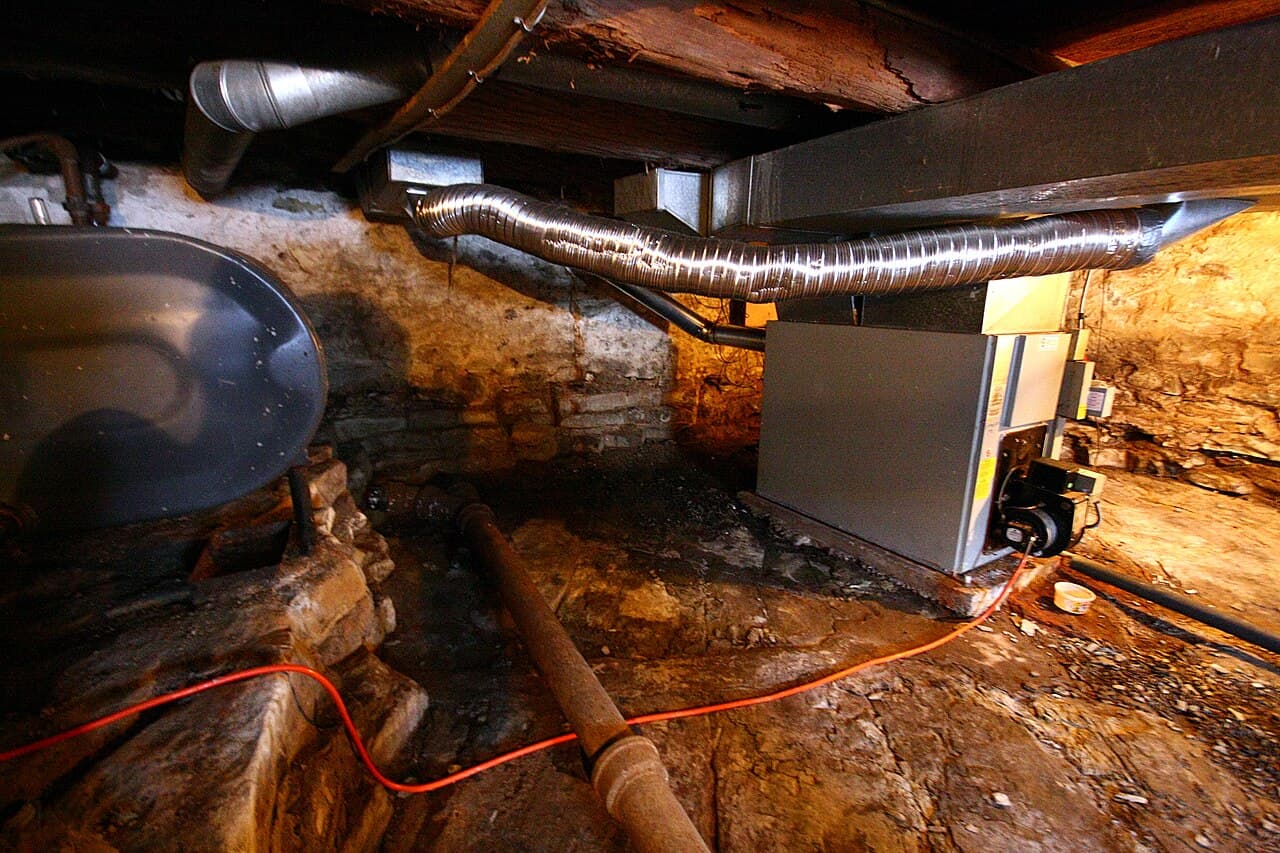
Crawl spaces add their own details. In a crawl space, flexible duct strapped at 3-foot intervals stops sagging and delivers air better.[5] Where a duct is already wrapped in insulation in good condition, a duct leakage test is recommended to find out how much it leaks, and the insulation may have to come off so the joints can be sealed.[5]
Testing before and after
A good contractor measures rather than guesses. Some utilities and home energy raters offer diagnostic tools such as blower door, duct blaster and pressure pan tests to find leaks a homeowner can't easily see.[4] If your contractor tests, ask for the before and after numbers in writing; they are the clearest proof the repair worked.
The materials matter
The sealant is where cheap repairs fail. Leaks are sealed with mastic or acrylic-adhesive foil tape. Mastic on its own is fine for cracks narrower than ¼ inch, and any sealant should carry the UL 181 rating for that particular type of duct.[4] Gray cloth duct tape with rubber-based adhesive eventually fails, so joints held with it need checking.[4] Virginia Cooperative Extension puts it plainly: "If you see the contractor bringing in duct tape, hire someone else."[4]
Why the return side and gas appliances matter
Return leaks are the harder half of the job. Return ducts run at lower pressure and draw air in, so their leaks are hard to detect, and repairing only the supply leaks can pull even more unconditioned air into the system.[4]
That has a safety side. In homes with gas appliances, atmospherically vented gas water heaters and furnaces are particularly at risk of back drafting carbon monoxide when there is significant return-side duct leakage.[4] This is why the combustion safety test at the end is part of the job, not an extra.
Old duct wrap and asbestos
In older homes, look before anyone cuts. Old crawl spaces may have asbestos-based insulation wraps on ductwork and pipes, and if one is found, a certified asbestos abatement firm has to be brought in.[5] You generally can't tell whether a material contains asbestos by looking at it unless it is labeled; if in doubt, treat it as if it does and leave it alone.[6] Point out any old wrap, tape or register boots to the contractor before the quote.
Permits in Virginia
Virginia's Uniform Statewide Building Code requires a permit application for installations or alterations involving mechanical systems,[7] and localities apply that to ducts differently. Fairfax County lists duct installation, new or replacement, among the projects that need a residential mechanical permit.[8] Pittsylvania County requires a mechanical permit to add, relocate or remove ductwork, and says replacing elements of the same type, size and location doesn't require one.[9] A repair that only seals and reconnects existing ducts may fall outside those lists, so ask the contractor how your county or city treats your job, and see whether replacing ductwork needs a permit in Virginia.
When to call a licensed pro
Call one when rooms stop heating or cooling evenly, when you find a duct that has fallen, torn or flattened, when ducts sweat or drip in summer, or when a gas furnace or water heater shares the house with leaky returns. In Virginia, no individual may do or offer to do HVAC work as a tradesman unless licensed or working under the supervision of a tradesman licensed in that specialty,[10] and the Board for Contractors' HVAC classification covers the installation, alteration, repair and maintenance of heating, ventilating and cooling systems.[11] Check the business on DPOR's License Lookup[12] before you sign.
For what the work tends to cost, see how much duct repair costs in Virginia. For ducts in a crawl space or attic, see who seals leaking ductwork there.
Getting it done
Loclis lists DPOR-licensed HVAC businesses with their licence number and class. Find HVAC businesses in Blacksburg or another town, see duct repairs, or browse more HVAC repair answers.
If your ducts are leaking, crushed or disconnected, describe the problem once and licensed local HVAC businesses quote the repair.
Common questions
- How long does a duct repair take?
- It depends on how much of the system needs work and how easy it is to reach. Reconnecting one fallen run in an open basement is a short visit; sealing every joint in a tight attic or crawl space, re-insulating and testing before and after can take a full day or more. Ask the contractor for an estimated completion date in the written contract.
- Can damaged flex duct be repaired, or does it have to be replaced?
- ENERGY STAR's contractor checklist covers both: straightening tangled or crushed flexible duct and repairing damaged or disconnected ducts. Whether a torn or flattened section can be saved is a judgment for the contractor on site, so ask which sections they plan to repair and which to replace, and why.
- What should a contractor use to seal ducts?
- Mastic, metal-backed foil tape or an aerosol-based sealant, with any sealant carrying the UL 181 rating for that type of duct. Gray cloth duct tape is the wrong product because its rubber-based adhesive eventually fails.
- Do I need a permit to repair ductwork in Virginia?
- It depends on the job and the locality. The building code requires a permit application for alterations involving mechanical systems; Fairfax County requires a mechanical permit for new or replacement duct installation, and Pittsylvania County for adding, relocating or removing ductwork. Ask the contractor how your county or city treats the specific repair.
- Why does the contractor want to test my gas furnace after sealing the ducts?
- Leaky return ducts can depressurise the house enough to pull combustion gases, including carbon monoxide, back out of a gas water heater or furnace. ENERGY STAR asks contractors to check for backdrafting and run a combustion safety test after ducts are sealed.
Sources
- [1] Hire a Professional Contractor for Duct Improvement Projects, ENERGY STAR, U.S. Environmental Protection Agency. Checked October 27, 2026.
- [2] Duct Sealing, ENERGY STAR, U.S. Environmental Protection Agency. Checked October 27, 2026.
- [3] Duct Sealing with ENERGY STAR (fact sheet), ENERGY STAR, U.S. Environmental Protection Agency. Checked October 27, 2026.
- [4] ENERGY SERIES: What About the Ductwork? (BSE-291NP), Virginia Cooperative Extension, Virginia Tech. Checked October 27, 2026.
- [5] Guide to Closing and Conditioning Ventilated Crawlspaces, ENERGY STAR, U.S. Environmental Protection Agency. Checked October 27, 2026.
- [6] Protect Your Family from Exposures to Asbestos, U.S. Environmental Protection Agency. Checked October 27, 2026.
- [7] 13VAC5-63-80, Section 108 Application for permit (Virginia Uniform Statewide Building Code), Virginia Administrative Code, Virginia General Assembly. Checked October 27, 2026.
- [8] Mechanical (MECHR) - Residential, Fairfax County Land Development Services. Checked October 27, 2026.
- [9] Mechanical Permits, Pittsylvania County, Virginia. Checked October 27, 2026.
- [10] Va. Code § 54.1-1129, Necessity for licensure, Code of Virginia, Virginia General Assembly. Checked October 27, 2026.
- [11] 18VAC50-22-20, Definitions of license classifications, Virginia Administrative Code, Virginia General Assembly. Checked October 27, 2026.
- [12] License Lookup, Virginia Department of Professional and Occupational Regulation. Checked October 27, 2026.
Want a pro to handle it?
Describe the job once. Licensed local businesses send quotes, and you pay only when you book one.
Get a quote for HVAC Repair