How much does erosion control cost in Virginia?
There is no single Virginia price. EPA's fact sheets, citing 2019 and 2020 national cost data and checked on October 27, 2026, put hydroseeding at about $50 to $100 per thousand square feet and sod at $25 to $100 per square yard installed. Your quote depends on slope, access, the cause of the water, and whether the job needs a plan or permit, so get itemized written bids.
Free to ask. Local shops send quotes, and you pay only when you book one.
By Kasra Taheri, Founder, LoclisPublished
Researched and drafted with AI, then checked claim by claim against the sources listed below before it was published. Prices and rules change; the dates beside each source say when it was last checked.
Step by step
Read when to stop and call a pro, further down this page, before you start.
Step 1: Find the cause of the erosion
Note where runoff enters the slope and whether gutters, downspouts or neighboring land feed it, because fixing the water changes the price.[4]
Step 2: Measure the area
Pace off the length and width of the bare area so each bidder prices the same square footage.
Step 3: Ask your locality about permits
Call the county or city engineer to ask whether the job reaches a land-disturbance permit threshold.[6]
Step 4: Request 811 marking
If the work involves digging, the contractor or you must submit a locate request first.[7]
Step 5: Collect at least three written bids
Ask for bids based on the same specifications.[8]
Step 6: Compare line by line
Check seed, mulch type, netting or matting, drainage work, cleanup and warranty, and be wary of a bid far below the others.[8]
Step 7: Check the licence
Confirm any contractor's Virginia licence for the work before you sign.[8]
Step 8: Ask about cost-share
Ask your local soil and water conservation district whether a cost-share program applies.[5]
There is no single price for erosion control in Virginia, because the job can be anything from a bag of seed and a bale of straw to a regraded hillside with drainage. National cost data gives a sense of scale. When we checked on October 27, 2026, EPA's fact sheets, which cite 2019 and 2020 RSMeans data, put hydroseeding at around $50 to $100 per thousand square feet and sod at $25 to $100 per square yard installed.[1][2] A written bid for your slope is the only real number.
What the national figures say
EPA publishes cost notes in its stormwater practice fact sheets. They are national, dated and aimed at construction sites, so use them to judge whether a bid is in the right range, not to set a price.
- Seeding bluegrass with hydroseeding generally costs around $50 to $100 per thousand square feet, according to EPA's 2021 permanent seeding sheet, which cites 2020 data.[1]
- Sodding costs can range from $25 to $100 per square yard including installation, again citing 2020 data.[2]
- For mulching and matting, EPA's table lists typical material and labor costs per acre, citing 2019 data: hay at one inch depth is $2,000 to $4,000, hydromulch is $10,000 to $17,000, and jute netting is $7,500 to $11,000.[3]
EPA's own caveat applies to all of them: it is difficult to develop cost estimates that apply nationwide and year-round.[1] Prices have moved since 2019 and 2020, so treat these as a rough guide only.
What drives a bid
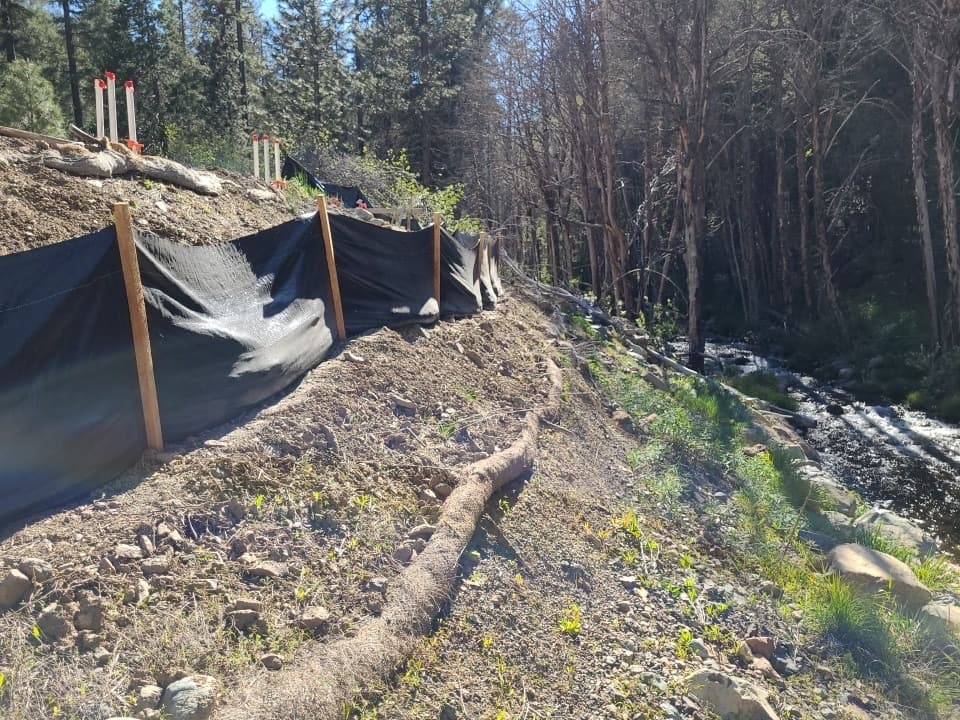
Slope and soil. A gentle slope can be seeded and strawed. On a steep one, the options include mulch matting, netting, tackifiers and hydromulch, which cost more than loose mulch.[3]
The cause of the water. If runoff is coming from a roof, the fix may be in the gutters. Possible causes include gutters that need to be cleaned or are undersized, downspouts and sump pump pipes and poor grading around foundation walls.[4] A bid that covers the slope but ignores the source is cheap for a reason. See how to stop soil erosion on a slope.
Area and access. Price scales with square footage, but also with whether equipment can reach the slope or crews must carry everything in by hand.
Materials. Seed alone, seed and straw, seed with netting, sod, hydromulch, stone: each has its own cost and its own life span.
Drainage and grading. Swales, channel liners, pipe and regrading add machine time and are where bids differ most. See how much yard grading costs in Virginia.
Plans and permits. Montgomery County requires a land disturbing permit when disturbing more than 10,000 square feet of land, with an erosion and sediment control plan reviewed, plan review fees paid, and surety provided.[6] The county says permit fees are calculated by the disturbed area shown on the approved plans, and that land disturbing activities involving the construction of a single family residence may sign an agreement in lieu of submitting an erosion and sediment control plan.[6] Other localities set their own rules, so ask yours. Digging also needs an 811 locate: no person shall make or begin any excavation or demolition without first submitting a locate request to the notification center.[7]
Getting a bid you can compare
The Virginia Board for Contractors says it is advisable to get at least three written bids or estimates using identical plans and specifications so you can compare prices and contractors.[8] It also warns to beware of any bid substantially lower than the others.[8] For erosion work, ask each bidder to write down:
- the area covered in square feet and the cause of the water they plan to address
- seed mix, mulch or matting type, and any netting or tackifier
- drainage and grading work, if any, and where the water will go
- permits and plans included, and who handles the 811 request
- cleanup, a watering or reseeding plan, and what the warranty covers
Help paying for it
The Northern Virginia Soil and Water Conservation District runs urban cost-share programs that provide financial and technical assistance to property owners, for problems like erosion, poor drainage, or poor vegetation.[5] That district serves Fairfax County, so its programs are for property owners there. Elsewhere in Virginia, ask your local soil and water conservation district what is offered.
Stop and call a pro if
- The bare area is larger than a yard repair. Larger projects may require permits or hiring a contractor.[4]
- Water is cutting a gully or reaching your foundation. Fixing it means regrading or drainage work, so price it as a contractor job.
- The work reaches a stream, wetland or floodplain. Ask your locality before anything is disturbed.
- A bid is far below the rest. Beware of any bid substantially lower than the others.[8]
- The contractor is unlicensed. If the work you are considering is valued at $1,000 or more, a valid Virginia Contractor’s License is required for the license category in which the contractor is to work.[8]
Next steps in Virginia
Read who to call about a washing-out hillside to pick the right professional, and browse excavation and grading services or more excavation answers.
To get prices for your own slope, describe the problem once and licensed local contractors quote it.
Common questions
- How much does hydroseeding a slope cost?
- EPA's permanent seeding fact sheet, citing 2020 RSMeans data and checked on October 27, 2026, says seeding bluegrass with hydroseeding generally costs around $50 to $100 per thousand square feet. It is a national figure, so treat it as a reference, not a Virginia quote.
- Is sod cheaper or more expensive than seed?
- Sod costs more up front. EPA's sodding sheet says costs including installation can range from $25 to $100 per square yard, citing 2020 data. Sod also protects the soil immediately, which matters on a slope.
- Why is erosion control on a hillside priced higher than on flat ground?
- Slopes need more than seed and straw. On steep ground the usual options are matting, netting, tackifier or hydromulch, and crews work slower and have harder access. Ask each bidder to explain what they will use on your slope.
- Can I get help paying for erosion control?
- Maybe. The Northern Virginia Soil and Water Conservation District runs urban cost-share programs for problems like erosion, poor drainage, or poor vegetation. Other parts of Virginia have their own conservation districts, so ask yours.
- Do I need a permit for erosion control work?
- It depends on the size. Montgomery County, Virginia, for example, requires a land disturbing permit above 10,000 square feet of land. Many yard-scale fixes fall below local thresholds, but ask your county or city engineer.
Sources
- [1] Stormwater Best Management Practice: Permanent Seeding (EPA-832-F-21-028FF), U.S. Environmental Protection Agency. Checked October 27, 2026.
- [2] Stormwater Best Management Practice: Sodding (EPA-832-F-21-028LL), U.S. Environmental Protection Agency. Checked October 27, 2026.
- [3] Stormwater Best Management Practice: Mulching (EPA-832-F-21-028V), U.S. Environmental Protection Agency. Checked October 27, 2026.
- [4] Solving Drainage and Erosion Problems: A Guide for Homeowners, Northern Virginia Soil and Water Conservation District, Fairfax County. Checked October 27, 2026.
- [5] Conservation Assistance Programs, Northern Virginia Soil and Water Conservation District, Fairfax County. Checked October 27, 2026.
- [6] Erosion and Sediment Control, Montgomery County, Virginia. Checked October 27, 2026.
- [7] Code of Virginia § 56-265.17, Notification required prior to excavation or demolition, Code of Virginia, Legislative Information System. Checked October 27, 2026.
- [8] What You Should Know Before You Hire a Contractor, Virginia Board for Contractors, Department of Professional and Occupational Regulation. Checked October 27, 2026.
Want a pro to handle it?
Describe the job once. Licensed local businesses send quotes, and you pay only when you book one.
Get a quote from a local pro