Who should I call about a washing-out hillside?
Call a Virginia-licensed contractor with a landscape service or excavation specialty for a washing-out hillside on your own land. If a new house is under bond, call the builder first. Your county or city engineer or local soil and water conservation district can tell you about permits and cost-share. Call the utility if soil is moving near a pipe or wire.
Free to ask. Local shops send quotes, and you pay only when you book one.
By Kasra Taheri, Founder, LoclisPublished
Researched and drafted with AI, then checked claim by claim against the sources listed below before it was published. Prices and rules change; the dates beside each source say when it was last checked.
Step by step
Read when to stop and call a pro, further down this page, before you start.
Step 1: Check who is responsible
If the house is new and under a development bond, the builder may be responsible for drainage problems from inadequate grading.[1]
Step 2: Photograph the hillside
Take dated photos of the washout, the bare soil and any sediment on driveways or neighboring land.
Step 3: Call your locality
Ask the county or city engineer or stormwater office about permits, protected areas and any rule that applies to your lot.[3]
Step 4: Ask the conservation district
Ask your soil and water conservation district for advice and any cost-share program.[2]
Step 5: Pick the right trade
Look for a contractor licensed in landscape service or underground utility and excavating work, or a general class that covers it.[4]
Step 6: Verify the licence
Look the contractor up with DPOR before you sign.[5]
Step 7: Get three written bids
Ask each to bid the same specifications.[5]
Step 8: Request 811 before digging
Make sure a locate request goes in before any excavation begins.[7]
For a hillside washing out on your own property, call a Virginia-licensed contractor who does landscape service or excavation work, after a short round of calls to the right local office. Which call comes first depends on who may be responsible and how bad the washout is. If a new house is under a development bond, start with the builder. If soil is moving toward a foundation or an exposed pipe, move faster.
Who to call, in order
The builder, if the home is new. In a new development under bond, the builder may be responsible for fixing drainage problems that arise as a result of inadequate grading.[1] Check your closing papers and call before paying anyone else.
Your county or city engineer or stormwater office. Permit rules are local. In Montgomery County, for example, the County Engineer administers the Erosion and Sediment Control Ordinance, and a land disturbing permit is required when disturbing more than 10,000 square feet of land.[3] Another locality may use a different threshold, so ask yours whether your fix needs a permit. Emergency repairs are treated separately in Montgomery County's rules: emergency work to protect life, limb or property, and emergency repairs, do not require the permit, but the land area disturbed shall be shaped and stabilized in accordance with the requirements of the plan-approving authority.[3]
Your soil and water conservation district. Fairfax County's district says its guide is meant for small-scale home projects and that larger projects may require permits or hiring a contractor.[1] It also runs urban cost-share programs that provide financial and technical assistance to property owners.[2] Ask your own district what it offers.
A licensed contractor. This is who actually fixes it, covered next.
The utility, if a line is exposed. If soil is washing out around a buried pipe or cable, do not dig. Call the utility that owns it, and a plumber or electrician if the line is yours.
Which contractor for which fix
Virginia licenses contractors by specialty, and the right one depends on the job.
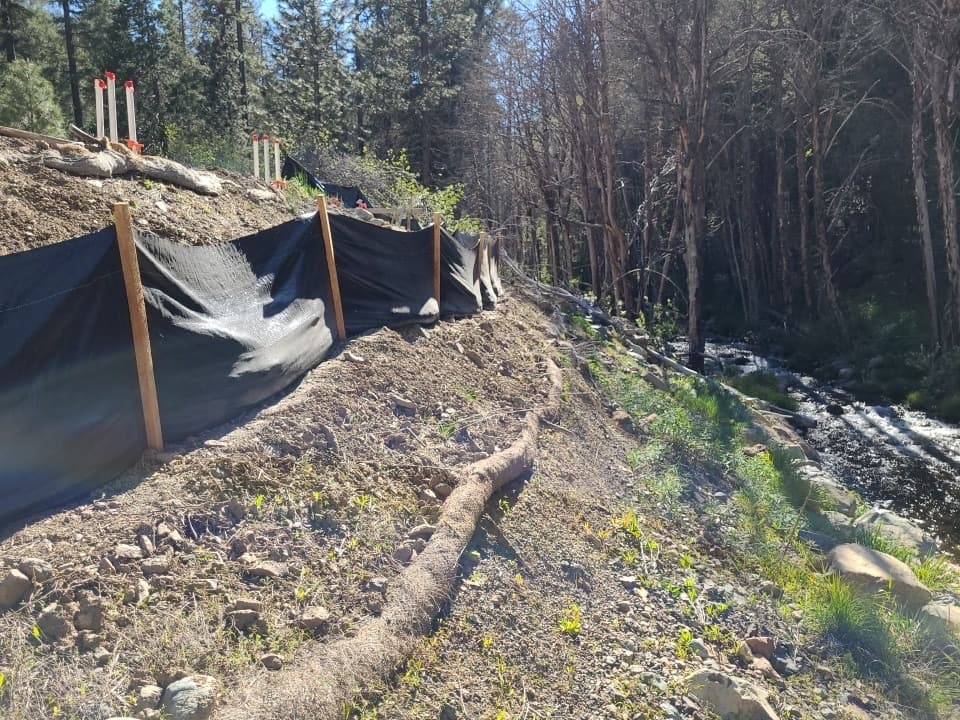
- Seeding, matting, light regrading, landscaping retaining walls. Virginia's Landscape service contracting specialty means the service that provides for the alteration or improvement of a land area not related to any other classification or service activity by means of excavation, clearing, grading, construction of retaining walls for landscaping purposes, or placement of landscaping timbers.[4]
- Pipe, drains and connections. The underground utility and excavating specialty covers the construction, repair, improvement, or removal of water, gas, and sewer connections to residential, commercial, and industrial sites.[4]
- A hillside that holds up a house, driveway or structural wall. Ask a general contractor and, where the slope supports a structure, an engineer. Browse the excavation answers for related jobs.
Check the licence before you sign
If the work you are considering is valued at $1,000 or more, a valid Virginia Contractor’s License is required for the license category in which the contractor is to work.[5] Unlicensed contracting is against the law.[5] Hiring a licensed contractor also makes you eligible to receive monetary compensation from the Contractor Transaction Recovery Fund in case of improper or dishonest conduct.[5]
A license number in an advertisement or on a business card does not necessarily mean the contractor’s license is valid,[5] so look it up on DPOR's license lookup.[6] Then solicit at least three bids for the work you need, all on the same specifications.[5] The next page, how much erosion control costs in Virginia, explains what drives the numbers.
Protected land and 811
Two things can stop a job before it starts. If your hillside runs down to a wetland, a floodplain or a stream, note that Chesapeake Bay Resource Protection Areas (RPAs) - wetlands, tidal coastline, floodplains, perennial streams, and their buffer zone - should not be altered without permission.[1] Ask your locality first.
And before any digging: no person shall make or begin any excavation or demolition without first submitting a locate request to the notification center.[7] See do you need to call 811 before digging in Virginia. A good contractor handles it; confirm that yours will.
Stop and call a pro if
- Soil is moving toward your foundation, a retaining wall or a driveway. Get a licensed contractor on site quickly and take photos.
- A pipe, cable or wire is exposed. Stay clear and call the utility that owns it.
- The washout is near a stream, wetland or floodplain. Call your locality before anyone disturbs it.[1]
- The slope keeps failing after you cover it. The cause is probably water you have not redirected; see how to stop soil erosion on a slope.
- A contractor wants cash up front or has no licence number. Walk away.
More in Virginia
Read why a yard floods when it rains and how a yard is regraded so water drains away from the house if water is the root cause. Browse excavation and grading services or more excavation answers.
When you are ready, describe the washout once and licensed local contractors quote it.
Common questions
- Should I call a landscaper or an excavation contractor for a washing-out hillside?
- It depends on the fix. Seeding, matting and light regrading are landscape work; piping, deep regrading and retaining walls usually mean an excavation or general contractor. Whoever you hire needs a Virginia licence for the work if it is valued at $1,000 or more.
- Who is responsible if the washout is caused by my neighbor's runoff?
- That depends on the facts and may be a civil matter. Start by talking with the neighbor, because wet conditions or erosion problems often occur throughout a neighborhood. A soil and water conservation district can advise on the drainage side.
- Will the county fix a washing-out hillside on my property?
- Generally no, because it is your land. The county engineer or stormwater office administers permit rules and can tell you what applies. Montgomery County, for one, says its County Engineer administers its Erosion and Sediment Control Ordinance.
- Do I need a permit to stabilize my hillside?
- Often not for yard-scale repair, but it depends on the locality and the size. Montgomery County requires a land disturbing permit above 10,000 square feet and treats emergency work to protect life, limb or property separately. Ask before you start.
- Who do I call if soil is washing out near a pipe, wire or foundation?
- Call the utility if a pipe or wire is exposed, and a licensed contractor for the foundation side. Do not dig around either yourself without an 811 locate request first.
Sources
- [1] Solving Drainage and Erosion Problems: A Guide for Homeowners, Northern Virginia Soil and Water Conservation District, Fairfax County. Checked October 27, 2026.
- [2] Conservation Assistance Programs, Northern Virginia Soil and Water Conservation District, Fairfax County. Checked October 27, 2026.
- [3] Erosion and Sediment Control, Montgomery County, Virginia. Checked October 27, 2026.
- [4] 18VAC50-22-30, Definitions of specialty services (Board for Contractors Regulations), Virginia Administrative Code. Checked October 27, 2026.
- [5] What You Should Know Before You Hire a Contractor, Virginia Board for Contractors, Department of Professional and Occupational Regulation. Checked October 27, 2026.
- [6] License Lookup, Virginia Department of Professional and Occupational Regulation. Checked October 27, 2026.
- [7] Code of Virginia § 56-265.17, Notification required prior to excavation or demolition, Code of Virginia, Legislative Information System. Checked October 27, 2026.
Want a pro to handle it?
Describe the job once. Licensed local businesses send quotes, and you pay only when you book one.
Get a quote from a local pro