How do I stop soil erosion on a slope?
Find where the water comes from and slow it first: gutters, downspouts and runoff from above are the usual cause. Then cover the bare soil with seed and straw mulch, and on a steep slope hold the mulch down with netting, matting or a tackifier. Big gullies, slopes near a stream or a house, and large disturbed areas are jobs for a licensed contractor.
Free to ask. Local shops send quotes, and you pay only when you book one.
By Kasra Taheri, Founder, LoclisPublished
Researched and drafted with AI, then checked claim by claim against the sources listed below before it was published. Prices and rules change; the dates beside each source say when it was last checked.
Step by step
Read when to stop and call a pro, further down this page, before you start.
Step 1: Trace the water
Walk the slope during or just after a rain and note where runoff enters and where it cuts channels. Gutters, downspouts and sump pump pipes are common causes.[1]
Step 2: Fix the source first
Clean or enlarge overflowing gutters and extend downspouts so water is discharged to a suitable area, not onto the slope.[2]
Step 3: Protect the pipe outlet
Where water leaves a pipe, set a splash block and, if erosion continues, fist-sized or smaller stones along the flow path.[2]
Step 4: Fill small washouts
Fill shallow depressions with soil and lightly rake the bare area so seed can catch. Call 811 before any digging.[8]
Step 5: Seed the bare soil
Sow a grass mix suited to the site; seeding establishes perennial vegetative cover that helps control erosion.[4]
Step 6: Mulch over the seed
Cover the seeded area with straw, up to 1 bale per 1000 square feet where the grass guide calls for it.[5]
Step 7: Anchor it on steep ground
On steep slopes, hold mulch in place with netting, matting or a tackifier.[3]
Step 8: Check after each storm
Look for new rills, lifted mulch and thin seed, then reseed and repair.[4]
Find out where the water is coming from and slow it down, then cover the bare soil. That order matters: seed and mulch laid on a slope that still gets a stream of roof water every storm will wash out again. Most yard erosion is fixable by a homeowner with surface work, a few bags of seed and a bale or two of straw. A deep gully, a slope above a stream or your house, or a big disturbed area is a different job.
What causes it
Yard erosion occurs when soil is washed off of the property by runoff.[1] Yard erosion leaves behind bare spots, gullies, and scouring.[1] Near the house, possible causes include gutters that need to be cleaned or are undersized, downspouts and sump pump pipes and poor grading around foundation walls.[1] Runoff from a neighbor's yard or a paved area above you can do the same.
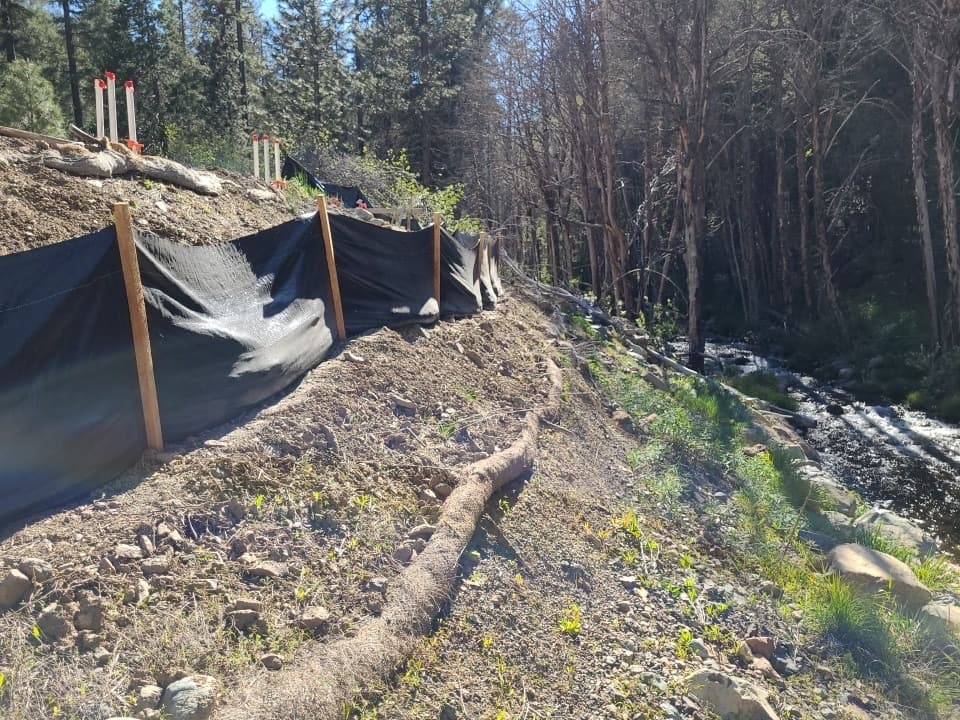
Fix the water first
Walk the slope in a rain. Look for the spot where water enters, the line it follows and where it drops sediment. If the source is your roof, fix the gutters and downspouts. Whenever you redirect stormwater, make sure it is discharged to a suitable area,[2] not onto the slope or your neighbor's yard.
At the end of a pipe, install a concrete or plastic splash block at the end of the pipe to direct flow away from the foundation wall and prevent erosion.[2] If erosion still occurs, add stones along the flow path. The stones should be fist-sized or smaller.[2]
Concentrated runoff is the enemy of a slope. Virginia's erosion and sediment control standards for construction sites say that concentrated runoff shall not flow down cut or fill slopes unless contained within an adequate temporary or permanent channel, flume, or slope drain structure.[6] Those standards apply to permitted work, but the principle holds in your yard: a slope can take sheets of gentle rain, not a pipe's worth of water in one spot.
Cover the soil
Plants and mulch do the lasting work. Seeding establishes perennial vegetative cover, which helps control soil erosion on disturbed areas.[4] EPA says that when properly implemented, permanent seeding often reduces soil loss by up to 99 percent.[4] Pick a grass mix suited to your sun and soil, and for low-maintenance slopes ask your local extension office or garden supplier for a mix that persists without frequent mowing or fertilizing.
Mulch protects the seed while it sprouts. Virginia Cooperative Extension's guidance for seeded winter cover is to mulch the seeded areas with up to 1 bale of straw per 1000 square feet of seeded area applied over the seed, and the use of a tackifier agent will help keep the straw in place.[5]
On a steep slope, loose straw is not enough. For areas with steep slopes or highly erodible soils, several options provide greater stability than loose mulch, including mulch matting, netting, tackifiers and hydromulch.[3] Matting and netting are sold at garden and building supply stores and are pinned down with the staples the maker specifies. Follow the product's directions for overlap and anchoring.
After a storm, walk the slope again. Reseed bare patches and repair lifted mulch right away. Virginia's standards expect this kind of follow-up: slopes that are found to be eroding excessively within one year of permanent stabilization shall be provided with additional slope stabilizing measures until the problem is corrected.[6]
Before you dig or disturb much soil
Raking, seeding and mulching are light work. Digging is not. No person shall make or begin any excavation or demolition without first submitting a locate request to the notification center,[8] so call 811 before you dig, even for a shallow trench or a buried downspout line. See do you need to call 811 before digging in Virginia.
Permits are local. Montgomery County says a land disturbing permit is required when disturbing more than 10,000 square feet of land, which includes clearing, grading, excavation, transporting and filling of land, and it exempts minor land-disturbing activities such as home gardens and individual home landscaping, repairs and maintenance work.[7] Other localities set their own thresholds, so ask yours. See do I need a permit to clear land in Virginia.
Also stay out of protected ground. Chesapeake Bay Resource Protection Areas (RPAs) - wetlands, tidal coastline, floodplains, perennial streams, and their buffer zone - should not be altered without permission.[1]
Stop and call a pro if
- The slope is cutting a gully. Deep channels usually mean a large volume of water that needs to be piped, channeled or regraded, not covered over.
- Soil is moving toward your foundation, a retaining wall or a driveway. A slope that threatens a structure needs a professional's assessment.
- The slope borders a stream, wetland or floodplain. These areas are protected and the rules are strict.[1]
- A large area is bare or you plan to regrade. You may be over a local permit threshold.[7]
- The repair you made keeps failing. Water is coming from somewhere you have not found; a contractor can regrade or add drainage.
- You hit a pipe, cable or wire. Stop and call the utility.
Next steps in Virginia
If water is the root cause, read how a yard is regraded so water drains away from the house and why a yard floods when it rains. For prices, see how much erosion control costs in Virginia, and for who to hire, who to call about a washing-out hillside. Browse excavation and grading services or more excavation answers.
When the slope is beyond a weekend, describe the problem once and licensed local contractors quote it.
Common questions
- What is the fastest way to stop soil washing off a slope?
- Cover it. Bare soil is what washes away, so seed it and mulch it with straw, and slow the water that reaches it. On a steep slope, hold the mulch down with netting, matting or a tackifier, because loose mulch can wash off.
- Does seeding actually work on a slope?
- EPA says that when properly implemented, permanent seeding often reduces soil loss by up to 99 percent. It depends on the slope, the soil and how healthy the plants get, so check the slope after storms and reseed thin spots.
- Do I need a permit to fix erosion on my own yard?
- Usually not for small repairs, but it depends on the locality. Montgomery County, Virginia requires a land disturbing permit above 10,000 square feet and exempts minor land-disturbing activities such as individual home landscaping, repairs and maintenance work. Ask your county or city engineer.
- Can I use gravel instead of plants?
- Yes in some places. EPA notes that pea gravel or crushed granite can be used on unvegetated areas and steep slopes, and gravel along a drip line is one of the fixes Fairfax County's conservation district suggests for gutter overflow.
- When is erosion a job for a contractor?
- When water is cutting deep gullies, when the slope is near a stream, wetland, floodplain or your foundation, or when a large area is disturbed. Those jobs may need a plan, a permit or engineering.
Sources
- [1] Solving Drainage and Erosion Problems: A Guide for Homeowners, Northern Virginia Soil and Water Conservation District, Fairfax County. Checked October 27, 2026.
- [2] Gutters and Downspouts: Wetness or Erosion Problems, Northern Virginia Soil and Water Conservation District, Fairfax County. Checked October 27, 2026.
- [3] Stormwater Best Management Practice: Mulching (EPA-832-F-21-028V), U.S. Environmental Protection Agency. Checked October 27, 2026.
- [4] Stormwater Best Management Practice: Permanent Seeding (EPA-832-F-21-028FF), U.S. Environmental Protection Agency. Checked October 27, 2026.
- [5] Temporary Grassing Options for Winter Soil Stabilization (SPES-743), Virginia Cooperative Extension, Virginia Tech. Checked October 27, 2026.
- [6] 9VAC25-875-560. Erosion and sediment control criteria, techniques, and methods: minimum standards, Virginia Administrative Code. Checked October 27, 2026.
- [7] Erosion and Sediment Control, Montgomery County, Virginia. Checked October 27, 2026.
- [8] Code of Virginia § 56-265.17, Notification required prior to excavation or demolition, Code of Virginia, Legislative Information System. Checked October 27, 2026.
Want a pro to handle it?
Describe the job once. Licensed local businesses send quotes, and you pay only when you book one.
Get a quote from a local pro