How much does flashing repair cost in Virginia?
No dependable, dated Virginia price list exists for flashing repair, so the cost depends on the job: how many flashings have failed, which ones, the roof's height and pitch, and any rotten decking or masonry behind them. Get three written, itemised quotes from licensed roofers, and keep the deposit to 10 percent or $1,000, whichever is less.
Free to ask. Local shops send quotes, and you pay only when you book one.
By Kasra Taheri, Founder, LoclisPublished
Researched and drafted with AI, then checked claim by claim against the sources listed below before it was published. Prices and rules change; the dates beside each source say when it was last checked.
This is a job for a licensed pro in Virginia
This page explains what the work involves, the permits, what a licensed pro does and what drives the cost. It does not give step-by-step instructions, because this work needs a licence, a permit or both, and doing it wrong can injure someone. Before you hire, check the licence on Virginia's DPOR record.
There is no dependable, dated Virginia price list for flashing repair, so no honest single number exists. What you pay depends on how much flashing has failed, how hard the roof is to work on, and what is hiding under it. Get at least three written, itemised quotes from licensed roofers and compare what each one includes.
What drives the cost
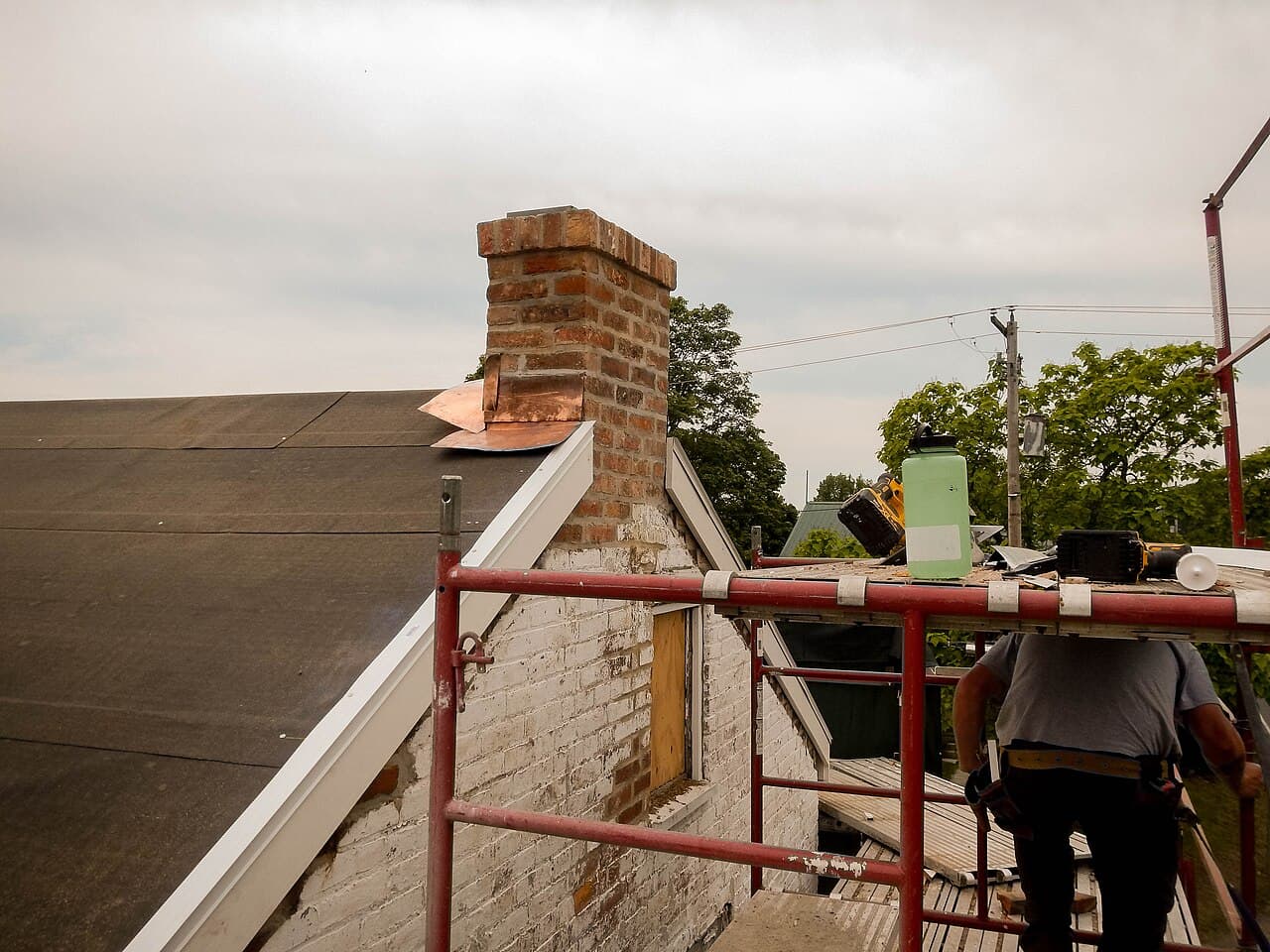
How many flashings, and which. Replacing a plumbing vent boot is a different job from re-flashing a chimney or a long wall junction. Flashing goes around every intersection or projection in a roof, such as vent pipes, chimneys, adjoining walls, dormers and valleys, and each of those is its own detail with its own labour.
Material. Metal or roll roofing, thicker or thinner metal, and special products for skylights all price differently. A quote should name the material.
Access. A steep, tall or complicated roof takes longer and needs more safety gear. OSHA's roofing guide says falls are the leading cause of death in the construction industry,[2] which is why roofers price height and pitch.
Hidden damage. Water that has been getting in can rot the roof deck and wet the insulation below. The USDA Forest Service says that without good tight flashings around chimneys, vents, skylights, and wall/roof junctions, water can leak into buildings and damage walls, ceilings, insulation, and even the electrical system.[1] Ask whether the quote covers replacing damaged decking and what the unit price is if more turns up. The Uniform Statewide Building Code exempts replacement of 256 square feet or less of roof decking in Group R-3, R-4, or R-5 buildings from a permit in most cases,[3] so a small deck repair usually does not add a permit fee.
Surrounding work. Chimney flashing may involve masonry. The Board for Contractors treats masonry as its own specialty, and its definition lists tuck pointing, sand blasting, mortar washing, parging and more,[4] so a quote that includes mortar work may be done by a different crew.
Repair or re-roof. If the roof covering is near the end of its life, a roofer may recommend replacing it along with the flashing. Ask each roofer for a repair-only price as well, so you can compare.
Getting quotes you can compare
DPOR advises getting at least three written bids or estimates using identical plans and specifications so you can compare prices and contractors, and not to automatically accept the lowest.[5] Send every roofer the same photos and description. Each quote should say:
- which flashings are being replaced or repaired, and with what material
- whether the leak has been traced to its source, not just sealed
- what happens if rotten decking is found
- the total price, when payments are due, and the start and finish dates
- the roofer's licence number and class, and the warranty on labour
Virginia law requires all licensed contractors to provide a written contract for residential work.[5]
Deposits and payments
DPOR's advice is to pay 10 percent down or $1,000, whichever amount is less.[6] It also advises that you do not pay cash and that payments not get ahead of the work.[6] DPOR also says to be wary of door-to-door solicitations promising repairs at a discounted price.[6]
When to call a licensed pro
Flashing repair is roofwork and belongs to a licensed roofer. If the work is valued at $1,000 or more, a valid Virginia Contractor's License is required for the license category in which the contractor is to work.[5] Under the Code of Virginia, a Class C contractor can take a single job over $1,000 but less than $30,000,[7] which is the class that matches many flashing repairs. Look up the licence on DPOR's licence lookup before you sign.
To understand what the repair is, read what roof flashing is and who repairs chimney and roof flashing. Browse all roofing answers or roofing businesses.
Describe the leak and add photos, and licensed local roofers send quotes you can compare side by side.
Common questions
- Is it cheaper to repair flashing or replace it?
- It depends on how much has failed. A single cracked vent boot is a small repair, while rusted or lifted flashing along a chimney or wall usually means replacing it. Ask each roofer to say which they recommend and why, and to price the repair on its own.
- Why does one roofer quote far more than another?
- Often because the quotes cover different work. Compare which flashings are included, the material, whether rotten decking is covered, and the warranty. DPOR advises getting at least three written bids using identical plans and specifications.
- How much deposit should I pay?
- DPOR's advice is to pay 10 percent down or $1,000, whichever amount is less, unless the job needs custom-made or special-order items, when it suggests limiting the deposit to 30 percent of the contract.
- Do I need a permit to repair flashing?
- Usually not on its own. The Uniform Statewide Building Code exempts replacement of roof covering in Group R-3, R-4, or R-5 buildings outside high wind areas, Ask your building department if your project is unusual.
- Can I save money by patching flashing myself?
- Sealant over a failed joint is a temporary patch that can hide the real problem, and going on the roof carries real risk: OSHA says falls are the leading cause of death in the construction industry. Photos from the ground are the useful thing you can do before calling a roofer.
Sources
- [1] Overview of Roofing Materials for Forest Service Facilities, USDA Forest Service, Missoula Technology and Development Center. Checked October 27, 2026.
- [2] Protecting Roofing Workers (OSHA 3755), U.S. Occupational Safety and Health Administration. Checked October 27, 2026.
- [3] 13VAC5-63-80. Section 108 Application for permit (Virginia Uniform Statewide Building Code), Virginia Administrative Code (Virginia General Assembly). Checked October 27, 2026.
- [4] 18VAC50-22-30. Definitions of specialty services (Board for Contractors Regulations), Virginia Administrative Code (Virginia General Assembly). Checked October 27, 2026.
- [5] What You Should Know Before You Hire a Contractor, Virginia Department of Professional and Occupational Regulation, Board for Contractors. Checked October 27, 2026.
- [6] Disaster Recovery: Avoiding Fraud, Virginia Department of Professional and Occupational Regulation. Checked October 27, 2026.
- [7] Code of Virginia § 54.1-1100. Definitions, Code of Virginia (Virginia General Assembly). Checked October 27, 2026.
Want a pro to handle it?
Describe the job once. Licensed local businesses send quotes, and you pay only when you book one.
Get a quote for Roofing