What is roof flashing?
Roof flashing is thin metal or roll roofing that keeps water out where a roof meets a chimney, wall, dormer, vent pipe or valley, or is cut through by a skylight. Shingles cannot seal those joints on their own. Failed flashing causes many roof leaks, so have a licensed roofer inspect and repair it rather than patching it with sealant yourself.
Free to ask. Local shops send quotes, and you pay only when you book one.
By Kasra Taheri, Founder, LoclisPublished
Researched and drafted with AI, then checked claim by claim against the sources listed below before it was published. Prices and rules change; the dates beside each source say when it was last checked.
This is a job for a licensed pro in Virginia
This page explains what the work involves, the permits, what a licensed pro does and what drives the cost. It does not give step-by-step instructions, because this work needs a licence, a permit or both, and doing it wrong can injure someone. Before you hire, check the licence on Virginia's DPOR record.
Roof flashing is the thin metal or roll roofing that keeps water out of the places where a roof is interrupted. Flashing is pieces of metal or roll roofing placed around any intersection or projection in a roof, such as vent pipes, chimneys, adjoining walls, dormers and valleys, to keep water from seeping into the building. Shingles shed water across an open slope, but they cannot seal a joint, so flashing does that job.
Where flashing goes
Anywhere the roof meets something else, or something pokes through it:
- Chimneys. Flashing runs up the sides and across the back of the chimney, and the top edge is usually covered or tucked into the masonry.
- Walls and dormers. Where a roof slope runs into a vertical wall, flashing is lapped under the roof covering and up the wall.
- Valleys. The channel where two slopes meet carries a lot of water off the roof.
- Vent pipes. A plumbing vent boot is a small flashing with a collar around the pipe.
- Skylights. Skylight makers supply flashing kits matched to the roof type; VELUX describes its flashing systems as designed to shed water without relying on sealants that can break down over time.[2]
- Eaves and rakes. Metal edging along the roof edge guides water off the roof and into the gutter.
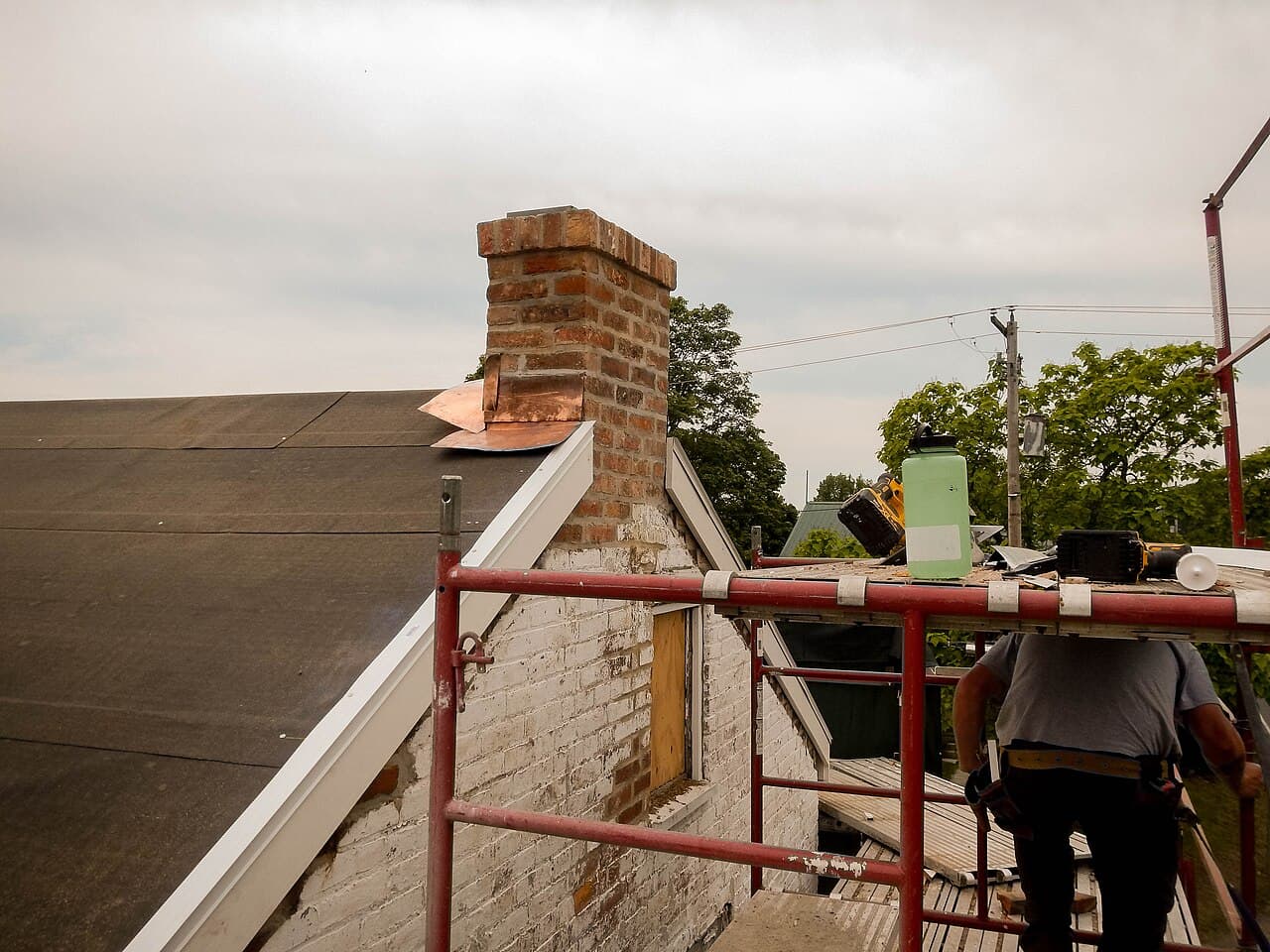
What it is made of
Flashing is usually sheet metal, and roll roofing is also used in some details. Which material is right depends on the roof covering and the detail, which is one reason a roofer's quote should name it.
Why it matters
Flashing is where roofs often leak first. The USDA Forest Service says many apparent roof leaks are really flashing leaks.[1] Without good tight flashings around chimneys, vents, skylights, and wall/roof junctions, water can leak into buildings and damage walls, ceilings, insulation, and even the electrical system.[1] The same guide says flashings should be checked twice a year when the roof is inspected and the gutters are cleaned.[1]
Common signs of a flashing problem are a stain on a ceiling or wall near a chimney, dormer or vent, rust or gaps along a metal edge, cracked or missing sealant, and water that only shows up in wind-driven rain. A smear of roofing cement over a joint is a temporary patch, not a repair, and it can hide the real failure.
Look from the ground
Binoculars from the yard show most visible damage, and photos taken from the ground help a roofer scope the job before a visit. Stay off the roof. OSHA's roofing guide says falls are the leading cause of death in the construction industry.[3]
When to call a licensed pro
Flashing repair is roofwork, so it is a job for a roofer, not a ladder project. In Virginia the Board for Contractors defines roofing contracting as the service that provides for the installation, repair, removal, or improvement of materials common to the industry that form a watertight, weather resistant surface for roofs and decks.[4] If the work is valued at $1,000 or more, a valid Virginia Contractor's License is required for the license category in which the contractor is to work.[5] Check any roofer with DPOR's licence lookup before you pay a deposit.
On permits, the Uniform Statewide Building Code exempts replacement of an unlimited amount of roof covering in Group R-3, R-4, or R-5 buildings, provided the building is not in an area where the nominal design wind speed is greater than 100 miles per hour.[6] Rules can differ for unusual work or properties, so ask your building department before you start.
Next, see how much flashing repair costs in Virginia and who repairs chimney and roof flashing. Browse all roofing answers or roofing businesses near you.
Describe the leak and add photos, and licensed local roofers send quotes you can compare side by side.
Common questions
- Is roof flashing the same as a drip edge?
- They are related but not the same. Both are metal that directs water, but flashing seals joints and penetrations such as chimneys, walls and valleys, while a drip edge runs along the eaves and rakes to guide water off the roof edge.
- How do I know if my flashing has failed?
- Look for stains on ceilings or walls near a chimney, dormer or vent, rust, gaps or lifted metal, and leaks that appear mainly in wind-driven rain. The USDA Forest Service notes that many apparent roof leaks are really flashing leaks, so a roofer should check flashing before blaming the shingles.
- Can I seal leaking flashing with roofing cement?
- It may slow a leak for a short time, but it is a patch, not a repair, and it can hide the real failure. Ask a roofer to find out why the flashing is leaking.
- How often should flashing be checked?
- The USDA Forest Service says flashings should be checked twice a year when the roof is inspected and the gutters are cleaned.
- Does flashing repair need a licensed contractor in Virginia?
- If the work is valued at $1,000 or more, a valid Virginia Contractor's License is required for the license category in which the contractor is to work, according to DPOR's hiring guide. Check the licence before you pay a deposit.
Sources
- [1] Overview of Roofing Materials for Forest Service Facilities, USDA Forest Service, Missoula Technology and Development Center. Checked October 27, 2026.
- [2] Installation Type & Flashing Systems, VELUX America LLC. Checked October 27, 2026.
- [3] Protecting Roofing Workers (OSHA 3755), U.S. Occupational Safety and Health Administration. Checked October 27, 2026.
- [4] 18VAC50-22-30. Definitions of specialty services (Board for Contractors Regulations), Virginia Administrative Code (Virginia General Assembly). Checked October 27, 2026.
- [5] What You Should Know Before You Hire a Contractor, Virginia Department of Professional and Occupational Regulation, Board for Contractors. Checked October 27, 2026.
- [6] 13VAC5-63-80. Section 108 Application for permit (Virginia Uniform Statewide Building Code), Virginia Administrative Code (Virginia General Assembly). Checked October 27, 2026.
Want a pro to handle it?
Describe the job once. Licensed local businesses send quotes, and you pay only when you book one.
Get a quote for Roofing