How much does floor leveling cost in Virginia?
We found no dated Virginia price from a primary source, so there is no honest single number. The cost follows how deep the low spots are, whether the floor is concrete or wood, how much prep and old-flooring removal it needs, and the flooring going on top. Get three written bids on identical specifications and compare them line by line.
Free to ask. Local shops send quotes, and you pay only when you book one.
By Kasra Taheri, Founder, LoclisPublished
Researched and drafted with AI, then checked claim by claim against the sources listed below before it was published. Prices and rules change; the dates beside each source say when it was last checked.
Step by step
Read when to stop and call a pro, further down this page, before you start.
Step 1: Measure the room
Note the room's square footage and any other rooms the new floor will run into.
Step 2: Find the depth of the lows
Use a long straightedge and a tape to measure how deep the low spots are; coverage per bag falls fast as the depth grows.[3]
Step 3: Name the floor and the new flooring
Write down whether the floor is concrete or wood, and which flooring goes on top, since its maker sets the flatness limit.[1]
Step 4: Flag old flooring and glue
Note any old vinyl or adhesive, which may contain asbestos and should not be sanded or ground.[3]
Step 5: Get three written bids
Ask for at least three written bids using identical specifications and compare what each includes.[4]
Step 6: Check the licence
Look up the contractor on DPOR before signing anything over $1,000.[4]
There is no single Virginia price
Floor leveling is priced by the room, and the number swings with how far out of level the floor is, what it is made of and what has to come off it first. We found no primary source that publishes a dated Virginia price for the job, so this page does not quote one. It explains what moves the price and how to get quotes you can compare.
Start with what you are buying. Sika lists a typical application thickness of 1/8 to 2 inches for its self-leveling underlayment.[3] A floor out of level by more than that is usually a framing question.
The cost drivers
Depth of the low spots. A floor that needs a thin skim costs little compared with one that needs an inch of material. Sika's data sheet lists coverage per 50 lb bag, not counting waste or porous floors: 42 square feet at 1/8 inch, 21 at 1/4 inch, 11 at 1/2 inch and 5.3 at 1 inch.[3] Tremco's product covers 24 square feet at 1/4 inch.[2] Doubling the depth roughly doubles the bags, and the bags are the part of the bill you can estimate yourself.
What the floor is made of. On concrete, the work is often a patch and a pour. Tremco's data sheet says priming concrete is not necessary in most cases, though extremely porous concrete may need a primer.[2] On wood or OSB, there is more to do: wood and OSB surfaces must be primed before the underlayment is poured, and the data sheet then calls for galvanized diamond metal lath fastened into the subfloor.[2] That is extra labour and materials.
Preparation. Grinding high spots, filling holes and cleaning the floor take time. The vinyl installation guide we read says gaps and holes greater than 3/16 inch should be filled level with the surrounding surface using cement-based patching material.[1] A floor with many holes or old glue costs more to get ready.
Old flooring and adhesive. Old resilient flooring and old adhesive may contain asbestos fibers or crystalline silica, so avoid creating dust.[1] Testing, and removal by a pro if needed, is a separate cost from the leveling itself.
The flooring going on top. The tolerance depends on the new floor. One vinyl plank guide asks for a surface flat within 3/16 inch per 10 foot radius,[1] and your tile, wood or carpet maker may ask for something else. A tighter limit means more of the room needs work.
Schedule and cure time. Tremco says light traffic is possible in as little as 4 hours and floor coverings can go down in as little as 24 hours, depending on temperature,[2] while Sika lists hardwood after 3 days.[3] Ask each bidder what cure time they have assumed before the new flooring goes on.
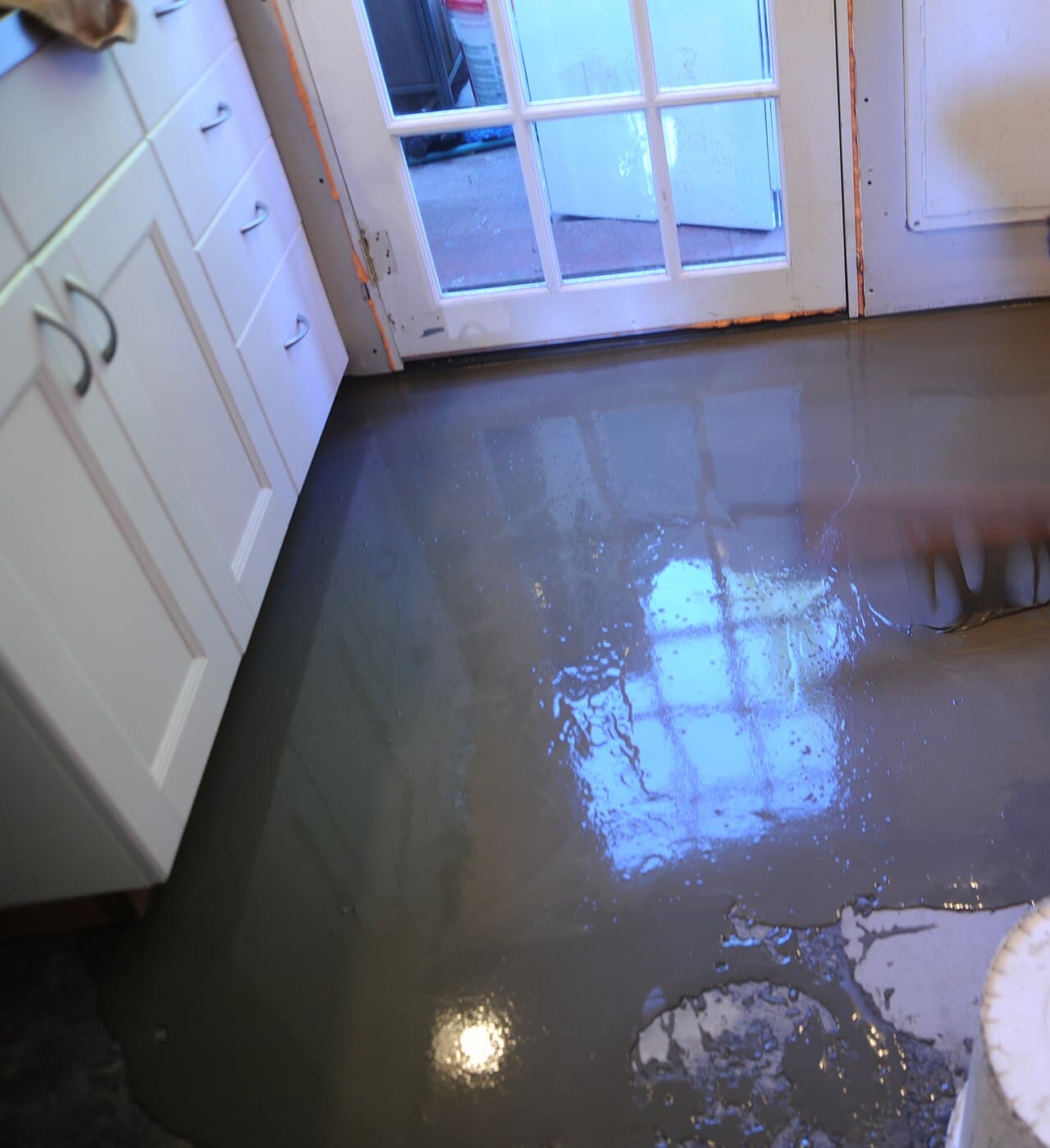
When leveling is not the right fix
If the floor slopes steadily or bounces, the cause may be in the framing. The vinyl guide says maximum deflection should not exceed 3/64 inch,[1] and a pour does not cure a springy floor. For that, read what subfloor repair costs and ask a carpenter or a general contractor to look.
Getting a quote you can compare
Virginia's Board for Contractors suggests getting at least three written bids using identical plans and specifications.[4] For leveling, make each bid state the following:
- The floor type and the product, with the thickness it plans to pour.
- Whether priming, lath and patching are included.
- Who tests for moisture and who removes old flooring.
- A start date, a finish date and the cure time before new flooring goes on.
Virginia law requires all licensed contractors to provide a written contract for residential work.[4] On deposits, the guide says a good rule of thumb is an initial deposit of no more than 10% of the total price.[4]
Licensing matters once the work is valued at $1,000 or more: the board says a valid Virginia Contractor's License is required for the license category in which the contractor is to work.[4] Class C contractors are those whose single contract or project is over $1,000 but less than $30,000.[5] Check the licence on DPOR's licence lookup before you sign.
Stop and call a pro if
- The floor slopes or bounces. That is a framing question, not a leveling-compound question.[1]
- There is old vinyl, sheet flooring or black adhesive. It may contain asbestos, and Sika says not to sand or grind it.[3]
- The floor is damp. One vinyl guide says if moisture is present, do not install the floor.[1]
- The quote is $1,000 or more. A valid Virginia contractor's license is required for the contractor.[4]
Getting help in Virginia
For the how-to side, see how to level a floor before installing new flooring and whether to hire a pro. Browse more flooring answers or the flooring guide.
When you are ready, describe the job and licensed local contractors quote it.
Common questions
- Is there a price per square foot for floor leveling in Virginia?
- We found no primary source that publishes a dated Virginia per-square-foot price, so we do not quote one. Material use rises quickly with depth: Sika's data sheet lists coverage per 50 lb bag of 42 square feet at 1/8 inch down to 5.3 at 1 inch.[^sika] Ask each contractor for a written, itemised quote.
- Does a wood subfloor cost more to level than concrete?
- Often, because there is more to do on the wood. Tremco says wood and OSB must be primed and then fastened with galvanized diamond metal lath before the pour, while priming concrete is not necessary in most cases.[^vulkem]
- Do I need a licensed contractor to level a floor?
- If the work is valued at $1,000 or more, the Board for Contractors says a valid Virginia Contractor's License is required for the license category in which the contractor is to work.[^dpor-guide] Class C contractors are those whose single contract or project is over $1,000 but less than $30,000.[^va-1100] Check the licence on DPOR's lookup.
- How much deposit is reasonable?
- The Board for Contractors guide says a good rule of thumb is an initial deposit of no more than 10% of the total price, and that a reputable contractor should be able to front the costs of supplies without a large sum of up-front money.[^dpor-guide]
- Why would a quote go up after the old floor comes up?
- Because the floor underneath can hide holes, loose boards or old adhesive. Old resilient flooring and adhesive may contain asbestos fibers or crystalline silica,[^aquawood] so ask what the quote assumes about the old floor and what a change order would cost.
Sources
- [1] Aquawood Plus Installation Guide (luxury vinyl plank), Aquawood, manufacturer installation guide. Checked October 27, 2026.
- [2] Vulkem Pro Series Self-Leveling Floor Underlayment (data sheet), Tremco Sealants. Checked October 27, 2026.
- [3] SikaLevel self-leveling underlayment (product data sheet, May 2026), Sika USA. Checked October 27, 2026.
- [4] What You Should Know Before You Hire a Contractor, Virginia Board for Contractors, DPOR. Checked October 27, 2026.
- [5] Code of Virginia § 54.1-1100. Definitions (contractors), Virginia General Assembly, Legislative Information System. Checked October 27, 2026.
Want a pro to handle it?
Describe the job once. Licensed local businesses send quotes, and you pay only when you book one.
Get a quote from a local pro