Why are the floors in my house uneven?
Uneven floors usually mean something moved: soil shrinking and swelling under the footings, a slab lifting, or water collecting near the foundation. Fairfax County says clays shrink in dry periods and swell in wet ones, and that settlement can warp door frames and crack walls. Because the cause decides the repair, have a licensed pro diagnose it before anyone levels over it.
Free to ask. Local shops send quotes, and you pay only when you book one.
By Kasra Taheri, Founder, LoclisPublished
Researched and drafted with AI, then checked claim by claim against the sources listed below before it was published. Prices and rules change; the dates beside each source say when it was last checked.
This is a job for a licensed pro in Virginia
This page explains what the work involves, the permits, what a licensed pro does and what drives the cost. It does not give step-by-step instructions, because this work needs a licence, a permit or both, and doing it wrong can injure someone. Before you hire, check the licence on Virginia's DPOR record.
Uneven floors usually mean something under or around the house has moved: the soil beneath the footings, the slab, or the framing above. Which one it is decides the fix, and working that out is a job for a professional, not something to cover with a new layer of leveling compound.
Soil that shrinks and swells
In parts of Northern Virginia, Fairfax County's guide to marine clay soils explains the main cause. The clays shrink during dry periods of the year and swell during wet periods.[1] In dry weather, particularly summer, the soil loses moisture, and this causes the clays to shrink, leaving a void, or gap, under the footings.[1] The footings lose support.
The county describes what follows: the buildings settle, usually in an uneven fashion, resulting in broken footings, cracked masonry walls, interior cracks in plaster, and warped door and window frames.[1] A floor that slopes, a door that has started to stick and a diagonal crack over a window can all be the same movement showing up in different places.
Slabs can move too. Fairfax County says damage to floor slabs and roadways occurs when underlying clays shrink and swell,[1] and that the swelling can force a slab up, sometimes requiring replacement of the floor slab.[1] Not every Virginia house sits on clay like this, and soils differ from one county to the next, but the pattern is a useful one: uneven floors often follow moisture changes in the ground.
Water that should be elsewhere
Water is the other usual suspect. The Northern Virginia Soil and Water Conservation District says most wet basements are a result of water problems outside of the house.[2] Its guidance for the ground around a house: "Land around your house should slope away from foundation walls. Ideally, a 5% grade should be maintained for a distance of ten feet around your home."[3] Soil that stays soggy next to a foundation, or dries out in a drought, is soil that is changing volume under your house.
What to look for before anyone visits
You do not need to diagnose it, but a few observations make the visit more useful:
- Which rooms and which direction. A slope toward one corner points somewhere different from a bounce in the middle of a room.
- Cracks. Fairfax County advises that you measure and keep a record of the width and extent of the cracks and the time of the year that you made the recordings.[1] It also notes that if the cracks open up during the summer months, especially during very dry years, and close up during the moist winter months, they are probably caused by shrinking and swelling of clays below the footings.[1]
- Doors and windows that bind, gap or no longer latch.
- Trees close to the house. Fairfax County says trees should be planted at least 20 feet away from residential structures to minimize drying of the soils by the root system.[1]
Why not just level over it
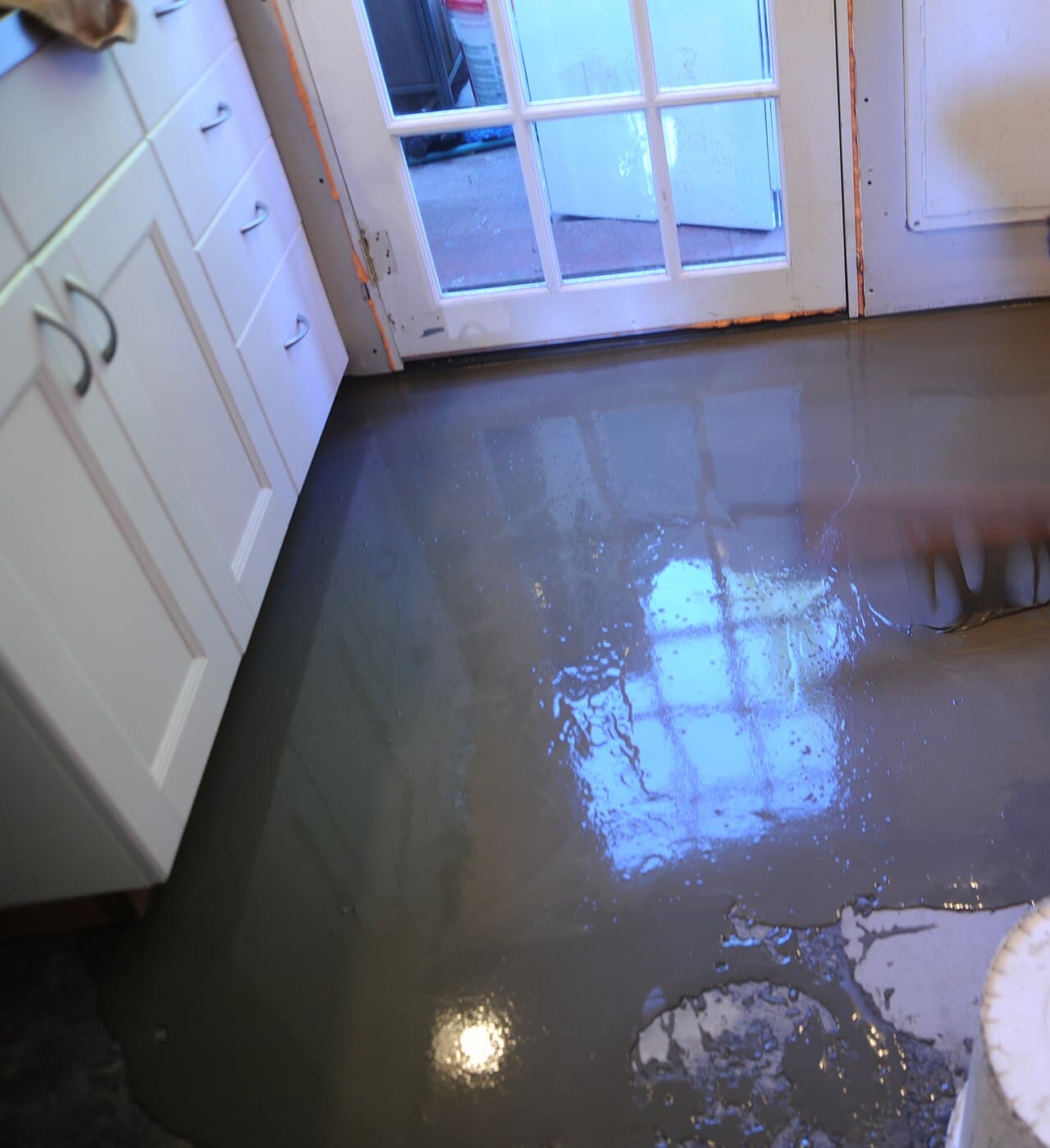
Self-leveling compound or patch makes the surface flat. It does nothing for the cause. If the footing is still settling, the floor goes out of level again and the cracked new layer is a second repair. The Fairfax guide warns that an incomplete or improper repair will likely result in recurring problems in the future.[1] Diagnose first, then decide whether the floor needs more than a leveling job.
What the professionals do
Fairfax County says correctly identifying the problems usually requires a thorough investigation of the soil and structural conditions by a qualified professional.[1] For difficult repairs it advises homeowners to consult a qualified engineer experienced in soil and foundation investigations for design and inspection of difficult repairs.[1] When the foundation has settled, remedial underpinning construction is often necessary to reinforce a foundation that has been damaged by settlement.[1]
If the diagnosis is a minor one, such as drainage that needs correcting or a floor that is simply out of flat, the work goes to a flooring or concrete contractor. For what that costs, see how much floor leveling costs in Virginia, and to decide who should do a flat-floor fix, should I hire a pro to level my floor.
When to call a licensed pro
Call early if the floor is moving, not only uneven: cracks that widen, doors that stop closing, a slab that has lifted, or a floor that feels soft or bouncy. Structural repair is not a homeowner task.
Virginia ties licensing to the size of the job. If the work you are considering is valued at $1,000 or more, a valid Virginia Contractor's License is required for the license category in which the contractor is to work.[4] A Class C licence covers a single contract or project of over $1,000 but less than $30,000, and Class B starts at $30,000.[5] The Board for Contractors also advises getting at least three written bids using identical plans and specifications, and notes that Virginia law requires all licensed contractors to provide a written contract for residential work.[4]
If you suspect the gas pipe or meter is being pushed on by a damaged wall, do not wait for a quote. Fairfax County says to call the gas company immediately if you think that your natural gas pipe or gas meter is under pressure from a damaged wall, since an explosion could occur from a leaking pipe.[1]
Getting help in Virginia
Loclis lists DPOR-licensed businesses with their licence number and class. Browse more flooring answers or the flooring guide, and when you are ready, describe the problem and licensed local contractors quote it.
Common questions
- Is an uneven floor a sign of foundation problems?
- It can be. Fairfax County describes uneven settling that leads to broken footings, cracked masonry walls, interior plaster cracks and warped door and window frames. A floor that is out of flat in one room with no other signs may be something simpler, which is why a professional looks at the whole house, not only the floor.
- Can I just level the floor with self-leveling compound?
- That makes the surface flat but does not stop whatever is moving. The Fairfax County guide warns that an incomplete or improper repair will likely result in recurring problems. Find the cause first, then decide whether a leveling job is enough.
- Why do cracks and sticking doors get worse in summer?
- Fairfax County says that cracks that open during the summer months, especially in very dry years, and close up during the moist winter months, are probably caused by shrinking and swelling of clays below the footings.
- Does this only happen in Northern Virginia?
- The Fairfax County guide is about its marine clay soils, so its details apply there. Soils differ across Virginia, but the same idea holds anywhere: ground that changes volume with moisture, or water collecting next to a foundation, can move a house.
- Who should I hire to look at uneven floors?
- For anything beyond a minor flat-floor fix, the county guide advises consulting a qualified engineer experienced in soil and foundation investigations. For the repair itself, check the contractor's Virginia licence first, because a licence is required when the work is valued at $1,000 or more.
Sources
- [1] Homeowner's Guide to Overcoming Problems with Marine Clay-Marumsco Soils in Fairfax County, Fairfax County Department of Land Development Services. Checked October 28, 2026.
- [2] Solving Drainage and Erosion Problems: A Guide for Homeowners, Northern Virginia Soil and Water Conservation District, Fairfax County. Checked October 28, 2026.
- [3] Gutters and Downspouts: Wetness or Erosion Problems, Northern Virginia Soil and Water Conservation District, Fairfax County. Checked October 28, 2026.
- [4] What You Should Know Before You Hire a Contractor, Virginia Board for Contractors, DPOR. Checked October 28, 2026.
- [5] Code of Virginia § 54.1-1100. Definitions (contractors), Virginia General Assembly, Legislative Information System. Checked October 28, 2026.
Want a pro to handle it?
Describe the job once. Licensed local businesses send quotes, and you pay only when you book one.
Get a quote from a local pro