Should I hire a pro to level my floor before new flooring?
Do it yourself only for a small room with shallow low spots on sound concrete. Hire a pro for a large room, a wood subfloor that needs priming and lath, a floor that flexes, or any old vinyl or glue that may contain asbestos. In Virginia, work valued at $1,000 or more needs a licensed contractor.
Free to ask. Local shops send quotes, and you pay only when you book one.
By Kasra Taheri, Founder, LoclisPublished
Researched and drafted with AI, then checked claim by claim against the sources listed below before it was published. Prices and rules change; the dates beside each source say when it was last checked.
Step by step
Read when to stop and call a pro, further down this page, before you start.
Step 1: Measure the lows
Use a straightedge to find how deep the low spots are and how large the area is.[3]
Step 2: Identify the floor
Decide whether the floor is concrete or wood, and whether the old flooring is old vinyl or glue that may contain asbestos.[1]
Step 3: Check the new flooring's limit
Read the flooring maker's flatness limit before choosing a method.[1]
Step 4: Decide DIY or hire
Keep a small, shallow, concrete job; hire for a large, wood, flexing or old-adhesive floor.
Step 5: Verify the licence and bids
Get three written bids and look up the contractor's licence on DPOR before signing.[4]
Hire a pro when the floor is more than a skim coat
For a small, shallow low spot on a solid floor, leveling is a job many homeowners can do. Hire a pro when the area is large, the depth is more than a thin coat, the floor is wood, the floor flexes, or you are not sure what the old flooring is. The cost of getting it wrong is a bonded layer that has to be chipped out.
Jobs you can usually do yourself
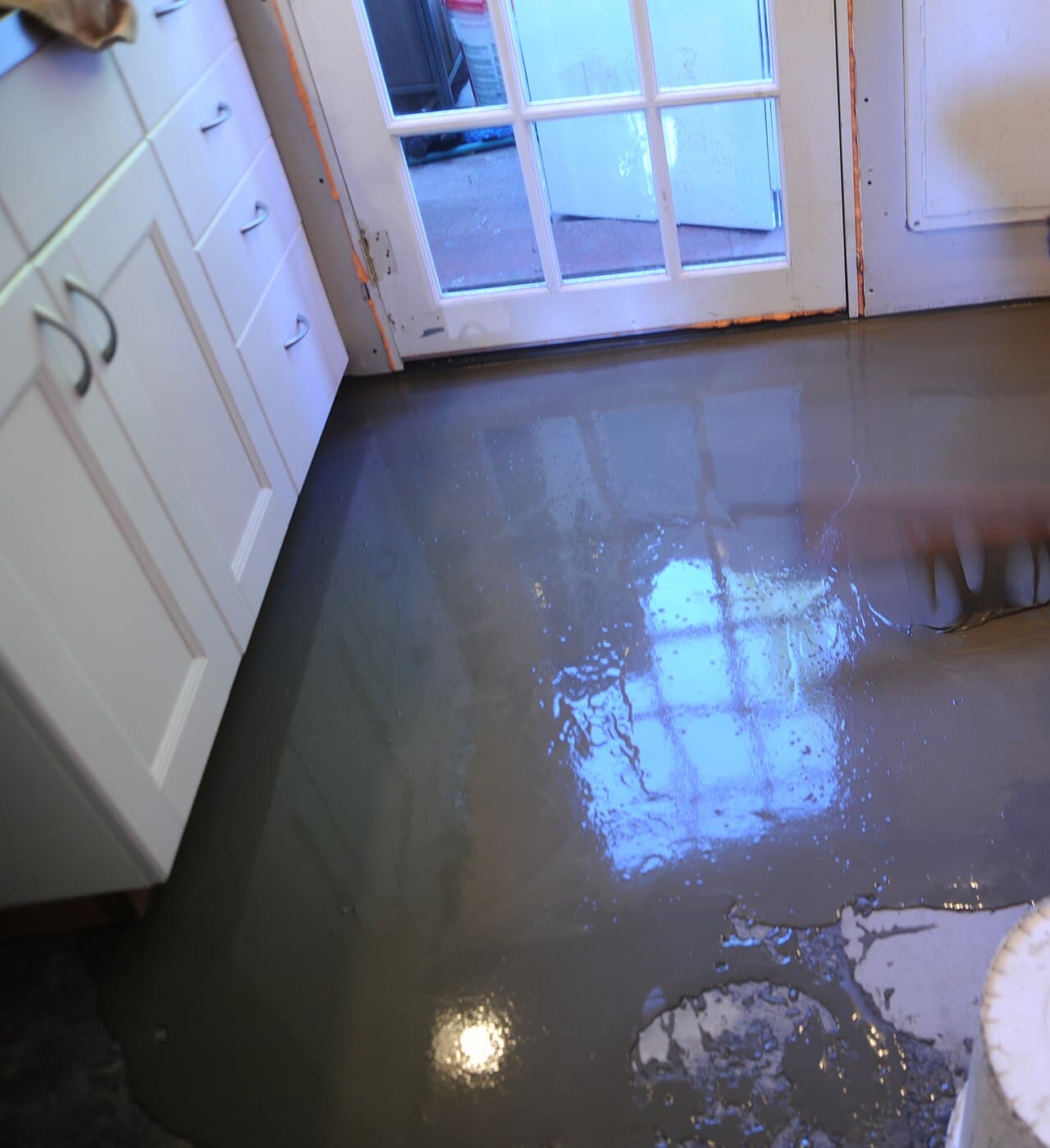
Sika lists a typical application thickness of 1/8 to 2 inches for its self-leveling underlayment.[3] A small room with shallow lows on sound concrete fits that. Tremco's data sheet says priming concrete is not necessary in most cases, though extremely porous concrete may need a primer,[2] so the preparation is short. Our how-to guide walks through it.
Reasons to hire
The pour has to go in as one continuous pass. The product should be placed continuously, in a continuous stream from one corner,[2] and the mixing, pouring and spreading all happen within a limited working time. Sika gives a pot life of about 25 minutes.[3] A large room is easier with a crew.
The subfloor is wood. Wood and OSB surfaces must be primed before the underlayment is poured,[2] and the data sheet then calls for galvanized diamond metal lath with fasteners about every 6 inches.[2] Any boards that move must be re-secured with screws.[2]
The floor flexes. The vinyl installation guide says maximum deflection should not exceed 3/64 inch.[1] A bouncing floor is a framing problem. A contractor can tell whether it needs carpentry before any leveling goes on; see subfloor repair costs.
The old floor might contain asbestos. Old resilient flooring and old adhesive may contain asbestos fibers or crystalline silica, so avoid creating dust.[1] Sika says not to sand or grind adhesive residue, since old cutback adhesive may contain asbestos.[3] The guide adds that local regulations may require professional removal.[1]
The flooring has a tight flatness limit or warranty. One vinyl guide asks for a surface flat within 3/16 inch per 10 foot radius,[1] and it makes the contractor or owner responsible for cure time, moisture testing and the structural integrity of the compound.[1] Hiring a pro moves that work to someone who does it all the time.
Weather and heating. Tremco says not to use its product if ambient temperatures will fall below 40 °F within 72 hours after placement,[2] and Sika says radiant heating and forced air ventilation have to be off for 24 hours before and while the underlayment cures.[3]
How to hire in Virginia
Virginia requires a licensed contractor when the work is valued at $1,000 or more: the Board for Contractors says a valid Virginia Contractor's License is required for the license category in which the contractor is to work.[4] Class C covers a single contract or project over $1,000 but less than $30,000.[5] Look the contractor up on DPOR's licence lookup before you sign.
Then compare bids. The board suggests at least three written bids using identical plans and specifications,[4] and says Virginia law requires all licensed contractors to provide a written contract for residential work.[4] Ask each bid to name the product, the thickness, whether priming and lath are included, who tests moisture and who removes old flooring. The price side is covered in what floor leveling costs in Virginia.
Stop and call a pro if
- The floor slopes across the room or bounces underfoot. The cause is in the framing, not the surface.[1]
- You find old vinyl, sheet flooring or black adhesive. Do not sand or grind it.[3]
- The wood subfloor needs lath and priming over a large area. That is a crew job.[2]
- The job is valued at $1,000 or more. The contractor must be licensed.[4]
- The floor is damp. One vinyl guide says if moisture is present, do not install the floor.[1]
Getting help in Virginia
Browse more flooring answers or the flooring guide. When you are ready, describe the job and licensed local contractors quote it.
Common questions
- Can I level a floor myself?
- A small room with shallow low spots on sound concrete is a reasonable first job, since Sika lists a typical thickness of 1/8 to 2 inches and Tremco says priming concrete is not necessary in most cases.[^sika][^vulkem] Large rooms, wood subfloors and floors that flex are better left to a pro.
- Is a wood subfloor harder to level?
- Yes. Tremco says wood and OSB must be primed, and the data sheet then calls for galvanized diamond metal lath fastened into the subfloor, with moving boards re-secured with screws first.[^vulkem]
- What if my old floor might have asbestos?
- Do not sand or grind it. Sika warns that old cutback adhesive may contain asbestos and that harmful dust may result,[^sika] and the vinyl guide says local regulations may require professional removal.[^aquawood] Have it tested and handled by a pro first.
- Does the flooring warranty matter?
- It can. One vinyl guide asks for a surface flat within 3/16 inch per 10 foot radius and puts responsibility for cure time, moisture testing and structural integrity of the compound on the contractor or owner.[^aquawood] Read your flooring's own guide.
- Do I need a licensed contractor in Virginia?
- For work valued at $1,000 or more, yes: the Board for Contractors says a valid Virginia Contractor's License is required for the license category in which the contractor is to work.[^dpor-guide]
Sources
- [1] Aquawood Plus Installation Guide (luxury vinyl plank), Aquawood, manufacturer installation guide. Checked October 27, 2026.
- [2] Vulkem Pro Series Self-Leveling Floor Underlayment (data sheet), Tremco Sealants. Checked October 27, 2026.
- [3] SikaLevel self-leveling underlayment (product data sheet, May 2026), Sika USA. Checked October 27, 2026.
- [4] What You Should Know Before You Hire a Contractor, Virginia Board for Contractors, DPOR. Checked October 27, 2026.
- [5] Code of Virginia § 54.1-1100. Definitions (contractors), Virginia General Assembly, Legislative Information System. Checked October 27, 2026.
Want a pro to handle it?
Describe the job once. Licensed local businesses send quotes, and you pay only when you book one.
Get a quote from a local pro