How much does a foundation cost for a new house in Virginia?
There is no honest single Virginia price for a new-house foundation, because it swings with the foundation type, the soil, the depth, the site and the permit. The reliable way to a number is itemized written quotes for your plans and lot. Ask what is included, who handles the soils report and inspections, and how changes are priced.
Free to ask. Local shops send quotes, and you pay only when you book one.
By Kasra Taheri, Founder, LoclisPublished
Researched and drafted with AI, then checked claim by claim against the sources listed below before it was published. Prices and rules change; the dates beside each source say when it was last checked.
This is a job for a licensed pro in Virginia
This page explains what the work involves, the permits, what a licensed pro does and what drives the cost. It does not give step-by-step instructions, because this work needs a licence, a permit or both, and doing it wrong can injure someone. Before you hire, check the licence on Virginia's DPOR record.
There is no single Virginia price for a new-house foundation, and any number quoted without your plans and lot should be treated as a guess. A foundation is a bundle of jobs: site work and excavation, footings, walls or slab, waterproofing and drainage, inspections and backfill. How much each one costs depends on your soil, your design and your site. The dependable route is to collect itemized written quotes and compare them line by line.
What moves the cost
Foundation type. A slab on grade, a crawlspace and a full basement involve very different amounts of digging, concrete, steel and waterproofing. A basement is the most work because the excavation is deep and the walls are tall and must hold back soil.
Soil and depth. Soil decides how deep and how heavily reinforced the footings must be, and whether the ground needs engineering. The Fairfax County Code requires that a soils report be prepared by a qualified engineer for all new construction and grading work in Marine Clay.[1] There, Fairfax County requires that all footings placed in marine clay be at minimum 4 feet deep, with the ultimate depth determined by the results of a detailed investigation of the soils.[1] Not every Virginia lot is on marine clay, but the principle holds: poor soil means more design, more depth and more cost, and a soils report is worth having before you price anything.
Site and access. A steep or crowded lot costs more to dig. Steep embankments in Marine Clays, as well as any other soils, present a safety hazard unless they are adequately sloped or protected by shoring,[1] so a cut into a slope may need shoring or a retaining wall. Rock, a high water table and hauling spoil away all add time.
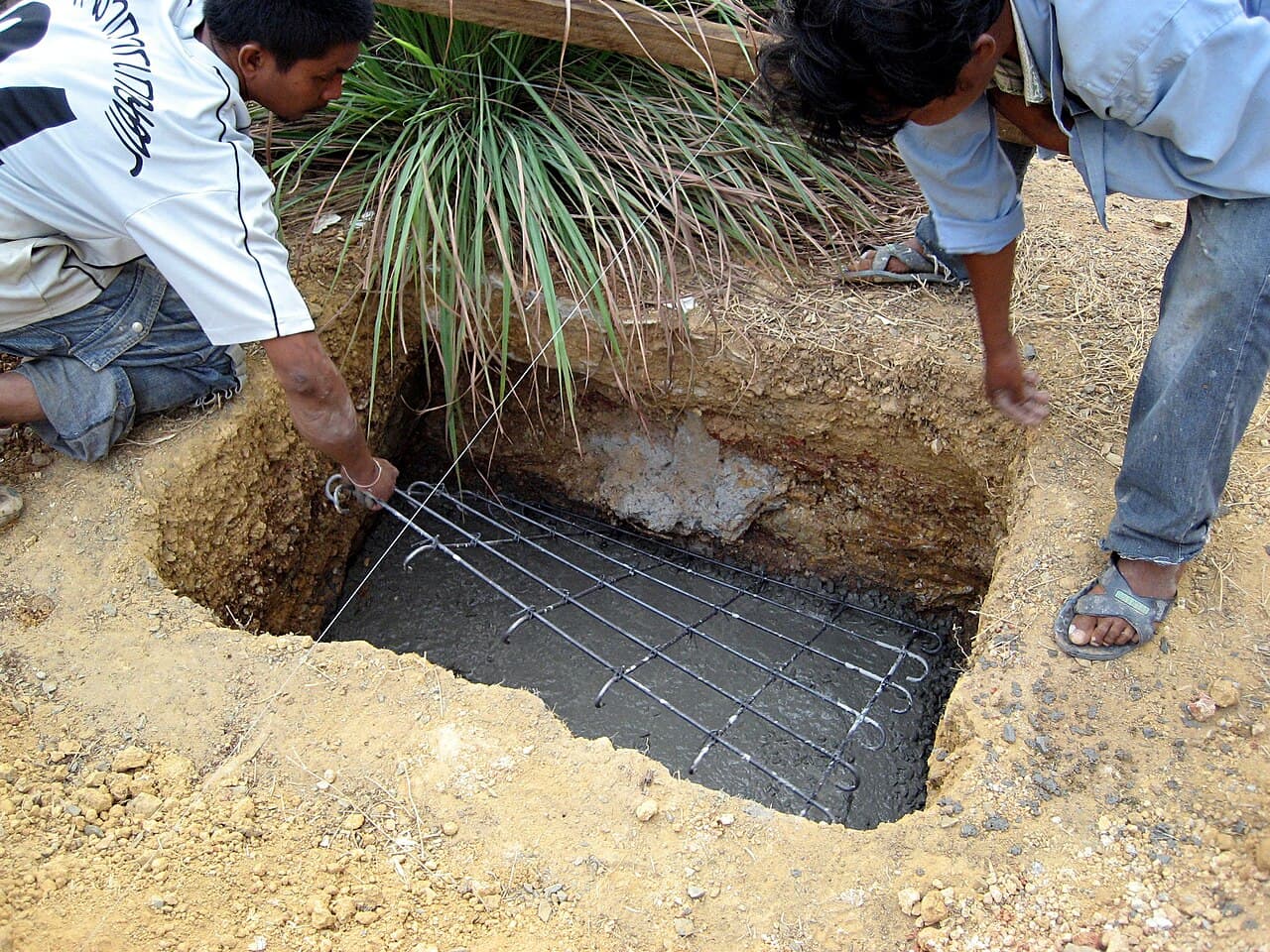
Water control. Foundation drains, damp-proofing or waterproofing, and a sump where needed are often separate line items. For basements, Richmond County requires an additional inspection of the drainage system and waterproofing.[2]
Permits and inspections. The Uniform Statewide Building Code requires an application to the building official, and a permit, before construction of a building or structure begins.[3] Fees are set locally, so ask your building department rather than relying on a figure from another county. Inspections come at set stages; Richmond County's building inspections page says a footing inspection is required after trenches have been excavated, forms and grade stakes are in place, and before concrete is poured.[2] For what happens at each stage, see what pouring footings for a house involves.
Who is doing the work. Some builders carry the foundation inside a single contract price; others bring in an excavator and a foundation or concrete subcontractor. The price you see may include the builder's margin and coordination, or it may not.
Getting quotes you can compare
Fairfax County's repair guide advises contacting at least three contractors and comparing the costs and services offered, and asking for a written estimate that includes separate statements for materials and labor.[1] That guide is written for foundation repair, but the advice applies to new work too. For each foundation quote, ask for:
- the foundation type, dimensions and the plan or engineer's drawing it is based on
- excavation, hauling and backfill, and who removes the spoil
- footing depth and reinforcing, wall type and height, and waterproofing and drains
- who pays for the permit, the soils report and any special inspections
- how unexpected conditions, such as rock or soft soil, will be priced
- the schedule, the payment schedule and the warranty
Make sure the contract is in writing. Virginia's Board for Contractors rules refer to a legible written contract clearly specifying the terms and conditions of the work to be performed,[5] and say it should show the contractor's name, address, license number, class of license, and classifications or specialty services.[5] They also say any modification to the contract that changes the cost, materials, work to be performed, or estimated completion date must be in writing and signed by all parties,[5] so agree how changes are priced before you sign.
When to call a licensed pro
For all of it. A foundation is structural, permitted and inspected work. Virginia licenses contractors by the value of the work: Class B contractors handle a single contract of $30,000 or more but less than $150,000, and Class A contractors a single contract of $150,000 or more.[4] Ask any bidder for the licence number and class and check the licence before paying a deposit.
Related reading: who to hire to check a cracked foundation if you are dealing with an existing house, and how yard regrading keeps water away from a house.
Browse excavation services or read more excavation answers. To get prices for your own lot, describe the job once and licensed local businesses quote it.
Common questions
- Why can't you give a price per square foot?
- Because we have no dated Virginia price from a primary source to give you, and the spread between sites is wide. Foundation type, soil, depth, slope, water and local requirements all move the number. Get itemized written quotes for your plans.
- Is the foundation priced separately from the house?
- It can be. A builder may include it in a total contract price or have it done by a foundation subcontractor. Either way, ask for it itemized so you can see what excavation, footings, walls, waterproofing and backfill cost.
- Does a bad soil report raise the cost?
- It can. Soil that needs deeper footings, engineered fill or special design adds work. In Fairfax County's marine clay, footings must be at minimum 4 feet deep, with the ultimate depth determined by a detailed soils investigation.
- Are permits and inspections part of the quote?
- They should be spelled out. A building permit is required before construction begins, and inspections such as the footing inspection happen before concrete is poured. Ask whether permit fees and any engineer or special inspections are included or are separate.
- Can I change the foundation design after signing?
- Only in writing. Virginia's Board for Contractors rules say any modification that changes the cost, materials, work to be performed, or estimated completion date must be in writing and signed by all parties.
Sources
- [1] Homeowner's Guide to Overcoming Problems with Marine Clay-Marumsco Soils in Fairfax County, Fairfax County and the Northern Virginia Soil and Water Conservation District. Checked October 27, 2026.
- [2] Inspections, Richmond County, Virginia, Building Inspections. Checked October 27, 2026.
- [3] 13VAC5-63-80. Section 108 Application for permit (Virginia Uniform Statewide Building Code), Virginia Administrative Code, Virginia General Assembly. Checked October 27, 2026.
- [4] Va. Code § 54.1-1100, Definitions, Code of Virginia, Virginia General Assembly. Checked October 27, 2026.
- [5] 18VAC50-22-260, Filing of charges; prohibited acts, Virginia Administrative Code, Board for Contractors. Checked October 27, 2026.
Want a pro to handle it?
Describe the job once. Licensed local businesses send quotes, and you pay only when you book one.
Get a quote from a local pro