How much does it cost to have shrubs planted in Virginia?
There is no reliable statewide price for shrub planting, because the bill is mostly the plants plus labor, and both swing with plant size, root ball type, how many shrubs you need, and how much soil work the site takes. Get two or three written quotes that list each plant's species, size and spacing, and what prep, mulch, cleanup and aftercare are included.
Free to ask. Local shops send quotes, and you pay only when you book one.
By Kasra Taheri, Founder, LoclisPublished
Researched and drafted with AI, then checked claim by claim against the sources listed below before it was published. Prices and rules change; the dates beside each source say when it was last checked.
Step by step
Read when to stop and call a pro, further down this page, before you start.
Step 1: Decide what the shrubs are for
Write down the job they must do, such as hiding a foundation, screening a neighbor or filling a bed, and measure the area.
Step 2: Note your site conditions
Record sun or shade, wet or dry soil, and your hardiness zone so the quote suggests plants that suit the spot.[1]
Step 3: Run a soil test
A routine Virginia Tech soil test tells you whether the bed needs lime or fertilizer before anyone sells you amendments.[3]
Step 4: Check drainage
Dig one test hole, fill it with water, and see whether it drains within 24 hours.[1]
Step 5: Ask for a plant list
Each quote should name the species, the container or root ball size, the quantity and the spacing.
Step 6: Ask what prep is included
Find out whether removing old shrubs, replacing rocky backfill, amending the bed and hauling debris are in the price.
Step 7: Ask about mulch and cleanup
Confirm the mulch type and depth, and whether pots, tags and twine are taken away.
Step 8: Ask who requests the utility locate
Someone must contact Virginia 811 before digging; agree in writing who does it.[6]
Step 9: Ask about aftercare and replacements
Get the watering plan for the first season and any plant replacement terms in writing.
Step 10: Check licences for any building work
If the job adds grading, drainage or a retaining wall, look the business up on DPOR's License Lookup.[9]
Step 11: Compare quotes line by line
Line up the same plants, sizes and services so you are comparing like with like, not just totals.
No one can give an honest per-shrub price for all of Virginia, because a shrub planting quote is mostly two things that vary enormously: the plants themselves and the labor to put them in the ground properly. A few small container shrubs tucked into an existing bed is a short job. A row of large evergreens along a foundation, with old shrubs pulled out and the soil rebuilt, is a different job entirely. What you can control is the quote: ask for one that spells out every plant and every service, and you will know exactly what you are paying for.
What drives the price
Plant size and root ball. Most shrubs are sold as container-grown plants, and a small share as balled-and-burlapped (B&B) plants.[1] Larger plants cost more at the nursery, and B&B root balls are heavy, so they take more labor to move and set.
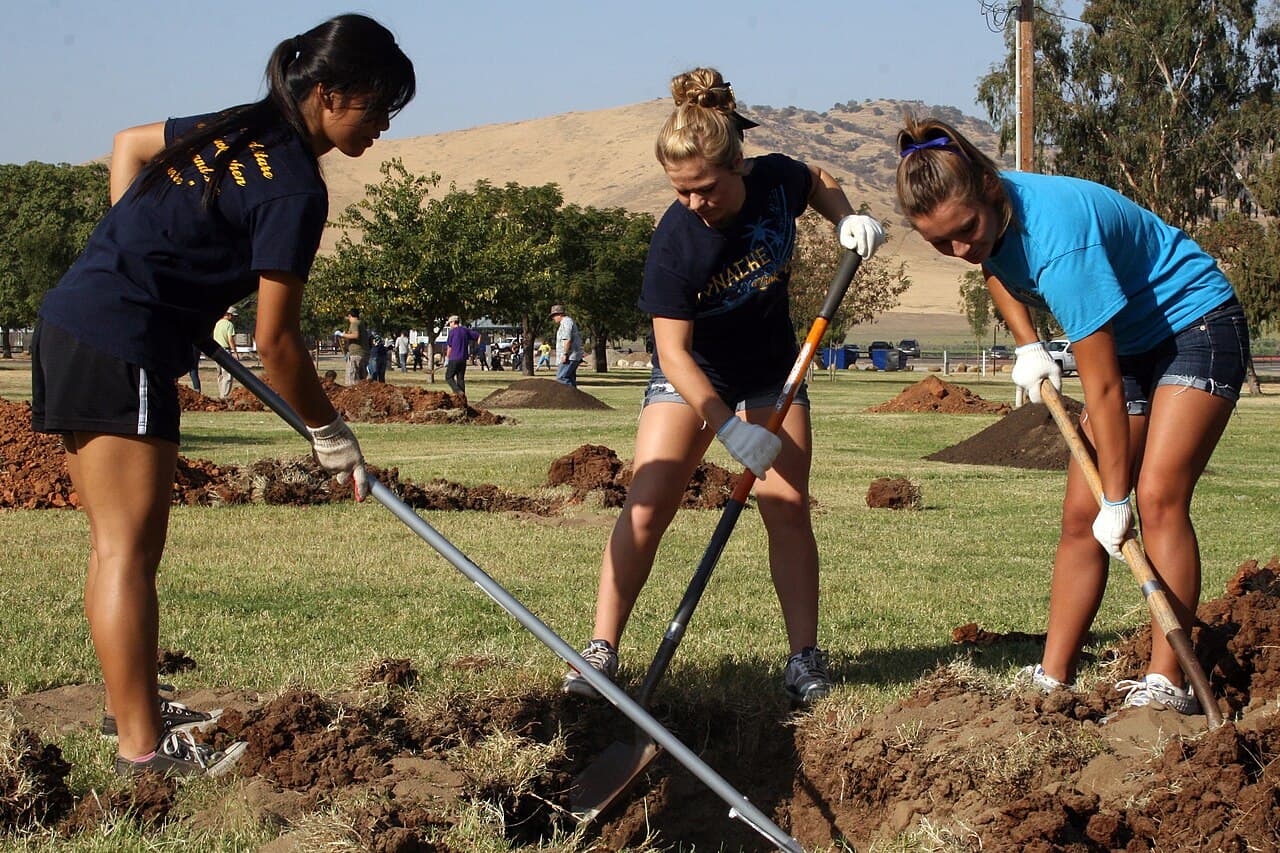
Hole size. Proper planting is more digging than many people expect. Virginia Tech's guidance is a hole at least twice as wide as the shrub's root ball,[1] and for trees, at least three to five times as wide as the root ball.[2] A crew that digs narrow holes is cheaper on the day and costly later.
How many plants. Spacing is a trade-off between time and money: a closer spacing fills in faster but means buying more plants, while a wider spacing takes longer to fill in and costs less.[1] For a hedge or screen, the spacing on the quote has a large effect on the total.
Soil and site work. This is where quotes differ most. Virginia Tech's advice is that if the original soil has too much rock or construction debris, replace it with local topsoil.[1] For a mass planting, it suggests working 3 to 5 inches of organic matter into the entire bed, to the depth of the root balls,[1] while for single shrubs the advice is not to add organic matter to an individual planting hole, since it generally does not improve growth or survival.[1] Removing old overgrown shrubs and their roots, regrading, or fixing a wet spot all add labor.
Drainage. Wet soil reduces shrub growth and survival. Virginia Tech's test is simple: dig a hole, fill it with water, and "If the water doesn't drain in 24 hours, plant elsewhere."[1] A site that fails needs different plants or drainage work, and drainage work is a bigger job than planting.
Access. Narrow side yards, steps, slopes and long carries from the truck all slow a crew down.
What you may not need to pay for
Fertilizer at planting. Virginia Tech notes that nursery plants, especially container-grown ones, have usually been well fertilized in production and may not need fertilizer at planting[1] unless the soil is deficient. A soil test settles it cheaply: when we checked in October 2026, Virginia Tech's soil lab listed a routine soil test at $10.00.[3]
Heavy mulch. The recommendation is to mulch 2 to 3 inches deep around each shrub, kept off the stems.[1] Paying for a deep volcano of mulch promotes shallow roots, disease and pest injury,[1] not value.
Aftercare is part of the cost
New shrubs live or die by watering in the first season. Container plants dry out fast, and Virginia Tech says to expect watering two to three times a week in summer during dry spells,[1] while B&B plants usually need only weekly watering.[1] Decide before you sign who does that. If it is you, budget your time; if it is the landscaper, it will be on the bill. Our guide to how often to water new plants covers the schedule, and why new plants wilt after planting covers what goes wrong.
Ask too what happens if a shrub dies in the first year. Replacement terms vary, and many are void if the plants were not watered, so get the terms in writing.
The utility locate
Planting means digging, and digging means a locate request. Virginia 811 tells homeowners, "From fences to gardens, for any digging project, contact Virginia 811 three days before"[6] the work, and the locate service is free.[6] Agree with the landscaper who requests it.
Help with the cost for native plantings
If you are replacing lawn with native shrubs and beds, look at the Virginia Conservation Assistance Program, an urban cost-share program run through Virginia's participating Soil and Water Conservation Districts.[5] When we checked in October 2026, conservation landscaping, including mulched beds and tree plantings, was reimbursed at 80% of total costs, with a maximum payment of $7,000.[4] Contact your district before any work starts.
Licences when the job grows
A planting-only job is simple. When a quote adds grading, a wall or drainage, licensing comes in. The Board for Contractors' landscape service contracting specialty covers the alteration or improvement of a land area not related to any other classification or service activity by means of excavation, clearing, grading, construction of retaining walls for landscaping purposes, or placement of landscaping timbers,[8] and under Virginia law, a Class C contractor licence covers a single job worth over $1,000 but less than $30,000.[7] Check the business on DPOR's License Lookup[9] before you sign for that part of the work. For whether hiring out is worth it at all, see whether to pay a landscaper to plant shrubs and perennials.
Stop and call a pro if
- The shrubs are large balled-and-burlapped plants too heavy to move safely by hand.
- Old shrubs with big root systems have to come out first.
- The site fails the 24-hour drainage test, or water runs toward the house.
- The plan includes grading, a retaining wall, drainage pipe or irrigation.
- Utility marks run through the planting area.
Browse more lawn and landscaping answers, see garden and bed planting services, or look up lawn and landscaping businesses around Blacksburg. For quotes you can compare line by line, describe the job once and local businesses quote it.
Common questions
- Why do quotes for the same shrubs vary so much?
- Usually because they are not quoting the same job. One may price smaller container plants with no prep, another larger balled-and-burlapped plants with old-shrub removal, bed amendment, mulch and a season of watering. Ask each company to list species, size, quantity, spacing and every service, then compare line by line.
- Is it cheaper to buy the shrubs myself and pay only for planting?
- Sometimes, but ask first. A landscaper may plant customer-supplied shrubs on different terms, such as no replacement promise, since they did not choose the plants. Before buying, check that container plants are not root-bound, with a solid mat of roots circling the outside of the root ball.
- Do bigger shrubs cost more to plant?
- Yes. Larger plants cost more to buy, need bigger holes and are heavier to move, and balled-and-burlapped plants weigh far more than container plants of similar size. Smaller plants are cheaper and often establish easily, but take longer to fill the space.
- Can I get help paying for a native planting?
- Possibly. The Virginia Conservation Assistance Program offers cost-share for conservation landscaping in participating Soil and Water Conservation Districts. When we checked in October 2026 it reimbursed 80% of total costs up to $7,000. Contact your local district before you start, because approval comes first.
- Does a landscaper need a licence to plant shrubs in Virginia?
- Check whenever the job goes beyond planting. Grading, excavation and retaining walls fall under the Board for Contractors' landscape service contracting specialty. If the work goes beyond planting, check the business on DPOR's License Lookup.
Sources
- [1] Shrubs: Functions, Planting, and Maintenance (426-701), Virginia Cooperative Extension, Virginia Tech. Checked October 27, 2026.
- [2] Planting Trees (426-702), Virginia Cooperative Extension, Virginia Tech. Checked October 27, 2026.
- [3] Instructions for Soil Sampling Home Lawns, Gardens, Fruits, and Ornamentals (452-125), Virginia Cooperative Extension, Virginia Tech. Checked October 27, 2026.
- [4] Conservation Landscaping, Virginia Association of Soil and Water Conservation Districts. Checked October 27, 2026.
- [5] Virginia Conservation Assistance Program (VCAP), Virginia Association of Soil and Water Conservation Districts. Checked October 27, 2026.
- [6] Virginia 811: Safety is in Your Hands, Virginia 811. Checked October 27, 2026.
- [7] Va. Code § 54.1-1100, Definitions (contractors), Code of Virginia, Virginia General Assembly. Checked October 27, 2026.
- [8] 18VAC50-22-30, Definitions of specialty services, Virginia Administrative Code, Board for Contractors. Checked October 27, 2026.
- [9] License Lookup, Virginia Department of Professional and Occupational Regulation. Checked October 27, 2026.
Want a pro to handle it?
Describe the job once. Licensed local businesses send quotes, and you pay only when you book one.
Get a quote from a local pro