Is it worth paying a landscaper to plant shrubs and perennials?
It is worth paying a landscaper when the job is big, heavy or tricky: many plants, large balled-and-burlapped shrubs, old shrubs to remove, poor soil or drainage, or a design you cannot picture yourself. A few container perennials or small shrubs in an easy bed are a reasonable do-it-yourself job, as long as you plant them correctly and keep them watered.
Free to ask. Local shops send quotes, and you pay only when you book one.
By Kasra Taheri, Founder, LoclisPublished
Researched and drafted with AI, then checked claim by claim against the sources listed below before it was published. Prices and rules change; the dates beside each source say when it was last checked.
Step by step
Read when to stop and call a pro, further down this page, before you start.
Step 1: Request a utility locate
Contact Virginia 811 about three days before you dig; the service is free.[8]
Step 2: Test the drainage
Dig one hole, fill it with water, and choose another spot if it has not drained in 24 hours.[2]
Step 3: Pick healthy plants
Avoid root-bound pots, where a solid mat of roots circles the outside of the root ball.[2]
Step 4: Dig wide, not deep
Make the hole at least twice as wide as the root ball and only as deep as the roots, so the top sits level with or slightly above the ground.[2]
Step 5: Strip tags and ties
Take every tag, wire and rope off the stems, because they can girdle and kill the plant as it grows.[2]
Step 6: Unpot and fix circling roots
Ease the plant out of its container without breaking up the root ball, and cut any roots that circle it.[2]
Step 7: Handle burlap in the hole
Set a B&B shrub in the hole first, fold the burlap down the sides, and take off all twine.[2]
Step 8: Backfill with the soil you dug
Use the native soil without adding organic matter, swapping in local topsoil only if it is full of rock or debris.[2]
Step 9: Settle with water
Water when the hole is about three-fourths full, then finish filling to the original level.[2]
Step 10: Build a watering ring
Shape a low berm of extra soil around the hole's edge so water soaks in over the root ball.[2]
Step 11: Mulch
Spread 2 to 3 inches of mulch, keeping it off the stems.[2]
Step 12: Water through the first season
Keep the root ball from drying out, especially in the first summer.[2]
Paying a landscaper is worth it when the job is beyond what you can lift, dig or design, or when you cannot look after the plants for their first season. It is usually not worth it for a handful of small container perennials or shrubs going into a bed you can reach with a hose. The plants are the same either way; what you are buying is labor, judgment about plant choice and placement, and correct planting.

What actually decides whether new plants live
Many new shrubs and perennials that fail are not killed by pests. They are planted too deep, in a hole too narrow, in soil that holds water, or left to dry out. Virginia Tech's tree guidance puts it bluntly: "Mechanical damage and improper tree care kill more trees than any insects or diseases."[3] Its list of planting mistakes includes digging the hole too narrow and over-amending the backfill, digging too deep or filling the bottom with gravel, leaving treated or synthetic burlap on, and piling up excessive mulch.[3] The same mistakes hurt shrubs.
Plant choice matters too. Some plants are fussy about soil. Mountain laurel and azaleas have very fine roots and a low survival rate in clay soils unless the backfill is amended.[2] And Virginia Tech warns against relying on one or two species, because too few species puts a large share of the planting at risk if a pest problem arrives.[2] Someone who plants for a living should know which plants suit your soil and spot.
Then there is time. Shrubs and trees can take up to three years to get established,[4] and the first summer is the hardest, because the potting soil of most container-grown plants holds only a one- to two-day supply of water.[2] Whoever plants, someone has to water.
When doing it yourself makes sense
- A few container perennials or small shrubs, in a bed that is already dug and drains well.
- Plants you can lift and carry yourself, with a hose that reaches.
- You are willing to follow the steps on this page, including the drainage test and the utility locate.
- You will be home to water through the first summer.
The step list here walks through planting a shrub the way Virginia Tech recommends. Perennials go in the same way on a smaller scale; our guide to when to plant perennials in Virginia covers timing.
When paying a landscaper is worth it
- Many plants or a whole bed. Digging dozens of wide holes is days of work, and a crew does it in hours.
- Large or balled-and-burlapped shrubs. They are heavy, and setting them at the right depth without breaking the root ball takes practice.
- Old shrubs to remove. Overgrown foundation plants come out with big root masses.
- Problem soil. Rocky fill, construction debris or a site that fails the drainage test needs more than a shovel.
- You want a design. If you cannot picture the finished bed, design is where professional help adds the most.
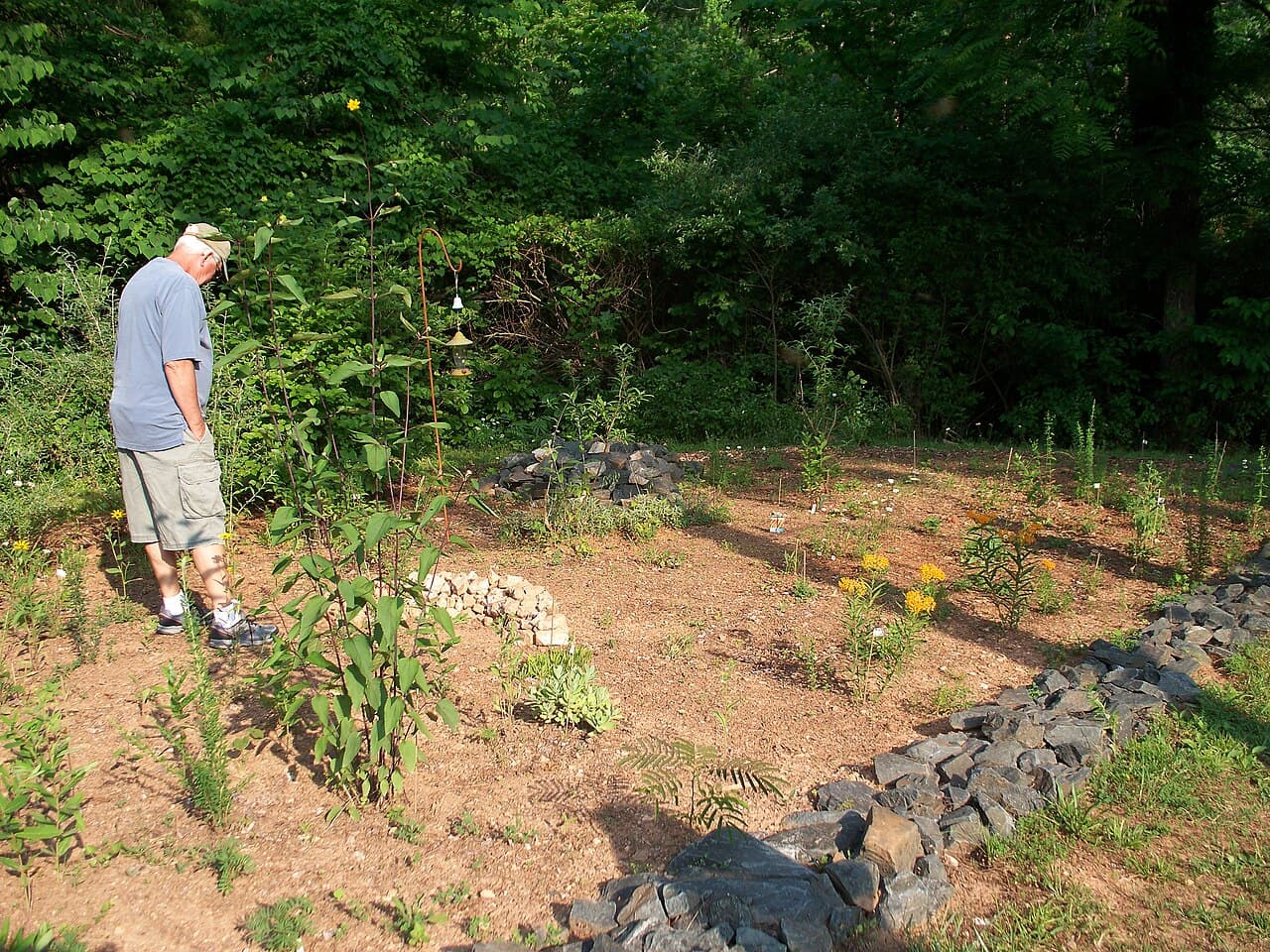
Does professional landscaping add value to a house?
Virginia Tech summarises survey research on how landscaping affects what buyers think a house is worth. Respondents ranked design sophistication first, at 42 percent of the value added, plant size second at 36 percent, and variety of plant types third at 22 percent.[1] Moving from a lawn-only house to a well-landscaped one raised perceived value from 5.5 percent in Louisiana to 11.4 percent in South Carolina,[1] and very minimal landscapes, with a simple design and small plants, actually detracted from value.[1] The author concludes that investing in the services of a landscape design professional will optimize the value of a home,[1] and notes that the value of a landscape improvement increases over time as trees and shrubs grow.[1]
Two cautions. These are perceived values from a 1999 survey of home and garden show visitors in seven other states, not Virginia sale prices. And the factor that mattered most was design, not who held the shovel, so paying for a plan and planting it yourself can capture much of the benefit.
What to check when you hire
- A written plant list with species, sizes, quantities and spacing, so quotes compare. Our guide to what shrub planting costs in Virginia lists what a quote should include.
- The utility locate. Virginia 811 says, "From fences to gardens, for any digging project, contact Virginia 811 three days before"[8] digging. Agree who requests it.
- Licences for anything beyond planting. The Board for Contractors' landscape service contracting specialty covers work by means of excavation, clearing, grading, construction of retaining walls for landscaping purposes, or placement of landscaping timbers.[5] Check those businesses on DPOR's License Lookup.[7]
- A pesticide license for weed control. Under Virginia law, "No person may apply or recommend for use any pesticide commercially without a pesticide business license and the employment of a certified commercial applicator"[6] responsible for the work.
- Insurance, aftercare and replacement terms in writing, including who waters and what happens if a plant dies.
Stop and call a pro if
- The shrubs are too heavy to move or set safely by hand.
- Water stands in your test hole a day later, or runs toward the house.
- Old shrubs, stumps or big roots have to come out first.
- The plan needs grading, a retaining wall, drainage or irrigation.
- Utility marks run through the bed, or you hit anything buried while digging.
Browse more lawn and landscaping answers, see garden and bed planting services, or look up lawn and landscaping businesses around Blacksburg. If you decide to hire, describe the job once and local businesses quote it.
Common questions
- Can I pay for a design and plant it myself?
- Yes, and it is often the best value. Design was the factor that added the most perceived value in the survey Virginia Tech reports, while the planting itself is labor you can do for a modest bed. Ask the designer for a plan with species, sizes, quantities and spacing so you can buy and plant in stages.
- What does a landscaper do that I might not?
- A good crew matches plants to sun, soil and space, checks drainage, digs wide holes at the right depth, deals with burlap, wire baskets and circling roots, replaces rocky backfill, and mulches correctly. They also bring the labor and equipment for large balled-and-burlapped shrubs and for removing old plants.
- Will a landscaper water the new plants?
- Only if the agreement says so. Some planting jobs end on the day the last shrub goes in, and the first season of watering falls to you. Ask before you sign, and get the watering plan and any replacement terms in writing.
- Does the landscaper need a licence?
- It depends on the work. Grading, excavation, clearing and retaining walls are landscape service contracting under the Board for Contractors, and applying weed killer or other pesticides for hire needs a Virginia pesticide business license. Check any business doing that work on DPOR's License Lookup or ask for its pesticide license.
- Is it cheaper to hire someone in fall?
- Prices are set by each business, so there is no rule. Fall is a good time to plant in Virginia, and booking the work for early fall or early spring, rather than the middle of summer, gives the plants an easier start whoever does the digging.
Sources
- [1] The Effect of Landscape Plants on Perceived Home Value (426-087), Virginia Cooperative Extension, Virginia Tech. Checked October 27, 2026.
- [2] Shrubs: Functions, Planting, and Maintenance (426-701), Virginia Cooperative Extension, Virginia Tech. Checked October 27, 2026.
- [3] How NOT to Kill a Tree: 24 Common Tree Care Mistakes That Damage Landscape Trees (430-210), Virginia Cooperative Extension, Virginia Tech. Checked October 27, 2026.
- [4] Native Plants in the Landscape: Maintaining Native Plants (SPES-799), Virginia Cooperative Extension, Virginia Tech. Checked October 27, 2026.
- [5] 18VAC50-22-30, Definitions of specialty services, Virginia Administrative Code, Board for Contractors. Checked October 27, 2026.
- [6] Va. Code § 3.2-3924, Licenses required, Code of Virginia, Virginia General Assembly. Checked October 27, 2026.
- [7] License Lookup, Virginia Department of Professional and Occupational Regulation. Checked October 27, 2026.
- [8] Virginia 811: Safety is in Your Hands, Virginia 811. Checked October 27, 2026.
Want a pro to handle it?
Describe the job once. Licensed local businesses send quotes, and you pay only when you book one.
Get a quote from a local pro