How much does an electrician cost per hour in Virginia?
No official source publishes what Virginia electrical shops bill per hour. What is published is pay: in Bureau of Labor Statistics 2025 wage data, the median Virginia electrician earned $30.24 an hour. A shop's billed rate is higher, because it also covers the business's costs, and the total depends on trip fees, minimums, parts, access, permits and the licence level of the person sent.
Free to ask. Local shops send quotes, and you pay only when you book one.
By Kasra Taheri, Founder, LoclisPublished
Researched and drafted with AI, then checked claim by claim against the sources listed below before it was published. Prices and rules change; the dates beside each source say when it was last checked.
This is a job for a licensed pro in Virginia
This page explains what the work involves, the permits, what a licensed pro does and what drives the cost. It does not give step-by-step instructions, because this work needs a licence, a permit or both, and doing it wrong can injure someone. Before you hire, check the licence on Virginia's DPOR record.
There is no official figure for what Virginia electricians bill per hour, so any single number you see online is somebody's estimate. What is published is what electricians earn, and that sets the floor: in Bureau of Labor Statistics 2025 wage data, the median Virginia electrician earned about $30 an hour. A shop's billed rate is higher than that, and the total on your invoice depends as much on how the shop prices visits as on the hourly number.
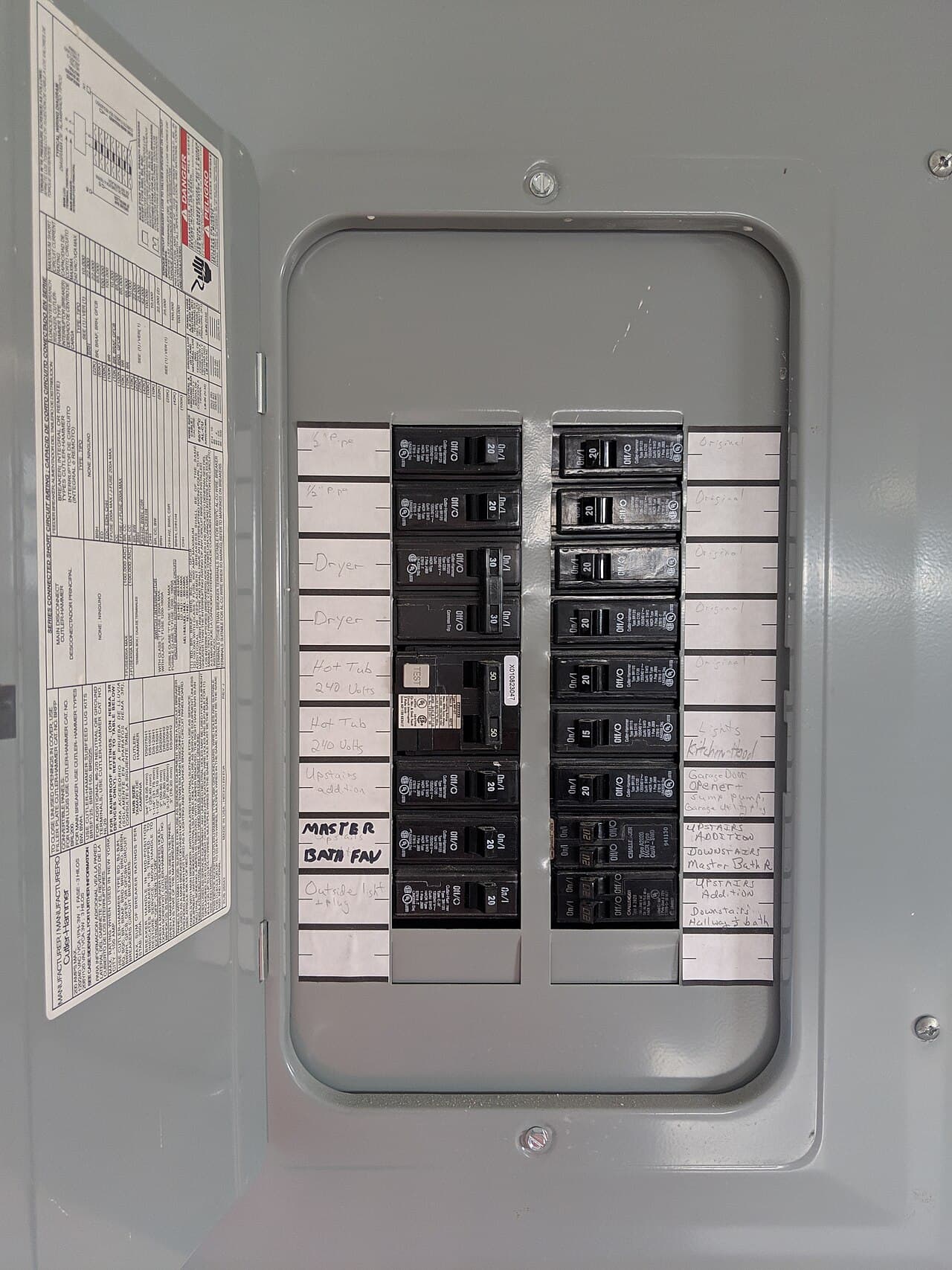
What Virginia electricians earn
When we checked on 26 October 2026, Bureau of Labor Statistics 2025 wage data published on O*NET OnLine showed that the median wage for electricians in Virginia was $30.24 an hour.[1] The spread is wide: the lowest-paid 10% earned $19.61 an hour or less and the highest-paid 10% earned $50.83 or more.[1] The national median was $30.38.[1]
Regional medians in the same data were close to the state figure: Blacksburg-Christiansburg-Radford area $30.04, Charlottesville $30.28, Richmond $29.50, Roanoke $27.98 and Virginia Beach-Chesapeake-Norfolk $29.98.[1] The Washington-Arlington-Alexandria metro area, reported across DC, Virginia, Maryland and West Virginia, was higher at $36.50.[1]
Why the rate on your bill is higher
Those figures are wages. A shop's billed hour also has to pay for the van and its stock of parts, insurance, licences, continuing education, office staff, time spent driving between jobs, and a profit. That is why the billed rate is usually well above the wage, and why two licensed shops in the same town can quote different rates.
Licensing is part of that cost, and it is not optional. Under Virginia law, no individual may work as an electrical tradesman unless licensed, though someone working under a tradesman licensed in that specialty does not need their own licence.[3] The business needs a contractor's licence too, and the Board for Contractors requires a master tradesman licence as a condition of licensing an electrical contractor.[2] A Class C licence covers single jobs over $1,000 and under $30,000.[2] The licences have to be kept up: journeyman and master tradesmen must complete a continuing education course to renew, three hours for electrical, covering the National Electrical Code.[4]
How electricians price a repair
Shops in Virginia tend to use one or more of these, so ask which before you book:
- Service call or trip fee. A fixed charge for coming out and diagnosing the problem. Ask whether it is credited if you approve the repair.
- Minimum charge. Often the first hour, or part of it, billed whether the job takes ten minutes or fifty.
- Hourly plus parts. Time on site, sometimes in quarter- or half-hour steps, plus materials at the shop's price.
- Flat rate. A set price for a defined repair, such as replacing a failed GFCI, whatever the time it takes.
- After-hours rates. Evenings, weekends and emergencies usually cost more.
What drives the total
The hourly rate is only one part of the bill. These matter as much:
- How long the fault takes to find. A dead outlet with a tripped GFCI upstream is quick; a flicker that only happens when the air conditioner starts can take time to trace.
- Access. Wiring behind finished walls, in a crawlspace or above a finished ceiling takes longer to reach and may leave drywall to patch.
- The house. Older wiring, a crowded or outdated panel, or earlier work done without a permit can turn a small repair into a larger one.
- Who is sent. Some shops bill a master electrician's time at a higher rate than a journeyman's or an apprentice's.
- Permits. In Virginia, a permit is required before work starts on installations or alterations involving electric wiring,[5] while replacing switches, dimmers, standard 125-volt 15- or 20-amp receptacles, light fixtures and ceiling fans needs no permit application in Groups R-3, R-4 and R-5.[5] Fees are set by each locality. When we checked on 26 October 2026, Montgomery County listed residential electrical trade permits at $0.03 per square foot with a $45 minimum and a residential service upgrade at $75, plus a 2% Virginia state levy on each fee and a 2% technology fee with a $10 minimum.[6]
Getting a written quote
For anything beyond a quick fix, compare prices the way the Board for Contractors suggests: get at least three written bids or estimates using identical plans and specifications.[7] Beware of any bid substantially lower than the others.[7] Virginia law requires all licensed contractors to provide a written contract for residential work,[7] and the Board says it should state the total price, when payments will be made, and whether there is a cancellation penalty.[7] For deposits, its rule of thumb is an initial deposit of no more than 10% of the total price or $1,000, whichever is less.[7]
A good electrical quote also says:
- The hourly rate, the trip fee and the minimum charge, and whether the fee is credited.
- Whether the price is fixed, or hourly with a cap you have agreed.
- Which parts are included, and their brand or rating where it matters.
- Whether a permit is needed, who gets it, and whether its fee is included.
- Whether patching any opened drywall is included.
Our answers on what happens during a service call and how much deposit a contractor can ask for go further.
When to call a licensed pro
Any repair to wiring, the panel or a hard-wired fixture is work for a licensed electrician in Virginia, whatever the hourly rate. Call the same day, and do not wait to compare quotes, if an outlet or switch is warm, you smell burning plastic, a breaker trips again as soon as it is reset, or an appliance gave you a shock. Before hiring, check the electrician's licence on DPOR's record.
Get quotes
Browse electrical services on Loclis, look up electricians in Blacksburg, or read more electrical answers. On Loclis you describe the job once and licensed businesses quote; a business that needs to see it first can offer an estimate visit, and a paid visit's fee comes off its price. See pricing for how Loclis charges.
Describe your electrical repair and get quotes from licensed local electricians.
Common questions
- Is the hourly wage what I will pay?
- No. The Bureau of Labor Statistics figures are what electricians are paid, not what their employers bill. A shop's hourly rate also has to cover vehicles, insurance, licensing, office costs, unbilled travel and profit, so the billed rate is higher than the wage.
- Why do some electricians charge a trip or service call fee?
- It pays for the drive and the first part of the visit, including diagnosis, whether or not you go ahead with a repair. Ask what it includes and whether it is credited against the repair. On Loclis, a paid service call opens a repair whose fee comes off the repair price.
- Is a flat price better than an hourly rate?
- Neither is better in general. A flat price tells you the total before work starts; hourly billing can cost less for a quick fix and more for a fault that takes time to trace. What matters is a written price, or a written hourly rate with a cap, before the work begins.
- Do I pay more for a master electrician?
- Often, but not always. Virginia requires a master tradesman licence for an electrical contractor, and some shops bill a master's time at a higher rate than a journeyman's or an apprentice's. Ask who will do the work and at what rate.
- Does the permit cost come on top?
- Usually, when a permit is needed. Fees are set by each locality. When we checked on 26 October 2026, Montgomery County charged residential electrical permits at $0.03 per square foot with a $45 minimum, plus state and technology fees. Ask whether the quote includes it.
Sources
- [1] Virginia Wages: 47-2111.00 Electricians (Bureau of Labor Statistics 2025 wage data), O*NET OnLine, U.S. Department of Labor. Checked October 26, 2026.
- [2] Code of Virginia § 54.1-1100, Definitions (contractor classes), Code of Virginia, Legislative Information System. Checked October 26, 2026.
- [3] Code of Virginia § 54.1-1129, Necessity for licensure, Code of Virginia, Legislative Information System. Checked October 26, 2026.
- [4] Tradesmen (Board for Contractors), Virginia Department of Professional and Occupational Regulation. Checked October 26, 2026.
- [5] 13VAC5-63-80, Virginia Uniform Statewide Building Code, Section 108 Application for permit, Virginia Administrative Code, Legislative Information System. Checked October 26, 2026.
- [6] Permit & Inspection Fees, Montgomery County, Virginia, Building Permits & Inspections. Checked October 26, 2026.
- [7] What You Should Know Before You Hire a Contractor, Virginia Board for Contractors, DPOR. Checked October 26, 2026.
Want a pro to handle it?
Describe the job once. Licensed local businesses send quotes, and you pay only when you book one.
Get a quote for Electrical Repair