How often should garage door rollers be replaced?
No manufacturer here sets a fixed number of years. Rollers are checked every year and replaced when they show broken wheels, bent shafts or worn bearings, or when the door gets noisy or wobbly. Oil them yearly, and keep the check going. Replace the hinge rollers yourself; leave the bottom corner ones to a pro.
Free to ask. Local shops send quotes, and you pay only when you book one.
By Kasra Taheri, Founder, LoclisPublished
Researched and drafted with AI, then checked claim by claim against the sources listed below before it was published. Prices and rules change; the dates beside each source say when it was last checked.
Step by step
Read when to stop and call a pro, further down this page, before you start.
Step 1: Check once a year
Pick the same month each year to inspect the door and its rollers.[3]
Step 2: Close and lock the door
Close the door and lock it in the down position first.[1]
Step 3: Inspect each roller
Look for broken wheels, bent shafts or worn out bearings.[1]
Step 4: Tighten the hinges
Snug loose hinge screws without over tightening.[1]
Step 5: Oil the rollers
Put light oil on the rollers, bearings and hinges, and do not grease the tracks.[3]
Step 6: Test the balance
Move the door by hand and call a technician if it binds or will not stay put halfway.[3]
Step 7: Replace the worn ones
Swap worn hinge rollers one at a time, and leave bottom corner rollers to a pro.[1]
Replace them when they wear, not on a timer
There is no fixed number of years for garage door rollers. The manufacturer maintenance lists we checked work on a yearly inspection: you look, you oil, and you replace what is worn. How long a roller lasts depends on how often the door runs, whether the wheels are steel or nylon, and how well the track stays aligned.
So the useful schedule is an annual check, and a replacement whenever the check finds damage or the door starts to misbehave.
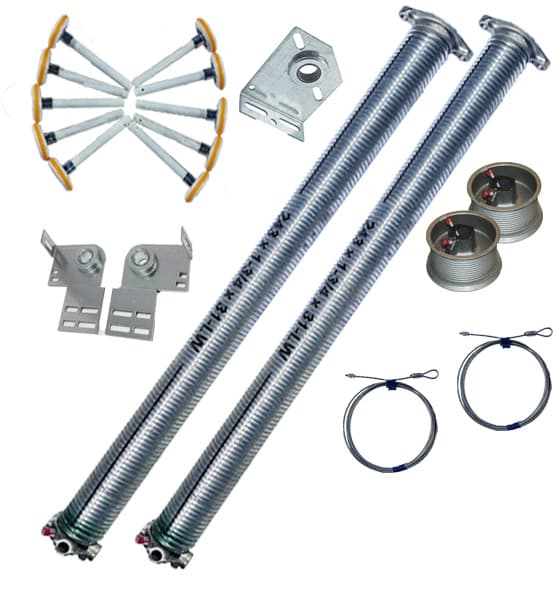
What to check every year
Clopay's annual maintenance list says to Lubricate all moving parts of the door with light household oil,[1] and the list includes Steel rollers.[1] LiftMaster agrees, and puts it on its every-year list: "Oil door rollers, bearings and hinges."[3] Do not grease the doors tracks.[3]
While you are there, look at the rollers. Check roller for broken wheels, bent shafts, or worn out bearings.[1] Tighten screws on loose hinges.[1] Be careful not to over tighten.[1]
LiftMaster also has a monthly test: Manually operate door. If it is unbalanced or binding, call a trained door systems technician.[3] Do that before you blame the rollers.
Signs a roller is due
Replace a roller when you find any of the faults on the annual list. Between checks, these point the same way:
- A wobble or rattle as the door travels
- A roller that does not spin freely or has a flat-spotted or cracked wheel
- Grinding noise, or a door that jerks
- A roller that has slipped out of the track more than once
If rollers pop out, the cause may be the track rather than the roller; see why rollers wobble or pop out of the track.
Doing the replacement
Replace worn rollers in the hinges and top brackets one at a time. The rules are short: Door must be locked and in the down position.[1] Also, No more than one hinge is to be removed from the door at any given time.[1] If you are changing one, it is cheap to change the rest of the hinge rollers on the same visit. The full job is in how to replace garage door rollers.
When you are shopping, take an old roller with you and match the stem length, wheel size and wheel type.
Stop and call a pro if
- The roller is in a bottom corner bracket. The brackets at the bottom corners of your garage door are under great tension.[1]
- The track is bent. Check for bent track. If bent, call an authorized professional dealer.[1]
- The door binds, sticks or will not stay put. If doors bind or stick, they should be serviced by a professional.[2]
- A spring or cable looks worn or loose. Leave it to a technician.
Getting help in Virginia
Browse more garage door repair answers or see garage door repair pros on Loclis. If you would rather not do it, post the roller job and ask each pro for the roller type and the price in writing.
Common questions
- Is there a set lifespan for garage door rollers?
- The manufacturer sheets we checked do not give one. Clopay's instructions and LiftMaster's checklist both work on inspection: look at the rollers every year and replace the ones that are worn or damaged.
- What are the signs a roller needs replacing?
- Broken wheels, bent shafts and worn out bearings, according to Clopay. In daily use that shows up as wobble, grinding, rattling or a door that no longer travels smoothly.
- Should I replace all the rollers at once?
- If the door is old and several are worn, replacing the hinge and top rollers together is sensible, one at a time with the door locked. The bottom corner rollers stay with a pro.
- How often should I oil the rollers?
- LiftMaster's checklist puts oiling door rollers, bearings and hinges in its every-year list. Do not grease the tracks.
- Do I need a pro for roller replacement?
- Not for the hinge and top rollers if you follow the lock-and-one-at-a-time rules. The bottom corner brackets are under great tension, so call a pro for those.
Sources
- [1] Avante Garage Door Installation Instructions, Clopay Building Products. Checked October 28, 2026.
- [2] Non-Reversing Automatic Garage Door Openers Are a Hazard (CPSC publication 523), U.S. Consumer Product Safety Commission. Checked October 28, 2026.
- [3] LiftMaster Residential Maintenance, LiftMaster. Checked October 28, 2026.
Want a pro to handle it?
Describe the job once. Licensed local businesses send quotes, and you pay only when you book one.
Get a quote for Garage Doors