How do I replace garage door rollers?
You can replace the rollers on the hinges and the top bracket yourself, one at a time, with the door closed and locked and the opener disconnected. Do not touch the bottom corner brackets or the roller in them: they are under heavy spring tension. If a bottom roller is the bad one, or the track is bent, call a pro.
Free to ask. Local shops send quotes, and you pay only when you book one.
By Kasra Taheri, Founder, LoclisPublished
Researched and drafted with AI, then checked claim by claim against the sources listed below before it was published. Prices and rules change; the dates beside each source say when it was last checked.
Step by step
Read when to stop and call a pro, further down this page, before you start.
Step 1: Close and lock the door
Close the door fully and lock it in the down position.[1]
Step 2: Disconnect the opener
Unplug the opener, then pull the quick-release cord to detach the door from it.[2]
Step 3: Find the bad rollers
Look at each roller for broken wheels, bent shafts or worn out bearings.[1] Mark the ones to change, skipping any in the bottom corner brackets.
Step 4: Match the new roller
Take an old roller to a garage door supplier and buy the same stem length, wheel size and steel or nylon wheel.
Step 5: Work on one roller at a time
Have a helper hold the panel steady while you work, and never take off more than one hinge at a time.[1]
Step 6: Free the old roller
Slide the old roller out of its hinge or top bracket tube. If the roller will not come out while the hinge is in place, unscrew that one hinge, swap the roller and refit the hinge before touching another.[1] Do not loosen track brackets or anything at the bottom corners.
Step 7: Fit the new roller
Slide the new roller into the same tube, in the hinge tube farthest from the face of the door where there are two.[1]
Step 8: Re-seat it in the track
Guide the wheel back into the track and snug the hinge screws, taking care not to over tighten.[1]
Step 9: Move the door by hand
Raise and lower the door by its handle to check that it travels evenly and does not bind.[2]
Step 10: Oil and reconnect
Put a little light oil on the rollers, not grease on the tracks,[3] wipe off the excess and reconnect the opener.
Which rollers you can change
You can replace the rollers on the hinges and in the top bracket yourself, one at a time, with the door closed and locked. The rollers in the two bottom corner brackets are not part of that job. Those brackets hold the lift cables, and they are under tension.
The brackets at the bottom corners of your garage door are under great tension.[1] Clopay's installation instructions say: "Do not attempt to loosen any bracket fasteners except when and as directed in detail in the following instructions."[1] Otherwise, the bracket could spring out with dangerous force.[1] The same manual adds: Springs, cables, and bottom fixtures are under strong spring tension.[1] Do not attempt to loosen any fasteners on these components.[1]
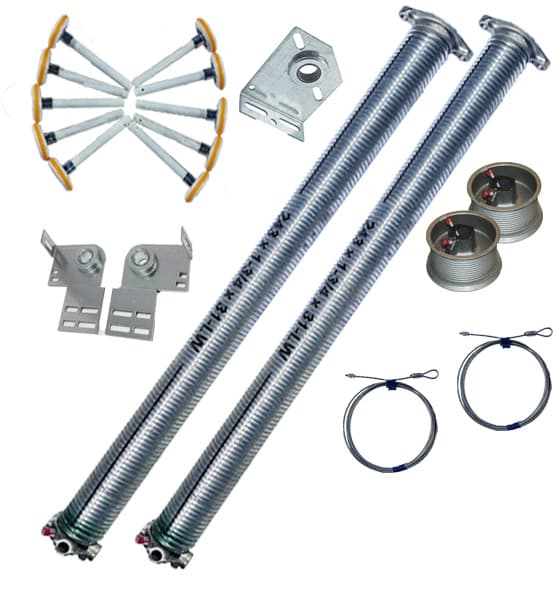
The photo shows what stays untouched: the springs, cable drums and lift cables. The rollers are the small wheels on stems that ride in the track.
Check the rollers first
A manufacturer's annual check is simple: Check roller for broken wheels, bent shafts, or worn out bearings.[1] Spin each one by hand if you can reach it. A good roller turns freely and sits straight in the track. A bad one wobbles, drags, shows a cracked wheel, or has a bent stem.
Clopay's guidance for the job itself is short and worth following to the letter. For replacing a broken roller the manual says: Door must be locked and in the down position.[1] It adds: No more than one hinge is to be removed from the door at any given time.[1] Note that a roller sits in a tube on the hinge, so loosening a hinge to reach it takes the panel connection with it.
Buy the right roller
Take an old roller to a garage door supplier. Match the stem length, the wheel diameter and the wheel type. Steel rollers are standard, and nylon rollers with sealed bearings are usually quieter. The long stem roller is used in bottom bracket.[1] That is another reason to leave the bottom ones alone: the part is different from the rest.
Buy a full set for the middle hinges and the top, not just the broken one. Old rollers wear at about the same rate.
Replace them, one at a time
Close the door, lock it, and disconnect the opener. The CPSC says to pull the “quick release” mechanism to detach the garage door from the opener,[2] and it is sensible to unplug the opener as well. Then follow the steps above: slide one roller out of its tube, put the new one in, and re-seat it in the track before you start on the next.
Where a hinge has two tubes, put the roller in the tube farthest from the face of the door. Clopay's installation steps say: Place the roller in the tube that is farthest from the face of the door.[1] If the roller will not come out with the hinge in place, take off that one hinge, never more.[1] When you refit the hinge, snug the screws. Be careful not to over tighten.[1]
Have a helper steady the panel. A door moved with a loose roller can rack sideways and jump the track.
Test and oil
Move the door up and down by its handle. CPSC puts it this way: "Using the garage door handle, manually move the door up and down to check that the springs are operating properly."[2] It should travel evenly and stay where you leave it.
Then oil the new rollers. Clopay's annual maintenance says to "Lubricate all moving parts of the door with light household oil" and the list includes Steel rollers.[1] LiftMaster says: "Oil door rollers, bearings and hinges."[3] Do not grease the doors tracks.[3] Grease on the track collects dust and can gum up the new rollers. For other noises, see how to make a garage door quieter.
Stop and call a pro if
- The bad roller is in a bottom corner bracket. The bottom brackets are under great tension.[1]
- A spring, cable or bracket is loose, frayed or bent. Springs, cables, and bottom fixtures are under strong spring tension.[1]
- The track is bent or the door has jumped it. Clopay's maintenance list says: "Check for bent track. If bent, call an authorized professional dealer."[1] Read what to do if a garage door comes off its track.
- The door is crooked, hard to move or out of balance. If the garage door and/or any of the supporting track are damaged, operating the door could be hazardous.[1] Call an authorized representative of the manufacturer or professional door repair service promptly.[1] A severely unbalanced garage door could unexpectedly crash to the floor possibly striking someone under the open door.[2] Also, and if doors bind or stick, they should be serviced by a professional.[2]
- The hinges are cracked too. That is a separate job; see replacing a broken hinge.
Getting help in Virginia
If the job is more than rollers, browse garage door repair answers or see garage door repair pros on Loclis. Realigned or damaged tracks are often the next step; what realigning a track involves explains it.
When you would rather have a technician do it, describe the worn rollers and local garage door pros will quote the job. Ask for the roller type and the price in writing.
Common questions
- Can I replace the roller in the bottom corner bracket myself?
- No. Clopay's instructions say the brackets at the bottom corners are under great tension, and that loosening bracket fasteners other than as directed could make the bracket spring out with dangerous force. The bottom roller sits in that bracket, and the lift cable is attached to it, so a worn bottom roller is a job for a door technician.
- How do I know a roller is worn out?
- Clopay's annual check is to look for broken wheels, bent shafts or worn out bearings. In practice, a roller that wobbles in the track, will not spin freely, shows a cracked or flat-spotted wheel, or makes the door grind and rattle is ready to change.
- Should I choose steel or nylon rollers?
- Either fits as long as the stem length and wheel size match your old ones. Nylon rollers with sealed bearings are usually quieter than plain steel ones, and steel rollers are the type Clopay lists for annual oiling. Whatever you choose, buy a full set rather than mixing worn and new.
- Do I replace all the rollers at once?
- It is a sensible idea if the door is old, because worn rollers tend to fail around the same time. Do them one at a time anyway, with the door closed and locked, and leave the bottom corner rollers to a pro.
- What should I lubricate afterward?
- LiftMaster's yearly checklist says to oil door rollers, bearings and hinges, and not to grease the door tracks. Use a light oil and wipe off what drips.
Sources
- [1] Avante Garage Door Installation Instructions, Clopay Building Products. Checked October 27, 2026.
- [2] Non-Reversing Automatic Garage Door Openers Are a Hazard (CPSC publication 523), U.S. Consumer Product Safety Commission. Checked October 27, 2026.
- [3] LiftMaster Residential Maintenance, LiftMaster. Checked October 27, 2026.
Want a pro to handle it?
Describe the job once. Licensed local businesses send quotes, and you pay only when you book one.
Get a quote for Garage Doors