How often should I mow my lawn in Virginia?
Mow whenever the grass has grown about half again its cutting height, so you never take off more than a third of the blade. For most Virginia lawns that means every five to six days in the spring and fall growth flush, about weekly through much of the season, and every 10 days or more when heat, drought or cold slow the grass down.
Free to ask. Local shops send quotes, and you pay only when you book one.
By Kasra Taheri, Founder, LoclisPublished
Researched and drafted with AI, then checked claim by claim against the sources listed below before it was published. Prices and rules change; the dates beside each source say when it was last checked.
Step by step
Read when to stop and call a pro, further down this page, before you start.
Step 1: Know your grass type
Cool-season grasses such as tall fescue grow fastest in spring and fall; warm-season grasses such as bermudagrass grow from mid-spring through mid-fall.[3]
Step 2: Pick a cutting height
For tall fescue, set the mower at 3 to 4 inches and keep it there.[2]
Step 3: Work out your mow-by height
Multiply your cutting height by 1.5; a 3-inch lawn is due for mowing at about 4.5 inches.
Step 4: Check the lawn twice a week
Stand a ruler in the grass in a few spots during spring and fall, when growth changes fast.
Step 5: Mow before it passes the mark
Never take off more than one-third of the leaf blade at one mowing.[4]
Step 6: Shift with the weather
Expect every five to six days during active growth and every 10 days or less when growth slows.[1]
Step 7: Skip wet days
Wait for the grass to dry; wet grass clings to the mower and clumps on the lawn.[1]
Step 8: Stop in a drought
Keep mowers and other traffic off the lawn during extreme drought.[5]
Step 9: Catch up gradually
If the lawn got ahead of you, bring it down over two or three mowings a few days apart.
Step 10: Keep the blade sharp
Sharpen the blade during the season so frequent mowing cuts cleanly instead of tearing the tips.[1]
Step 11: Fertilize at the right time
Feed cool-season lawns in fall rather than with heavy spring nitrogen, which drives extra growth and extra mowing.[2]
Mow by the grass, not by the calendar. Virginia Tech's guideline is to mow often enough that no more than one-third of the leaf height comes off at any one mowing.[1] For a typical Virginia lawn, that works out to about every five to six days in active growth and every 10 days or less once growth slows.[1] For many lawns that settles into roughly weekly mowing, with extra cuts in the spring and fall flush and fewer in a summer drought.

The one-third rule in practice
The rule is simple: never remove more than one-third of the leaf blade at any one mowing.[4] Turn it into a number by multiplying your cutting height by one and a half. A lawn kept at 3 inches is due at about 4.5 inches; a lawn kept at 4 inches is due at about 6. For tall fescue, Henrico County's Extension office says to set the mower at 3 to 4 inches for fescue lawns,[2] so most fescue lawns come due somewhere between 4.5 and 6 inches. Our guide to mowing height for fescue covers the height side.
A ruler stuck in the lawn twice a week in spring tells you more than any schedule. Once you see how fast your grass grows in a given month, you can set your mowing day around it.
How often through the Virginia year
Cool-season lawns (tall fescue, Kentucky bluegrass, perennial ryegrass, fine fescues) are most of Virginia's lawns. Cool-season grasses thrive when daytime highs are consistently in the 60 to 75°F range,[3] which is why in Virginia cool-season lawns do their best growing in spring and fall, while warm-season lawns grow from mid-spring through mid-fall.[3] In practice:
- Spring: growth takes off as the weather warms. Expect every five to six days at the peak, because tall fescue has a high mowing requirement during active growing periods.[3]
- Summer: hot, dry weather slows fescue down. Weekly or longer is usually enough, and in a real drought the advice is to keep mowers and other traffic off the lawn during extreme drought.[5]
- Fall: cooler nights and rain bring a second growth spurt. Mowing often goes back toward every five to six days, and the mower can chop fallen leaves at the same time.
- Winter: cool-season grass grows slowly; an occasional cut on a mild spell may be all it needs.
Warm-season lawns (bermudagrass, zoysiagrass, centipedegrass, St. Augustinegrass) follow the heat. Warm-season grasses are adapted to consistent temperatures in the 80 to 95°F range,[3] so they need the most mowing in midsummer. Repeated frosts eventually put warm-season grasses into winter dormancy, with a loss of green color, for 4 to 5 months from late fall to early spring,[3] and mowing stops.
How much care you want sets the pace
Frequency also depends on the lawn you are aiming for. Henrico County's SMART Lawns program describes mowing twice a week for a high-maintenance lawn, weekly for regular maintenance, and every 10 to 14 days for a reduced-maintenance lawn,[2] with the higher-maintenance lawns also getting more water and fertilizer. That trade-off is worth knowing, because your own habits drive how fast the grass grows. In Virginia Tech's words, "Overwatered lawns frequently lead to excess blade growth, summer fungal diseases, and more frequent mowing."[5] Henrico's guidance adds that fertilizing cool-season grasses in the fall builds roots without stimulating excessive growth,[2] which also means fewer spring mowings.
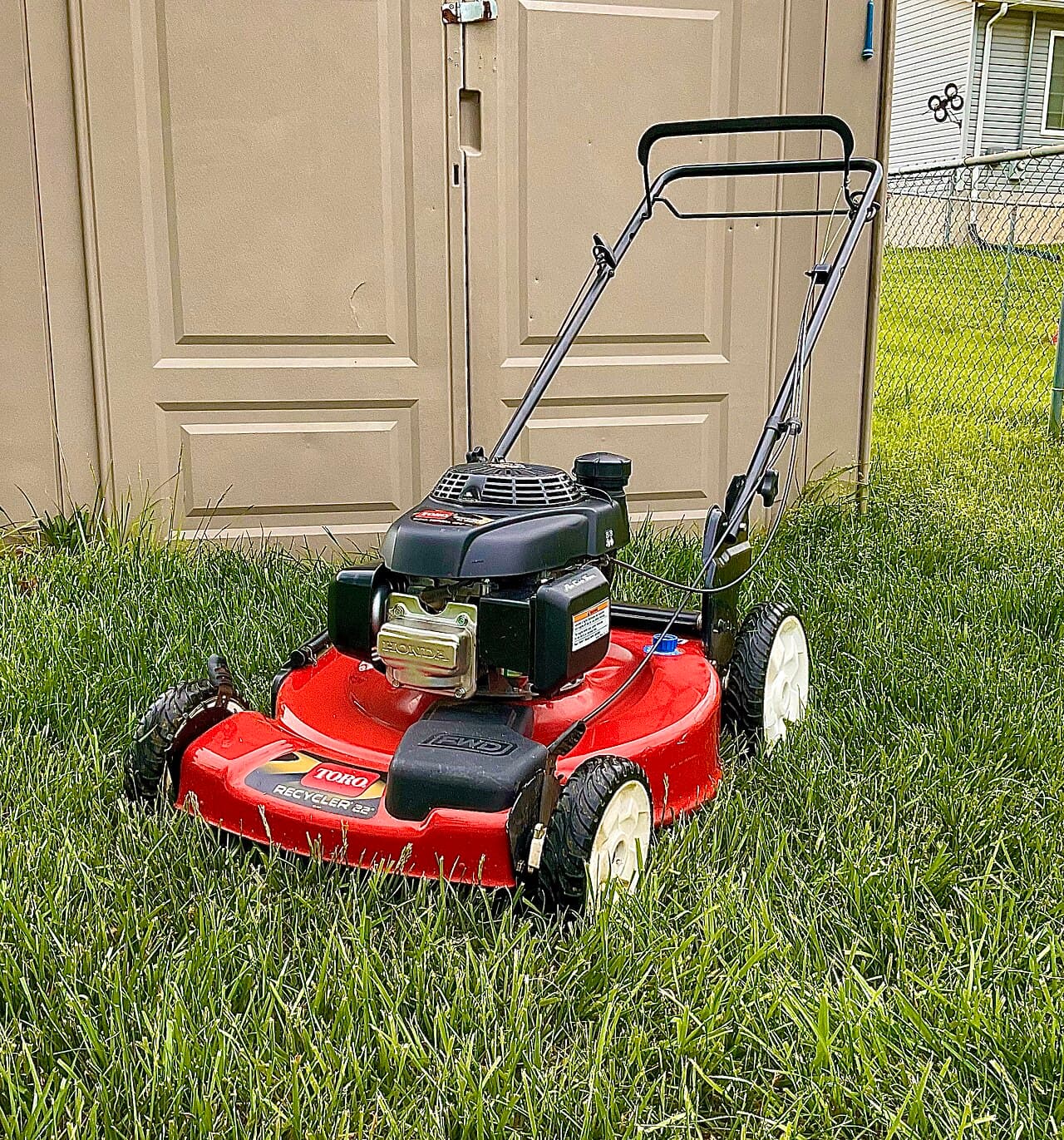
Habits that make frequent mowing easier
- Mow dry grass. Wet grass sticks to the mower and falls in clumps on the lawn,[1] so a rainy week can push mowing back a day or two. That is fine as long as you do not let the grass run far past the one-third mark.
- Catch up in stages. After a vacation or a wet spell, raise the deck, take off a third, and come back a few days later for the next cut.
- Mow new grass early. For a new tall fescue lawn kept at 2 inches, Virginia Tech's example is to "begin mowing as soon as your new lawn reaches a 3-inch height."[4]
- Keep the blade sharp. More mowings mean more wear; a sharp blade cuts cleanly where a dull one tears. If the lawn browns after mowing, see why a lawn turns brown after mowing.
If you fall behind
Letting the grass go is not only a lawn problem. Under Virginia law, localities may require owners to cut grass and weeds, and after reasonable notice may have it cut by their own agents and charge the cost to the owner.[7] Fairfax County, for example, runs a seasonal grass compliance program from April through October,[6] and there, residential lots under one-half acre must keep grass under 12 inches.[6] Rules differ by county, city and town, so check your own locality's code if you will be away for a stretch of the growing season.
Stop and call a pro if
- You cannot keep up with spring growth, or you will be away for weeks in the growing season.
- Parts of the lawn are too steep, wet or rough to mow safely with your equipment.
- The lawn browns or thins in patches even though you are mowing on schedule at the right height.
- Your locality has sent a tall-grass notice and you cannot cut it in time.
For more, see what lawn mowing costs in Virginia and what to look for in a mowing service, browse the lawn and landscaping answers, or look up lawn and landscaping businesses around Blacksburg. To have the lawn mowed on schedule, describe the job once and local businesses quote it.
Common questions
- Is mowing every two weeks enough?
- In slow-growth periods, often yes. In the spring and fall flush, a tall fescue lawn usually grows past the one-third mark well before two weeks, so a two-week schedule means cutting off too much at once. Henrico County's Extension office pairs every 10 to 14 days with a reduced-maintenance lawn.
- When should I start mowing in spring?
- Start when the grass has grown to about one and a half times your cutting height, not on a fixed date. Cool-season lawns such as tall fescue green up and grow early in spring; warm-season lawns such as bermudagrass wait until they have greened up from winter dormancy.
- When can I stop mowing for the year?
- Keep mowing as long as the grass keeps growing past the one-third mark. Cool-season lawns often keep growing into late fall, so the last mowings tend to come with leaf season. Warm-season lawns stop once frost sends them dormant.
- How soon should I mow new grass?
- Mow a new seeded lawn once it reaches about one and a half times its intended height. Virginia Tech's example for a new tall fescue lawn kept at 2 inches is to begin mowing when it reaches 3 inches, with a sharp blade and firm soil.
- Can I get fined for not mowing in Virginia?
- It depends on your locality. State law lets localities require grass to be cut and to cut it and bill the owner after notice. Fairfax County, for example, requires grass under 12 inches on residential lots under half an acre and charges the owner when its contractor has to cut. Check your county, city or town code.
Sources
- [1] Mowing To Recycle Grass Clippings: Let the Clips Fall Where They May (430-402), Virginia Cooperative Extension, Virginia Tech. Checked October 26, 2026.
- [2] SMART Lawns (revised March 2022), Virginia Cooperative Extension, Henrico County Office. Checked October 26, 2026.
- [3] Selecting Turfgrass for Virginia (SPES-748), Virginia Cooperative Extension, Virginia Tech. Checked October 26, 2026.
- [4] Fall Lawn Care (430-520), Virginia Cooperative Extension, Virginia Tech. Checked October 26, 2026.
- [5] Summer Lawn Management: Watering the Lawn (430-010), Virginia Cooperative Extension, Virginia Tech. Checked October 26, 2026.
- [6] Grass Height, Fairfax County Department of Code Compliance. Checked October 26, 2026.
- [7] Va. Code § 15.2-901, Locality may provide for removal or disposal of trash and clutter, cutting of grass, weeds, and running bamboo, Code of Virginia, Virginia General Assembly. Checked October 26, 2026.
Want a pro to handle it?
Describe the job once. Licensed local businesses send quotes, and you pay only when you book one.
Get a quote from a local pro