What height should I mow fescue in Virginia?
Keep tall fescue at about 3 to 4 inches for most of the season, and no lower than 2.5 to 3 inches going into summer heat. Cut off no more than one-third of the blade at a time, so a lawn kept at 3 inches gets mowed when it reaches about 4.5 inches, with a sharp blade and dry grass.
Free to ask. Local shops send quotes, and you pay only when you book one.
By Kasra Taheri, Founder, LoclisPublished
Researched and drafted with AI, then checked claim by claim against the sources listed below before it was published. Prices and rules change; the dates beside each source say when it was last checked.
Step by step
Read when to stop and call a pro, further down this page, before you start.
Step 1: Confirm it is tall fescue
Tall fescue is managed as a bunch-type grass rather than a creeping one, and it is one of the best-adapted lawn grasses across Virginia.[5]
Step 2: Pick your target height
Aim for 3 to 4 inches for most of the season, the range Henrico County's Extension office uses for fescue lawns.[1]
Step 3: Set the deck on pavement
With the engine off, park the mower on a flat driveway and set every wheel to the same notch on the height lever.
Step 4: Measure the real cut
Mow a strip, then stand a ruler in the cut grass on level ground; adjust a notch up or down if the lawn is not at your target.
Step 5: Mow by the one-third rule
Never remove more than one-third of the leaf blade in one mowing, so a 3-inch lawn is mowed by the time it reaches about 4.5 inches.[4]
Step 6: Keep the blade sharp
A dull blade rips and tears grass instead of cutting it, leaving tan, ragged tips and weaker plants.[3]
Step 7: Mow only dry grass
Wet grass clings to the mower and drops in clumps on the lawn, so wait until the dew or rain has dried off.[3]
Step 8: Leave the clippings
Let short clippings fall back into the lawn; they decompose quickly and return nutrients.[1]
Step 9: Raise the deck before summer
Move cool-season lawns to the taller side of the range before summer stress arrives, never below 2.5 to 3 inches.[2]
Step 10: Stay off in a drought
Keep mowers and other traffic off the lawn during extreme drought, when the grass has stopped growing anyway.[2]
Step 11: Bring tall grass down slowly
If the lawn got away from you, lower it over two or three mowings a few days apart instead of scalping it in one pass.
Mow tall fescue at about 3 to 4 inches. That is tall enough to shade out weeds, keep roots deep and carry the lawn through a Virginia summer, and short enough to look tidy. Going into summer, do not let the setting drop below 2.5 to 3 inches, and whatever height you choose, never take off more than a third of the blade at once.

The right height for tall fescue
Tall fescue is the backbone of many Virginia lawns: it is one of the best-adapted lawn grasses across the state, and it has the deepest root system of the cool-season lawn grasses grown here.[5] Those deep roots are the reason height matters. The leaf you leave on top feeds and shades the roots underneath.
Henrico County's Extension office tells homeowners to set the mower blade height at 3 to 4 inches for fescue lawns.[1] Its guidance also notes that grass mowed too short is more prone to disease,[1] and that keeping tall fescue between 3 and 4 inches helps it withstand stress and recover more quickly from disease pressure.[1]
You will see lower numbers in some Virginia Tech publications. The statewide grasscycling guide lists 2 to 3 inches for tall fescue,[3] and the fall lawn care guide uses a typical tall fescue height of 2 inches during an optimal growing period[4] as its example for a new lawn. Those figures are for grass in its optimal growing period. For a home lawn that has to get through July and August without much irrigation, the taller end is the safer choice.
Why taller matters most in summer
Summer is when fescue struggles. Virginia Tech's drought guidance sets a minimum of 2.5 to 3 inches for tall fescue, Kentucky bluegrass, perennial ryegrass and fine fescues,[2] and says to raise the cutting height on cool-season lawns ahead of summer stress.[2] Mowing on the taller side of the recommended range deepens the root system, shades the soil so less water evaporates, and improves drought tolerance.[2]
In practice, that means raising the deck a notch in late spring, before the first hot, dry spell, rather than waiting until the lawn is already browning. When a real drought sets in, the guidance is to keep mowers and other traffic off the lawn during extreme drought.[2] Dormant grass is not growing, so there is nothing to cut, and the wheels and blade only add stress.
The one-third rule sets your mowing day
Height and frequency work together. The rule Virginia Tech uses is to never remove more than one-third of the leaf blade at any one mowing.[4] Taking off more than that stresses the grass and often leaves a brown, stemmy look for a few days. Here is what it means at common fescue heights:
| Cutting height | Mow before the grass reaches |
|---|---|
| 2.5 inches | about 3.75 inches |
| 3 inches | about 4.5 inches |
| 3.5 inches | about 5.25 inches |
| 4 inches | about 6 inches |
In the spring and fall flush, that can mean mowing every five to six days during the active growing season.[3] In midsummer heat fescue slows down, and you may go much longer between cuts. Our guide to how often to mow a lawn in Virginia has a season-by-season schedule.
Getting the cut right
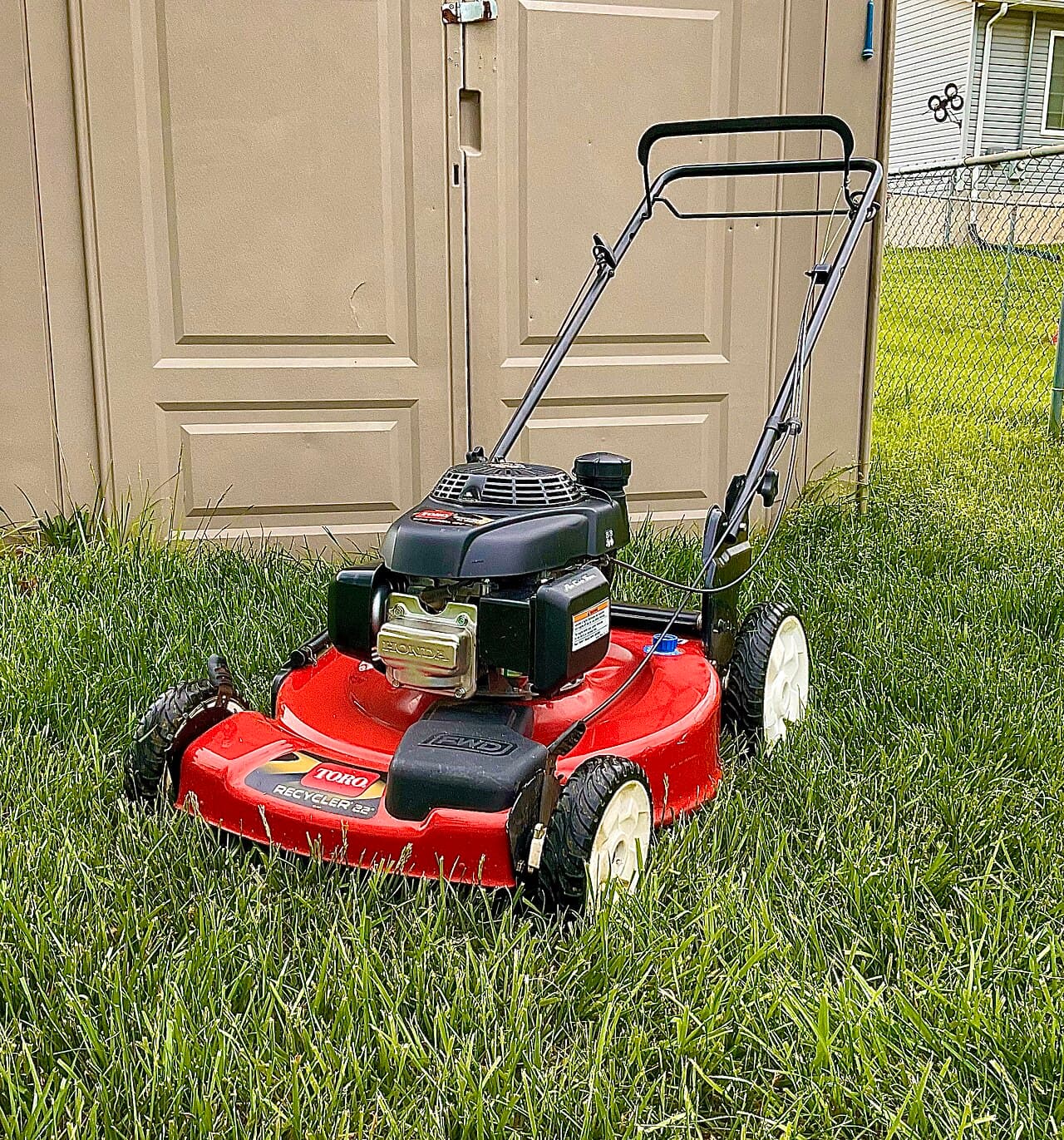
The number on the height lever is only a starting point. Mower decks are marked in notches or arbitrary numbers, and wheels sink into soft soil, so measure the cut grass with a ruler after the first pass and adjust from there.
Blade condition matters as much as height. Dull blades rip and tear the grass, which promotes disease, leaves the shredded tips tan and ragged, and weakens the plants.[3] If the lawn looks frosted or whitish a day after mowing, look closely at the tips; torn, frayed ends mean the blade needs sharpening.
Mow when the grass is dry. Wet grass sticks to the mower and falls in clumps on the lawn,[3] and those clumps can smother the grass underneath. When the cut is right, leave the clippings where they fall. Clippings decompose quickly, return nutrients to the lawn and do not contribute to thatch.[1]
Fescue mixed with other grasses
Many Virginia lawns are not pure fescue. Virginia sod producers have long planted a crop that is 90 percent turf-type tall fescue and 10 percent Kentucky bluegrass by weight,[5] and seed mixtures come in 95:5, 90:10 and 85:15 ratios by weight.[5] Bluegrass on its own can be cut shorter, at 1.5 to 2.5 inches for Kentucky bluegrass[3] in the same grasscycling guide, but in a mix, mow to suit the fescue. If your lawn loses its green color for 4 to 5 months from late fall to early spring[5] and thrives in August heat, it is probably a warm-season grass such as bermudagrass or zoysiagrass, which has its own height range and schedule.
Stop and call a pro if
- The lawn has slopes too steep to mow across comfortably, or banks where the mower slides or tips.
- Brown, circular patches keep spreading in hot, humid weather even at the right height. That points to a disease such as brown patch; see why a lawn turns brown after mowing for the other causes to rule out first.
- Large areas are thin or bare and need reseeding or renovation in the fall.
- The mower will not hold an even height, vibrates, or the blade is bent. A shop that does lawn mower repair can check the deck and blade.
For more on lawn care, browse the lawn and landscaping answers, see lawn mowing services, or look up lawn and landscaping businesses around Blacksburg. If you would rather hand the mowing off, describe the job once and local businesses quote it.
Common questions
- Is 2 inches too short for fescue?
- For an established home lawn in Virginia, usually yes, at least from late spring on. Extension guidance sets a minimum of 2.5 to 3 inches for tall fescue to hold up in summer, and grass cut too short is more susceptible to disease. Virginia Tech's fall lawn care guide uses 2 inches as its example for a tall fescue lawn in an optimal growing period, not as a summer height.
- Should I mow fescue shorter in the fall?
- There is no need to scalp it. Keep mowing at your usual height and keep following the one-third rule while the grass is growing in fall. A taller canopy does no harm if you plan to overseed.
- How do I know what my mower's height settings mean?
- Many mowers label the lever with numbers or notches rather than inches. Set it, mow a strip, and measure the cut grass with a ruler on level ground. Write down which notch gives you 3 to 4 inches so you can go straight to it next time.
- My lawn is fescue mixed with bluegrass. What height do I use?
- Mow it as tall fescue. Fescue and Kentucky bluegrass mixtures are common in Virginia, and both grasses share the same 2.5 to 3 inch summer minimum in Extension's drought guidance, so a 3 to 4 inch setting suits the mix.
- Does mowing high mean mowing more often?
- Not really. How often you mow depends on how fast the grass grows and the one-third rule, not the height itself. A taller lawn simply has more blade to work with, so each mowing removes a smaller share of the plant.
Sources
- [1] SMART Lawns (revised March 2022), Virginia Cooperative Extension, Henrico County Office. Checked October 26, 2026.
- [2] Summer Lawn Management: Watering the Lawn (430-010), Virginia Cooperative Extension, Virginia Tech. Checked October 26, 2026.
- [3] Mowing To Recycle Grass Clippings: Let the Clips Fall Where They May (430-402), Virginia Cooperative Extension, Virginia Tech. Checked October 26, 2026.
- [4] Fall Lawn Care (430-520), Virginia Cooperative Extension, Virginia Tech. Checked October 26, 2026.
- [5] Selecting Turfgrass for Virginia (SPES-748), Virginia Cooperative Extension, Virginia Tech. Checked October 26, 2026.
Want a pro to handle it?
Describe the job once. Licensed local businesses send quotes, and you pay only when you book one.
Get a quote from a local pro