How often should I replace the battery in a garage door remote?
There is no set schedule: replace it when the remote's range shrinks or it needs several presses, and not before. A coin cell loses very little just sitting, so the wear comes from use. Keep a fresh spare, and recycle the old cell instead of binning it.
Free to ask. Local shops send quotes, and you pay only when you book one.
By Kasra Taheri, Founder, LoclisPublished
Researched and drafted with AI, then checked claim by claim against the sources listed below before it was published. Prices and rules change; the dates beside each source say when it was last checked.
Step by step
Read when to stop and call a pro, further down this page, before you start.
Step 1: Read the old battery
Open the remote and read the type printed on the cell. Chamberlain's visor remote uses a 3V coin-cell lithium CR2032 battery.[1]
Step 2: Note the direction
Check which side faces up before you take the old cell out, so the new one goes in the same way.
Step 3: Fit the new cell
Slide in a fresh cell of the same type and close the case until it clicks.
Step 4: Test from the driveway
Press the remote from the distance where it used to fail. It should work at the old range.
Step 5: Tape and recycle the old cell
Put non-conductive tape over the old battery's terminals and take it to a battery recycler or a household hazardous waste collection.[3]
Step 6: Keep a spare and keep it away from children
Store the spare cell where young children cannot reach it.[3]
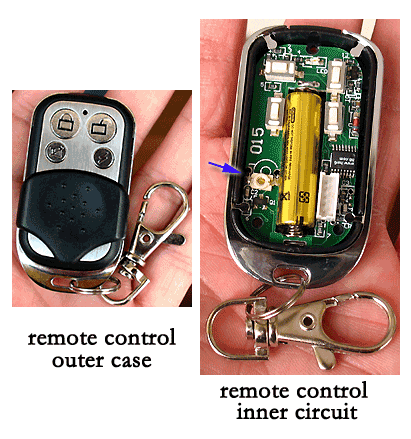
Replace the battery in a garage door remote when it starts to fail, not on a calendar: when the range shrinks, or when it takes two or three presses to move the door. No maker publishes one interval that fits every remote, because the drain depends on how often you press the button and on the remote.
Why a schedule does not fit
A coin cell loses very little just sitting. Energizer's datasheet for the CR2032, a common remote battery, lists its self discharge as "~1% / year".[2] So a remote that stays in the car does not flatten itself in a few months; the battery wears out through use, and a household that presses it four times a day wears it out sooner than one that presses it twice.
Signs the battery is going
- Range shrinks. The remote works at the door but not from the street.
- It takes several presses. The door moves on the second or third try.
- The light on the remote is dim or does not come on.
- A car's built-in buttons still work. Those draw power from the car, so a hand remote that fails while the car's buttons work points to the cell.
If you see any of these, fit a new battery before you try anything else. HomeLink, the system in many cars, says: "We recommend getting a new battery for your garage door remote for more accurate programming."[4]
Choosing and fitting the new cell
Read the type printed on the old one. Chamberlain's visor remote uses a 3V coin-cell lithium CR2032 battery,[1] but other remotes use different cells, so do not assume. Open the case with a coin or small screwdriver, note which side faces up, drop the new cell in the same way, and close the case.
Test it from where the old one used to fail. If it works, you are done, and the remote should still be paired. If it does nothing, work through why a garage door remote stops working, and for a car that needs training see programming your car's built-in garage door opener.
Handling the old and spare cells safely
Coin cells are a swallowing hazard. The EPA lists car keyless entry remotes among the products that use them, and says to store them out of the reach of young children.[3] Energizer's datasheet is blunter: "KEEP OUT OF REACH OF CHILDREN", and swallowing may lead to serious injury or death in as little as 2 hours due to chemical burns.[2] If a child may have swallowed one, see a doctor at once; the datasheet gives (800) 498-8666 for the doctor to call.[2]
The old cell is not household trash either. The EPA's advice is: "Do not put button-cell, coin, or lithium single use batteries in the trash or municipal recycling bins."[3] Cover the terminals with non-conductive tape (e.g., electrical tape) first,[3] then take it to a recycler, a retailer with battery take-back or your locality's household hazardous waste program. Ask your county or city solid waste office where that is.
Stop and call a pro if
- A fresh battery and re-pairing change nothing. The remote, or the opener's receiver, may have failed. See what a replacement costs in Virginia.
- The remote's case is swollen, wet or corroded. Replace the remote rather than the cell.
- The wall button does not work either. That is the opener or its power, not the battery.
- The door sticks, drops or looks crooked. Leave the springs and cables to a technician and stop using the opener.
- A child may have swallowed a battery. Call a doctor immediately.
Getting help in Virginia
If the remote cannot be fixed, Loclis lists licensed garage door businesses. Browse garage door repair, read more garage door answers, or describe the problem once and local companies can quote it.
Common questions
- What battery does a garage door remote use?
- It depends on the remote, so read the type printed on the old cell. Chamberlain's visor remote uses a 3V coin-cell lithium CR2032 battery.
- Does a remote battery run down if I never use the remote?
- Very slowly. Energizer's datasheet for the CR2032 lists a self discharge of about 1% a year, so a spare cell on a shelf holds its charge far better than one that is pressed daily.
- Do I need to reprogram the remote after changing the battery?
- Usually not, because swapping a battery does not normally change the pairing. If it does nothing after a fresh cell, see why a garage door remote stops working.
- Can I throw the old battery in the trash?
- No. The EPA says not to put button-cell, coin or lithium single use batteries in the trash or municipal recycling bins. Tape the terminals and take it to a recycler or a household hazardous waste collection.
- What if a child swallows the battery?
- Treat it as an emergency and get medical help at once. Energizer's datasheet warns that swallowing may lead to serious injury or death in as little as 2 hours, and gives (800) 498-8666 for the doctor to call.
Sources
- [1] 3-Button Visor Garage Door Remote (G953EV-P2), product page, The Chamberlain Group. Checked October 27, 2026.
- [2] ENERGIZER CR2032 Lithium Coin product datasheet (Form 2032NA0618), Energizer. Checked October 27, 2026.
- [3] Used Household Batteries, U.S. Environmental Protection Agency. Checked October 27, 2026.
- [4] Generic HomeLink Training Instructions, HomeLink (Gentex Corporation). Checked October 27, 2026.
Want a pro to handle it?
Describe the job once. Licensed local businesses send quotes, and you pay only when you book one.
Get a quote for Garage Doors