How do I keep weeds out of my garden beds?
Stop weeds before they start: keep 2 to 3 inches of organic mulch on the soil, plant closely enough that the leaves shade the ground, and pull or hoe weeds while they are small, a day or two after rain. Guard the edges against creeping grasses, and use an herbicide only as its label allows, because drift and residues damage garden plants.
Free to ask. Local shops send quotes, and you pay only when you book one.
By Kasra Taheri, Founder, LoclisPublished
Researched and drafted with AI, then checked claim by claim against the sources listed below before it was published. Prices and rules change; the dates beside each source say when it was last checked.
Step by step
Read when to stop and call a pro, further down this page, before you start.
Step 1: Clear the bed first
Pull or dig out the weeds already growing, roots and all, before you spread mulch; mulch does little against runners already in the soil.
Step 2: Mulch 2 to 3 inches deep
Spread pine needles, bark, shredded leaves or straw 2 to 3 inches deep over the bare soil.[2]
Step 3: Keep mulch off stems
Pull mulch back from shrub stems and trunks instead of piling it against them.[2]
Step 4: Vet your mulch
Use straw, hay, manure or grass clippings only from a supplier who knows the herbicide history.[6]
Step 5: Plant closely
Space plants so their leaves touch at maturity and shade out weed seedlings.[1]
Step 6: Weed after rain
Pull or hoe a day or two after rain or watering, when the soil is moist but not wet.[1]
Step 7: Get them young
Remove weeds while they are small, before they flower and set seed.[1]
Step 8: Bag runners and seed heads
Take grasses that spread by runners, and weeds going to seed, out of the bed instead of leaving them to dry.[1]
Step 9: Hold the edge
Keep a clean edge along the lawn, and mow any grass in the paths between beds before mature seeds fall into them.[3]
Step 10: Top up the mulch
Add mulch as the old layer breaks down, keeping the total near 2 to 3 inches rather than piling it deeper.[2]
The surest way to keep weeds out of a bed is to give them no bare soil, no light and no time. Keep a layer of organic mulch on the ground, fill the bed with plants that shade it, and pull what gets through while it is still small. Herbicides are a last resort in beds full of plants you want to keep.
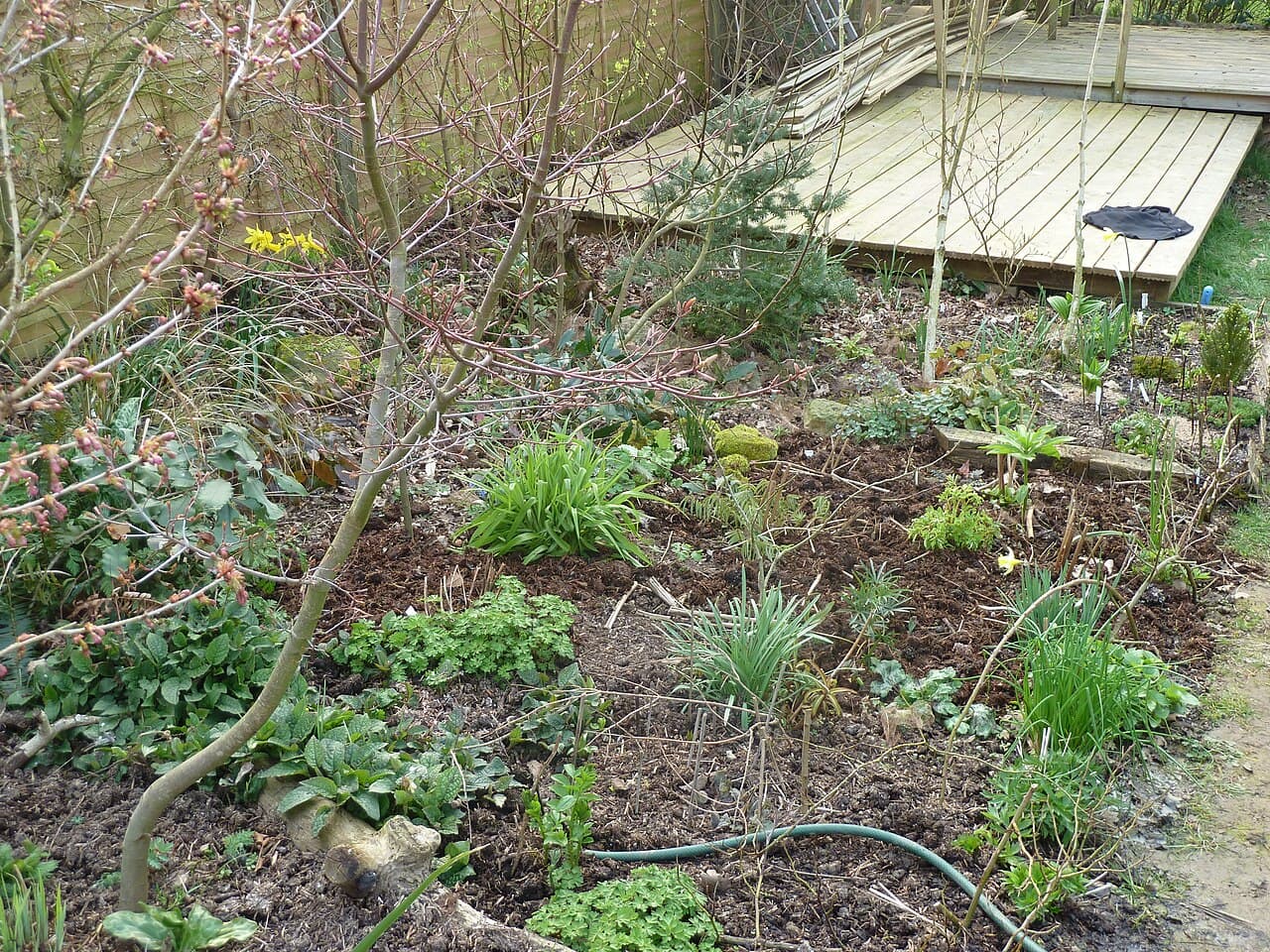
Mulch is the main defense
Mulch 2 to 3 inches deep slows water loss from the soil and reduces weed growth, in Virginia Cooperative Extension's words, and it suggests pine needles, straw, bark chips, or slightly decomposed or shredded leaves.[2] Do not overdo it: overly deep mulch, or mulch piled up against a trunk, promotes shallow roots, disease and pest injury.[2] A volcano of mulch heaped around a shrub's base is the thing to avoid.
Thick layers of organic mulch keep most annual weeds from poking through, and the few that do are easily pulled.[1] Weeds with runners are harder to smother, and black plastic may be a better choice where they dominate.[1]
Be careful where the mulch comes from. Virginia Tech warns that growth regulator herbicide residues can turn up in straw, hay, manure, grass clippings and compost and injure broadleaf plants,[6] and its advice is plain: do not use clippings from lawns treated within the past six weeks with 2,4-D, dichlorprop, dicamba, MCPP or triclopyr in ornamental beds or vegetable gardens.[6]
Pull them young
Mature weeds pull large quantities of water and nutrients from the soil, so removing them young pays off.[1] Hand-pulling is enough for small gardens and raised beds,[1] and a sharp hoe or hand weeder speeds it up in open soil. A few minutes a week beats an afternoon a month.
Timing makes the job easier. Extension's best time to weed is a day or two after a rain or watering.[1] Working wet soil damages its structure, especially heavy clay,[1] and in dry soil weeds are hard to pull and hoe.
What you do with pulled weeds matters too. Extension says weeds that have started to go to seed, and grasses that spread by rhizomes or stolons, should not be left in the garden after pulling.[1] Composting may not kill weeds or their seeds if the pile does not heat up enough,[1] and a separate Extension publication says a pile has to reach 140°F for 3 to 5 consecutive days to kill weed seeds.[5] If yours does not, bag them.
Shade the soil
Bare gaps between plants are invitations. When plants are spaced so their leaves meet, close spacing forms a nearly solid leaf canopy that acts as a living mulch and keeps weed problems down.[4] In a new bed, fill gaps with annuals or a groundcover until the permanent plants grow together.
Guard the edges
Many weeds in an established bed creep in from the side. Around a raised bed, perennial weeds such as bermudagrass can establish themselves under the frame and keep invading.[3] Keep a cut edge between lawn and bed, and mow any grass growing in the paths between beds before mature seeds fall into them.[3] For lawn grass spreading where it should not, see why lawn edges keep growing into sidewalk cracks.
Paths need the same attention. Newspaper covered with wood chips or hardwood mulch makes excellent weed suppression on paths,[1] and it breaks down over time instead of leaving a sheet to pull out later.
About landscape fabric
Fabric sounds like a permanent fix, but it is not. Woven polypropylene ground cover lasts 3 to 7 years or longer, depending on its grade and how much sun it gets.[3] The bigger problem is what goes on top: mulch spread on top of weed fabric decomposes into soil, weeds eventually grow on top of the fabric, and the fabric becomes hard to remove.[3] In planted ornamental beds, plain mulch topped up each year usually works better.
If you use an herbicide
In Virginia, it is against the law to use a pesticide, natural or synthetic, in any way that does not comply with its label,[5] so read the label before you buy and check that it covers the plants in your bed. Extension also warns that drift from herbicide sprays on the lawn or surrounding areas can damage garden plants,[1] so spray only on still days.
Extension notes that drift or runoff from pre-emergence herbicides does not damage growing plants but may prevent seeds from germinating,[1] which matters if you sow flowers or vegetables. For vegetable beds, Extension says no herbicides are recommended for killing emerged weeds in an established home vegetable garden that will not also damage or kill the vegetables.[1] It also advises you to keep a separate sprayer for herbicides and never use it for insect or disease control.[1]
If you pay someone to spray, anyone who uses pesticides on someone else's property in exchange for compensation must work for a company with a Pesticide Business License.[7]
Stop and call a pro if
- A perennial weed such as bermudagrass, bindweed or nutsedge has spread through the whole bed and keeps coming back after pulling.
- You want a herbicide program and are not sure which products are labeled for your plants.
- Poison ivy or a thorny vine has taken over the bed.
- The bed is overgrown enough that renovating it means removing plants and starting over.
For a new bed built to stay cleaner, see how to build a raised garden bed. Browse the lawn and landscaping answers, see mulch and bed maintenance services, or look up lawn and landscaping businesses around Blacksburg. To have a bed cleaned up and mulched, describe the job once and local businesses quote it.
Common questions
- How thick should mulch be to stop weeds?
- About 2 to 3 inches of organic mulch such as shredded bark, pine needles or shredded leaves. Thick layers keep most annual weeds from coming up, but piling it deeper or against stems invites shallow roots, disease and pests.
- Does landscape fabric work under mulch?
- Not for long. Woven fabric lasts a few years on its own, but mulch spread over it breaks down into soil and weeds root on top of the fabric, which then becomes hard to remove.
- Can I use grass clippings as mulch in my beds?
- Only from a lawn that has not been treated with broadleaf weed killers. Virginia Tech advises against using clippings from lawns treated within the past six weeks with 2,4-D, dichlorprop, dicamba, MCPP or triclopyr, since residues can injure garden plants.
- Should I put pulled weeds in the compost?
- Young weeds without seeds are fine. Weeds going to seed and creeping grasses are not, unless your pile gets hot: Virginia Tech says a pile must reach 140°F for 3 to 5 consecutive days to kill weed seeds. Otherwise put them in the trash.
- Is it safe to spray weed killer in a flower bed?
- Only with a product whose label lists that use, applied exactly as the label says, which Virginia law requires. Spray on a still day, shield nearby plants and keep a separate sprayer for herbicides. In a vegetable bed, hand weeding is the safer choice.
Sources
- [1] Weeds in the Home Vegetable Garden (426-364), Virginia Cooperative Extension, Virginia Tech. Checked October 26, 2026.
- [2] Shrubs: Functions, Planting, and Maintenance (426-701), Virginia Cooperative Extension, Virginia Tech. Checked October 26, 2026.
- [3] Comparison of Raised Bed Methods, Materials, and Costs (SPES-425), Virginia Cooperative Extension, Roanoke County Office and Virginia Tech. Checked October 26, 2026.
- [4] Intensive Gardening Methods (426-335), Virginia Cooperative Extension, Virginia Tech. Checked October 26, 2026.
- [5] Minimum Chemical Gardening (426-366), Virginia Cooperative Extension, Virginia Tech. Checked October 26, 2026.
- [6] Plant Injury From Herbicide Residue (PPWS-77), Virginia Cooperative Extension, Virginia Tech. Checked October 26, 2026.
- [7] Becoming a Certified Pesticide Applicator, Virginia Department of Agriculture and Consumer Services. Checked October 26, 2026.
Want a pro to handle it?
Describe the job once. Licensed local businesses send quotes, and you pay only when you book one.
Get a quote from a local pro