How do I backwash a sand filter?
Backwash when the gauge reads 6 to 8 PSI above the clean pressure you noted. Turn the pump off, push the valve handle down and turn it to Backwash, start the pump and run it about 2 minutes until the sight glass is clear. Pump off, set Rinse for 30 to 60 seconds, pump off, set Filter, then restart.
Free to ask. Local shops send quotes, and you pay only when you book one.
By Kasra Taheri, Founder, LoclisPublished
Researched and drafted with AI, then checked claim by claim against the sources listed below before it was published. Prices and rules change; the dates beside each source say when it was last checked.
Step by step
Read when to stop and call a pro, further down this page, before you start.
Step 1: Read the gauge
Compare the pressure gauge with the clean reading you noted after the last backwash; one manual says to backwash at 6-8 PSI above it.[1]
Step 2: Switch the pump off
Shut off the pump before you move the valve, and stand clear of the equipment whenever the pump starts.[1]
Step 3: Set up the waste line
Lay out the backwash hose or open the waste line so the water leaves where it will not flood a yard or wash into a storm drain.
Step 4: Set the valve to Backwash
Push the valve handle down, then turn it to BACKWASH; pressing down first protects the valve seat.[1]
Step 5: Run the pump until the water clears
Start the pump with all suction and return valves open and backwash about 2 minutes or less, until the water in the sight glass is clear.[1]
Step 6: Rinse
With the pump off, set the valve to RINSE, then run the pump for about half a minute to a minute.[1]
Step 7: Return to Filter
Stop the pump, set the valve to FILTER and restart the pump for normal filtering.[1]
Step 8: Note the new clean pressure
Write down the gauge reading now, because it is the number to compare against next time.[1]
Backwash by the gauge, not the calendar
A sand filter traps dirt in the sand bed, and as it fills the pressure on the gauge climbs and the flow drops. The way to know when to clean it is to note the gauge reading when the filter is clean and to backwash when it reads 6-8 PSI (0.41-0.55 BAR) higher than that.[1] That figure is from Hayward's manual for its S-200 filter; other makes give other numbers, so check the one for your tank.
Backwashing is not free. EPA's WaterSense pool guide cites an estimate that 23 percent of quantifiable pool water use is attributed to filter backwashes.[3] The same guide lists "Backwash once per week" as a maintenance practice for sand filters,[3] but the gauge is the better trigger: clean when it asks, and no oftener. During initial clean-up of the pool water it may be necessary to backwash frequently.[1]
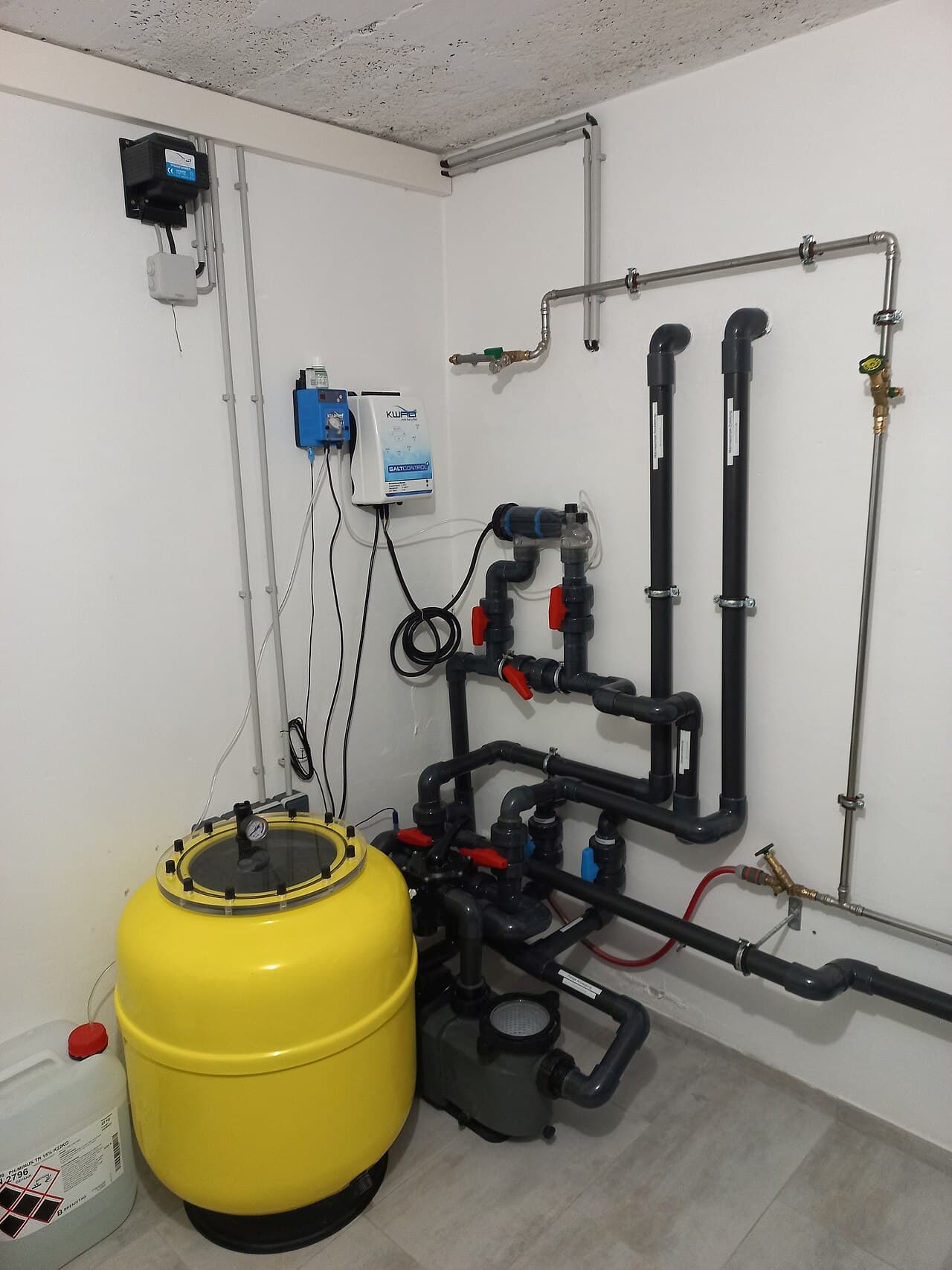
The backwash, in order
The valve on top of or beside the tank has positions for Filter, Backwash, Rinse, Waste and sometimes Recirculate and Closed. Backwashing sends water down through the filter and up through the sand, so the trapped dirt leaves through the waste line. The sequence is Backwash, then Rinse, then back to Filter.
Pump off before every valve move. Hayward's manual says to always shut off the pump before switching the filter control valve positions.[1] A separate warning says: "Do not change filter control valve position while system pump is running."[1]
Push down, then turn. To prevent damage to the control valve seat, always depress the handle before turning.[1]
Backwash until it clears. With the valve on Backwash, start the pump and run it about 2 minutes or less, depending on dirt accumulation, until the water in the sight glass is clear. That is Hayward's instruction: Stop the pump, set the valve to BACKWASH, start the pump and backwash approximately 2 minutes or less, depending on dirt accumulation, until the water in the sight glass is clear.[1] If your filter has no sight glass, watch the water at the end of the waste hose instead.
Rinse. Stop the pump, set the valve to RINSE and run the pump for about 1/2 to 1 minute.[1] This is so that all dirty water from backwashing is rinsed out to the filter to waste, preventing possible return to the pool.[1]
Back to Filter. Stop the pump, set the valve to FILTER and start it again. Then note the gauge: that new reading is your clean pressure for next time.
Safety before you start the pump
Hayward's manual warns that all suction and discharge valves must be open when starting the system.[1] It also warns that pool and spa water circulation systems operate under hazardous pressure during start up, normal operation and after pump shut off.[1] Stand clear of the equipment when the pump starts, and do not open a clamp or lid to look inside while the system is under pressure.
Point the waste line somewhere it will not flood a neighbour's yard or run into a storm drain, and check with your city or county if you are unsure what it allows for pool water.
Special cases
For new concrete or gunite pools, or where there is a large amount of plaster dust or debris, start the filter in the FILTER position, not BACKWASH, to prevent clogging of the underdrain laterals, according to Hayward.[1]
Do not skip the rest between steps. The underdrain is easily damaged if the re-circulation system is not allowed to rest between backwash and filtration operations,[2] and sand from a damaged underdrain can collect around the pool inlets in the interior of the pool.[2]
Water chemistry matters too. Hayward notes that insufficient chlorine or an out of balance pH level will permit algae and bacteria to grow in your pool and make it difficult for your filter to properly clean the pool water.[1] A filter that clogs fast is often fighting the water, not failing.
Stop and call a pro if
- The pressure climbs back within days. The Virginia Department of Health's pool guide says mudballs are caused by insufficient flow rates or time of backwashing, and that both mudballs and calcification in hard water areas are corrected by chemical treatment or replacement of the filter sand.[2]
- Sand shows up in the pool. That points to a damaged underdrain or laterals inside the tank, which means opening the filter.[2]
- The tank, clamp, lid or valve leaks, or the gauge never drops after backwashing. Shut the system off and do not run it.
- The pump, timer or controls misbehave. Before working on any electrical equipment, turn off power supply to the equipment,[1] and leave wiring and bonding to a licensed electrician. Virginia requires a contractor licence for work valued at $1,000 or more.[4]
Getting help in Virginia
If the filter is clean and the water is still cloudy, the pump may be the weak link: read how much pool pump repair costs in Virginia, try how to do a bucket test for a pool leak if you are topping up water often, and browse more pool equipment answers. Loclis lists local pros at pool and spa services, each with the licence details you can check.
When you want someone to look at the filter, describe the problem once and local pros reply with quotes.
Common questions
- How often should I backwash a sand filter?
- When the pressure gauge says so rather than on a fixed day. Hayward's manual for its S-200 filter says to note the clean reading and backwash at 6-8 PSI above it. EPA's WaterSense pool guide lists weekly backwashing for sand filters, but also notes that an estimated 23 percent of quantifiable pool water use goes to backwashes, so there is no reason to do it more often than the gauge asks.
- How long should I backwash?
- About 2 minutes or less, until the water in the sight glass is clear, then 30 to 60 seconds on Rinse. Hayward's manual gives those figures for its filter. A filter with no sight glass needs a longer look at the waste water, and your own model's manual is the authority on timing.
- Can I turn the valve while the pump is running?
- No. Hayward's manual says to shut off the pump before switching filter control valve positions, and a separate warning says not to change the valve position while the pump is running. Turning it under flow strains the pipework and can damage the valve.
- Why does the pressure stay high after I backwash?
- Usually the sand is fouled. The Virginia Department of Health's pool guide describes mudballs, caused by too little backwash flow or time, and calcification in hard water, and says both are corrected by chemical treatment or replacement of the sand. A pro can confirm which one it is.
- Should I backwash a brand-new sand filter or a new pool?
- A new filter gets an initial backwash of at least 2 minutes to clear fine sand particles, per Hayward. For a new concrete or gunite pool, or one with plaster dust or debris, Hayward says to start in the Filter position instead, to avoid clogging the underdrain laterals.
Sources
- [1] S200 Series Owner's Manual, High Rate Sand Filter (IS200 Rev C), Hayward Industries (manufacturer's manual). Checked October 27, 2026.
- [2] Pool Operation and Maintenance Guide (Portsmouth Health Department, 2018), Virginia Department of Health. Checked October 27, 2026.
- [3] Outdoor Water Use Guide for Swimming Pools, U.S. Environmental Protection Agency, WaterSense. Checked October 27, 2026.
- [4] What You Should Know Before You Hire a Contractor, Virginia Board for Contractors, DPOR. Checked October 27, 2026.
Want a pro to handle it?
Describe the job once. Licensed local businesses send quotes, and you pay only when you book one.
Get a quote for Pool Equipment