How do I clean out a garage in one weekend?
Plan the haul-away before Saturday: book a crew, a dumpster or a dump run, and look up your locality's hazardous waste site. On Saturday, empty the garage onto the driveway and sort everything into keep, donate, sell, trash and hazardous piles. On Sunday, haul off the trash and donations, clean the bare floor, and put back only what you are keeping, grouped by use.
Free to ask. Local shops send quotes, and you pay only when you book one.
By Kasra Taheri, Founder, LoclisPublished
Researched and drafted with AI, then checked claim by claim against the sources listed below before it was published. Prices and rules change; the dates beside each source say when it was last checked.
Step by step
Read when to stop and call a pro, further down this page, before you start.
Step 1: Book the haul-away first
Before the weekend, reserve a junk removal crew, a dumpster or a truck for a dump run, and check what your trash service's bulk pickup will and will not take.
Step 2: Find your hazardous waste option
Look up your county's household hazardous waste site or collection dates, because paints, cleaners, oils, batteries and pesticides need special care when you dispose of them.[1]
Step 3: Gather supplies
Have heavy-duty bags, boxes, two or three tarps, work gloves, a dust mask and labels for each pile ready on Friday night.
Step 4: Air out a garage that has had mice
If there are droppings or nests, open the garage to air out for at least 30 minutes before you work inside.[5]
Step 5: Empty the garage onto tarps
Carry everything out to tarps on the driveway so you can see the whole load and reach every corner of the floor.
Step 6: Sort into five piles
Make keep, donate, sell, trash and hazardous piles, and decide on each item once instead of moving it from pile to pile.
Step 7: Keep the hazardous pile in order
Leave chemicals in their original containers with lids tight, do not mix them, and keep flammables out of direct sunlight.[2]
Step 8: Bag loose lithium-ion batteries
Tape the terminals of loose lithium-ion batteries or put each one in its own plastic bag, and keep them out of the trash.[6]
Step 9: Clean droppings wet, not dry
Mist droppings with disinfectant or a bleach solution and wipe them up; do not sweep or vacuum them dry.[5]
Step 10: Haul out on Sunday morning
Load the trash and donations first, so the driveway clears and you can see what is left to put back.
Step 11: Clean the empty garage
Sweep or blow out the floor, knock down cobwebs and wipe shelves while nothing is in the way.
Step 12: Put back only the keep pile
Return what you are keeping grouped by use, with heavy things on low shelves and fuel, paint and propane in a shed away from the house if you have one.[7]
Step 13: Drop off the hazardous pile
Take the boxed chemicals, fuel and batteries to your locality's household hazardous waste site or next collection event.
You can clear a garage in a weekend if you make the hard decision before Saturday: how the junk is leaving. Book the hauler, dumpster or dump run first, look up where your hazardous leftovers go, then spend Saturday emptying and sorting and Sunday hauling, cleaning and putting back. The step list on this page is the order that works; below is what each part involves and where people get stuck.
Before the weekend: decide how the junk leaves
A cleanout stalls when the sorted piles have nowhere to go. Settle that first.
Your trash service. Check what bulk pickup it offers. Fairfax County residents whose trash the county collects get five free special pickups per fiscal year, which must be scheduled in advance,[3] and each pile is limited to 2 cubic yards, about 6 feet long, 3 feet wide and 3 feet high, sorted by type.[3] Richmond's every-other-week bulk collection does not take paint, gas tanks, propane tanks, lawn mowers, tires, auto parts or construction debris,[4] which is most of what a garage holds. Other localities and private haulers set their own rules, so ask yours.
A crew or a container. For a full garage, a junk removal crew that carries and loads on Sunday is the fastest way to finish. A dumpster works if you have room for it and want to load at your own pace. See what size dumpster you need for a cleanout and what a garage cleanout costs in Virginia.
Donations. Call ahead to find out what the local charity shops and building-material resale stores take and when they accept drop-offs, so the donate pile leaves the same weekend.
Saturday: empty, then sort
Pull everything out onto tarps on the driveway. It feels slower than sorting shelf by shelf, but you see the whole load at once, you find the duplicates (three shop vacs, four half-empty bags of grass seed), and you get to the floor and corners.
Sort into five piles: keep, donate, sell, trash and hazardous. Make one decision per item. A "maybe" pile usually ends up back in the garage.
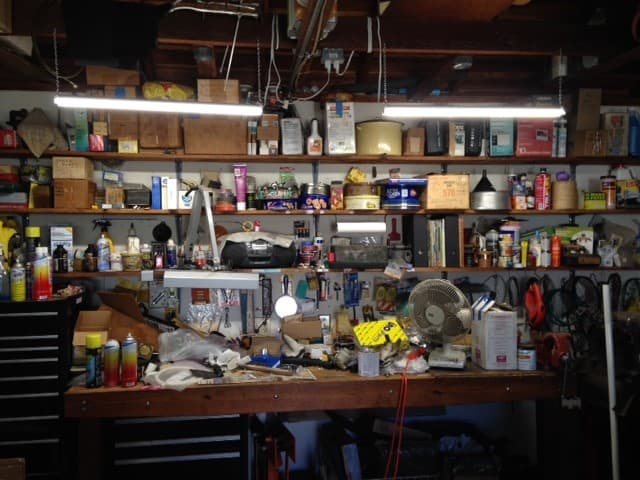
The hazardous pile
Garages collect the products that should never go in a trash bag or a hauler's truck: fuel, motor oil, solvent-based paint, thinner, pool chemicals, pesticides, propane and batteries. In Fairfax County, for example, the county's household hazardous waste program takes gasoline, motor oil, paint, paint thinner, pesticides and rechargeable batteries free from county residents,[2] and it accepts propane tanks up to 20 pounds, with a fee for the common barbecue size.[2] Larger tanks go back to a propane supplier.[2] Other localities run their own sites or collection days; your public works or solid waste office will have the schedule.
While the pile waits:
- Don't mix products, because some combinations give off deadly gases or start a fire.[8]
- Aerosol cans can hold chemicals that burn, and in the trash they can explode or start a fire.[8]
- Even used batteries can hold enough energy to injure someone or start a fire.[6] Tape or bag them as in the steps.
- Pack containers upright in a cardboard box for the drive, not in plastic bags.[2]
For paint specifically, see how to dispose of old paint in Virginia.
If mice have been living in it
Droppings and nests are common in garages, especially behind stored boxes and under shelving. Hantavirus pulmonary syndrome is rarely reported in Virginia, but it spreads mainly by breathing air contaminated with rodent urine, droppings or saliva,[5] so the rule is to keep the dust down. Wet the area with a commercial disinfectant or a solution of 1 ½ cups of bleach to 1 gallon of water, misted from a spray bottle,[5] then wipe it up. Wear gloves, bag dead rodents in a sealed bag inside a second bag, wash your gloved hands in disinfectant and then soap and water, and wash your bare hands after.[5] Throw out nesting material and chewed boxes rather than trying to save them.
Sunday: haul, clean, put back
Load the trash and donations first. Once the driveway is clear, sweep the floor and wipe the shelves while nothing is in the way. Then put back only the keep pile, grouped by what you use it for: lawn and garden, car, sports, tools, holiday. Heavy items go low, everyday items near the door, seasonal ones high or at the back.
Flammables deserve their own spot. Garage fires tend to spread farther and cause more injuries and property loss than fires that start elsewhere in the home.[7] Store oil, gasoline, paint, propane and varnish in a shed away from the house if you can.[7] For keeping it this way, see how to set up a garage so it stays organized.
Stop and call a pro if
- You find a large rodent infestation, droppings throughout insulation, or a dead animal you cannot reach safely.
- There are unlabelled drums, leaking containers or anything you cannot identify. Leave it alone and call your locality's hazardous waste office or the fire department's non-emergency line.
- Clearing the garage means taking down built-in shelving, a workbench fixed to the wall, a loft or a shed. That is removal work, not hauling.
- Heavy items such as a chest freezer, a gun safe, an engine or a full tool chest need more hands or equipment than you have.
- You uncover damaged wiring, a gas smell or water coming in where it should not.
Getting help on Loclis
Browse more junk removal and moving answers, see garage cleanout services, or find junk removal and moving businesses around Blacksburg. If you would rather have a crew do the hauling, describe the garage once on Loclis with a few photos and businesses quote on the same load.
Common questions
- How long does a garage cleanout really take?
- A one-car garage that is mostly boxes and tools is usually a full Saturday of sorting and a Sunday morning of hauling for two people. A packed two-car garage, a workshop full of hardware, or a garage that has had mice can take longer. Booking the haul-away before you start is what keeps it to a weekend.
- Can I put old paint and gasoline in the trash?
- Generally not. Fuel, solvent-based paint, pesticides and similar products go to a household hazardous waste program. Fairfax County takes them free from residents, and Richmond's bulk collection refuses paint and gas tanks. Some localities let you dry out latex paint and put it in the trash, so check yours.
- What do I do with an old propane tank?
- Keep it out of the trash and out of a junk removal load unless the hauler says it takes them. In Fairfax County, tanks up to 20 pounds go to the household hazardous waste site, with a fee for the common barbecue size, and larger tanks go back to a propane supplier.
- Is it safe to clean up mouse droppings myself?
- For ordinary droppings, yes, with care: air the garage out first, wear gloves, wet the droppings with disinfectant or a bleach solution and wipe them up rather than sweeping or vacuuming. A heavy infestation, or droppings throughout insulation or ductwork, is a job for a pest or cleanup professional.
- Should I rent a dumpster or hire a junk removal crew?
- A crew does the carrying and takes the load the same day, which suits a weekend. A dumpster suits a slower cleanout where you load it yourself over several days, and a dumpster placed on the street may need your locality's approval. Compare both against what your trash service's bulk pickup already covers.
Sources
- [1] Household Hazardous Waste (HHW), U.S. Environmental Protection Agency. Checked October 26, 2026.
- [2] Household Hazardous Waste, Fairfax County Department of Public Works and Environmental Services. Checked October 26, 2026.
- [3] Special Pickup, Fairfax County Department of Public Works and Environmental Services. Checked October 26, 2026.
- [4] Bulk and Brush, City of Richmond Department of Public Works. Checked October 26, 2026.
- [5] Hantavirus Pulmonary Syndrome (HPS), Virginia Department of Health. Checked October 26, 2026.
- [6] Used Lithium-Ion Batteries, U.S. Environmental Protection Agency. Checked October 26, 2026.
- [7] Basement and Garage Fire Safety, U.S. Fire Administration. Checked October 26, 2026.
- [8] Home Hazardous Materials, U.S. Fire Administration. Checked October 26, 2026.
Want a pro to handle it?
Describe the job once. Licensed local businesses send quotes, and you pay only when you book one.
Get a quote from a local pro