How do I clean a small engine carburetor?
Start with the cheap, safe fixes: pull the spark plug wire, drain the old fuel, put in fresh gasoline with a stabilizer and clean the air filter. If it still will not run, a carburetor cleaner used as its label directs often clears light varnish. Do not turn the mixture screws; a gummed-up or badly worn carburetor is a shop job.
Free to ask. Local shops send quotes, and you pay only when you book one.
By Kasra Taheri, Founder, LoclisPublished
Researched and drafted with AI, then checked claim by claim against the sources listed below before it was published. Prices and rules change; the dates beside each source say when it was last checked.
Step by step
Read when to stop and call a pro, further down this page, before you start.
Step 1: Disconnect the spark plug
Pull the spark plug wire off the plug before you touch anything on the engine.[5]
Step 3: Take a photo, then look
Photograph the air filter cover, throttle linkage and fuel line so you can put things back exactly as they were.
Step 4: Clean or replace the air filter
A clogged filter is a common reason for poor running and costs the least to fix.
Step 5: Use carburetor cleaner as labelled
Follow the can's directions for spraying the intake and linkage. Keep the cleaner away from any spark and out of your eyes.
Step 6: Refill with fresh fuel and stabilizer
Fill the tank with fresh gasoline, add stabilizer according to the package, and run the engine for a few minutes.[2]
Step 7: Leave the adjustment screws alone
If the engine still surges, stalls or will not idle, stop and take it to a shop rather than turning mixture screws.[4]
Step 8: Dispose of old fuel properly
Take drained fuel and spent cleaner to a household hazardous waste collection, not down a drain.[3]
The short version
Most "carburetor problems" are old-fuel problems. Before you take anything apart, replace the fuel, clean the air filter and give a cleaner a chance to work. Anything that needs the carburetor off the engine, a rebuild or any adjustment of its mixture screws is better left to a small engine shop.
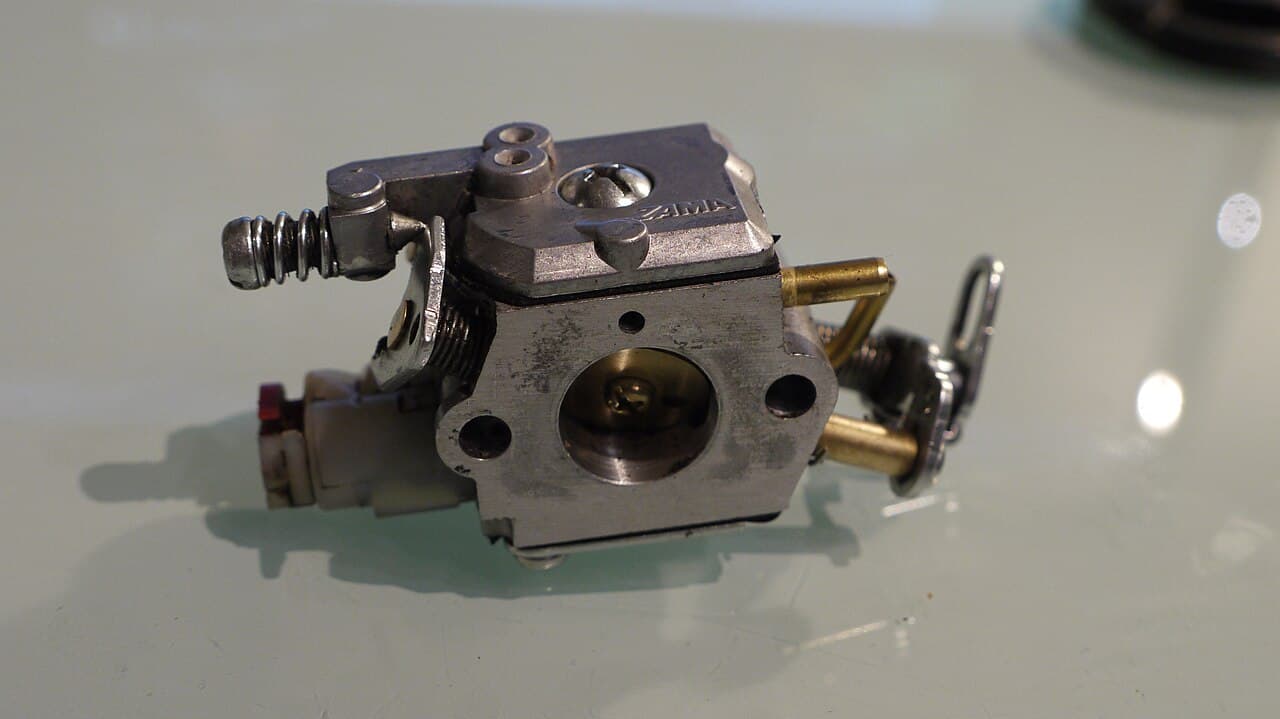
Why carburetors clog
The carburetor meters a tiny amount of fuel through very small jets. When fuel sits, it leaves a film that narrows those passages. Briggs & Stratton says "Gasoline deteriorates after 30 days and can negatively affect engine and starting performance."[1] Penn State Extension adds that "Engines that are rarely or seasonally used, such as lawnmowers or chainsaws, are especially prone to difficulties," and that "ethanol can pick up contaminants that gasoline doesn't and may deposit those contaminants inside your engine, leading to fouled filters or injectors."[6]
That is why a mower that sat all winter, or a chain saw left with half a tank, is the usual customer.
Before you start
Disconnect the spark plug wire. Virginia Cooperative Extension's mower safety guidance says "Disconnect the spark or electric plug before troubleshooting or repairing the mower."[5] Work outdoors with the engine cold. The same publication says "Never refuel the mower when its engine is hot or running." It also says "Store gasoline in an approved container with proper labeling."[5]
Keep sparks, flames and cigarettes away from the work area, and wear gloves and eye protection when using sprays.
What to do, in order
1. Fix the fuel. Drain the tank and put in fresh gasoline. Add a stabilizer: Briggs & Stratton says "Add the stabilizer according to package directions and then run the engine for a few minutes to circulate the solution through the carburetor."[2] The company also says its stabilizer can "help prevent gum deposits in the carburetor."[1]
2. Clean the air filter. Paper filters that are oily or clogged should be replaced; foam filters can be washed and dried. This is cheap and often more important than the carburetor.
3. Try a cleaner. Use an aerosol carburetor cleaner exactly as its label directs, usually sprayed into the intake and onto the throttle linkage with the engine off. Do not poke the jets with wire, which can enlarge them.
4. Test. Start the engine and let it warm up. If it now idles and accelerates smoothly, you are done.
Leave the adjustments alone
If the engine still runs rough, resist turning the mixture screws. The Forest Service's chain saw training guide puts it plainly: "The high- and low-end adjustments should be made by a qualified saw mechanic. Improper adjustment can result in poor operation or severely damage the chain saw."[4] Mowers and trimmers are no different in principle. A shop has the tools to set the mixture properly.
Dispose of the old fuel
Do not pour fuel or cleaner down a drain or on the ground. The EPA lists this among improper disposal: "Improper disposal of HHW can include pouring them down the drain, on the ground, into storm sewers."[3] It advises you to "Contact your local environmental, health, or solid waste agency to learn about permanent or periodic HHW collections near you."[3]
Keeping it clean
Fill the tank before storing, because "Keeping the tank full will minimize accumulation of moisture that causes carburetor-clogging rust."[2] Use stabilizer in anything that sits for weeks.
Stop and call a pro if
- Fuel leaks from the carburetor, fuel line or tank, or you smell gasoline when the engine is off.
- The engine surges, stalls or will not idle after fresh fuel, a clean filter and a cleaner. That means blocked jets, a worn diaphragm or a stuck float.
- Parts are cracked or stiff, such as a fuel line, primer bulb or gasket.
- You would need to adjust mixture screws or take the carburetor apart.
- The engine floods, smokes badly or overheats.
Getting help in Virginia
Read when to take a small engine in for carburetor service and how much carburetor cleaning costs in Virginia, or see how to fix a lawn mower that won't start. Browse local handyman and repair businesses or more small engine answers.
When the engine needs a shop, describe the problem and local businesses will quote it.
Common questions
- Can I clean a carburetor without taking it off?
- Often, for light varnish. Fresh fuel, a clean air filter and a carburetor cleaner used as its label directs can clear a mild case. If the engine still runs badly, the jets are probably blocked and the carburetor needs to come off, which is a shop job unless you are experienced.
- What causes a small engine carburetor to clog?
- Mostly old fuel. Briggs & Stratton says gasoline deteriorates after 30 days, and gum and varnish build up in the fuel system. Moisture can also cause rust that clogs the carburetor.
- Should I adjust the carburetor myself?
- No. The Forest Service's chain saw guidebook says the high- and low-end adjustments should be made by a qualified saw mechanic, and improper adjustment can seriously damage the engine. Idle speed is the only adjustment owners commonly touch, and only as the manual says.
- Is ethanol gasoline a problem?
- It can be. Penn State Extension says ethanol can pick up contaminants and deposit them in the engine, and that rarely used equipment such as mowers and chainsaws is especially prone to difficulties. Use fresh fuel and a stabilizer.
- How do I stop the carburetor clogging again?
- Use fresh fuel, add stabilizer, and keep the tank full during storage. Run the engine a few minutes after adding the stabilizer so it reaches the carburetor.
Sources
- [1] How to Perform Lawn Mower Maintenance, Briggs & Stratton. Checked October 27, 2026.
- [2] The Importance of Fuel Stabilizer, Briggs & Stratton. Checked October 27, 2026.
- [3] Household Hazardous Waste (HHW), U.S. Environmental Protection Agency. Checked October 27, 2026.
- [4] Chain Saw and Crosscut Saw Training Course, Instructor's Guidebook, Chapter 3: Chain Saw Use and Maintenance, USDA Forest Service, Technology and Development Program. Checked October 27, 2026.
- [5] Lawn Care: Rotary Mower Safety (BSE-42P), Virginia Cooperative Extension, Virginia Tech. Checked October 27, 2026.
- [6] Fuel Ethanol: Hero or Villain?, Penn State Extension. Checked October 27, 2026.
Want a pro to handle it?
Describe the job once. Licensed local businesses send quotes, and you pay only when you book one.
Get a quote for Small Engines