Why does my small engine only run with the choke on?
It is usually running too lean: the carburetor is not delivering enough fuel for the air coming in, and the choke hides that by cutting the air. Old fuel, a gummed-up carburetor, a dirty fuel or air filter are the usual causes. Try fresh fuel and clean filters first; leave the mixture screws to a shop.
Free to ask. Local shops send quotes, and you pay only when you book one.
By Kasra Taheri, Founder, LoclisPublished
Researched and drafted with AI, then checked claim by claim against the sources listed below before it was published. Prices and rules change; the dates beside each source say when it was last checked.
Step by step
Read when to stop and call a pro, further down this page, before you start.
Step 1: Disconnect the spark plug
Pull the spark plug wire off the plug and work outdoors with the engine cold.[5]
Step 2: Replace old fuel
Empty the tank into an approved container and refill with fresh gasoline; fuel more than 30 days old is suspect.[1]
Step 3: Add stabilizer
Add stabilizer as the package directs and run the engine a few minutes so it reaches the carburetor.[6]
Step 4: Check the air filter
Replace a filter that is saturated with dirt or soaked with fuel mix, or that is torn or loose.[3]
Step 5: Check the fuel filter
Inspect the fuel filter and replace it if it looks dirty, following the engine manual.[3]
Step 6: Use carburetor cleaner as labelled
Spray the intake and linkage as the can directs, away from sparks and out of your eyes.
Step 7: Test with the choke open
Start the engine and let it warm up; if it still dies with the choke open, stop and take it to a shop.
The short version
An engine that runs only with the choke on is almost always getting too little fuel for the air it is drawing in. Closing the choke cuts the air, which makes the mixture richer and hides the problem. The usual causes are old fuel, a gummed-up carburetor, a blocked fuel filter or a dirty air filter, and the cheap ones come first.
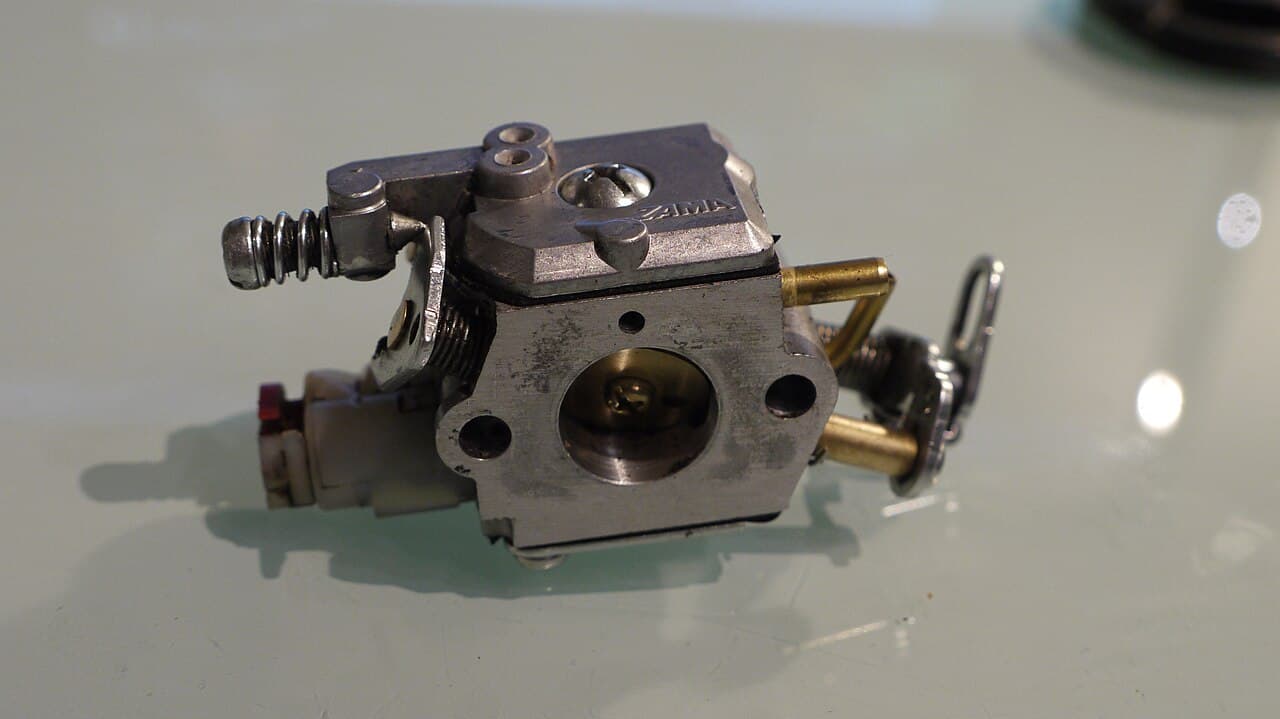
What the choke is doing
The choke is a cold-start aid. It restricts the air entering the carburetor so the same trickle of fuel makes a richer mixture, which a cold engine needs. A warm, healthy engine runs with the choke open.
If yours stalls the moment you open it, the carburetor is not metering enough fuel, or the fuel is not reaching it. Running on the choke also tends to smoke and foul the spark plug, so treat it as a clue and not a fix.
Start with the fuel
Old gasoline is the most common reason. Briggs & Stratton says "Gasoline deteriorates after 30 days and can negatively affect engine and starting performance."[1] Its storage guidance adds that "Gas begins to degrade in as little as 30 days which can lead to your engine's fuel system clogging and your equipment not starting the following season."[2] ECHO sets its limit at 90 days for its trimmer engines: "Use of unmixed, improperly mixed, or fuel older than 90 days, (stale fuel), may cause hard starting, poor performance, or severe engine damage".[3]
Ethanol can add to it. Penn State Extension says "ethanol can pick up contaminants that gasoline doesn't and may deposit those contaminants inside your engine, leading to fouled filters or injectors."[4] Rarely used equipment is the usual victim: "Engines that are rarely or seasonally used, such as lawnmowers or chainsaws, are especially prone to difficulties".[4]
What to check, in order
Work outdoors with the engine cold. Virginia Cooperative Extension's guidance is "Disconnect the spark or electric plug before troubleshooting or repairing the mower."[5]
1. Fresh fuel. Drain the tank into an approved container and refill with fresh gasoline. Briggs & Stratton's advice is to "Add the stabilizer according to package directions and then run the engine for a few minutes to circulate the solution through the carburetor."[6]
2. Air filter. ECHO's manual says to replace a filter that is "saturated with dirt" or "soaked with fuel mix", along with one that is torn or no longer seals.[3]
3. Fuel filter. The same manual's maintenance schedule lists the fuel filter as "Inspect/Replace", so a filter that looks dirty is worth changing.[3]
4. Carburetor cleaner. Use an aerosol cleaner exactly as its label directs, sprayed into the intake and onto the linkage, away from any spark.
5. Test. Start the engine, let it warm up and open the choke. If it now holds a steady idle, you are done.
Do not turn the mixture screws
It is tempting to richen the mixture with an adjustment screw. Manufacturers say to leave it. ECHO states "Carburetor adjustments, other than idle speed, must be performed by an authorized ECHO dealer."[3] Penn State Extension notes that ethanol blends tend to run leaner, and that "older engines may need a bit of manual adjustment to get the air-fuel mixture just right."[4] That is a job for someone with the tools to read the result.
Stop and call a pro if
- Fresh fuel, a clean filter and cleaner did not help. The jets are probably blocked or a diaphragm is worn, and the carburetor needs to come off for cleaning or a rebuild.
- Fuel leaks from the carburetor, fuel line or tank, or you smell gasoline with the engine off.
- The fuel line is cracked or stiff.
- The engine floods, smokes heavily or overheats.
- It needs mixture adjustment to run at all.
Getting help in Virginia
For the cleaning steps, read how to clean a small engine carburetor. To plan the cost, see how much carburetor cleaning costs in Virginia, and for the signs a shop visit is due, when to take a small engine in for carburetor service. Browse local handyman and repair businesses or more small engine answers.
When it needs a shop, describe the problem and local businesses will quote it.
Common questions
- Is it bad to run an engine with the choke on?
- Not for starting, but it is a rich mixture, so running that way tends to smoke, waste fuel and foul the spark plug. It also means something is wrong that should be found.
- Can old gas make an engine need the choke?
- Yes. Briggs & Stratton says gasoline deteriorates after 30 days and can hurt engine and starting performance, and ECHO sets 90 days for its trimmer engines.
- Should I adjust the carburetor myself?
- Leave the mixture screws alone. ECHO says carburetor adjustments other than idle speed must be done by an authorized dealer.
- Will carburetor cleaner fix it?
- Sometimes, for light varnish, when used as the label directs. If the engine still dies with the choke open, the jets are probably blocked and it needs a shop.
Sources
- [1] How to Perform Lawn Mower Maintenance, Briggs & Stratton. Checked October 28, 2026.
- [2] Storing Your Mower & Outdoor Power Equipment, Briggs & Stratton. Checked October 28, 2026.
- [3] Grass Trimmer/Brush Cutter Operator's Manual, model SRM-410U, ECHO Incorporated. Checked October 28, 2026.
- [4] Fuel Ethanol: Hero or Villain?, Penn State Extension. Checked October 28, 2026.
- [5] Lawn Care: Rotary Mower Safety (BSE-42P), Virginia Cooperative Extension, Virginia Tech. Checked October 28, 2026.
- [6] The Importance of Fuel Stabilizer, Briggs & Stratton. Checked October 28, 2026.
Want a pro to handle it?
Describe the job once. Licensed local businesses send quotes, and you pay only when you book one.
Get a quote for Small Engines