Why are my new fence posts leaning?
New fence posts usually lean because the holes are too shallow or too narrow, the concrete had not set when the braces came off, the backfill was not tamped, or the soil is loose, wet or prone to frost heave. Wind on a solid fence and the weight of a gate add steady sideways force. Most single posts can be dug out and reset.
Free to ask. Local shops send quotes, and you pay only when you book one.
By Kasra Taheri, Founder, LoclisPublished
Researched and drafted with AI, then checked claim by claim against the sources listed below before it was published. Prices and rules change; the dates beside each source say when it was last checked.
Step by step
Read when to stop and call a pro, further down this page, before you start.
Step 1: Find where it moves
Push the top of each leaning post and watch the ground line to see whether the post rocks in its concrete or the whole collar moves in the soil.
Step 2: Check the pattern
Note whether one post, a corner, a gate post or a whole run leans, and which way, since that points to the cause.
Step 3: Look at the ground
Check for soft or soggy soil, washed-out backfill, downspouts or sprinklers wetting the post, and soil heaped against the wood.
Step 5: Expose the footing
Dig beside the leaning post with a shovel to see how deep it goes and whether the concrete is cracked or the wood is soft.
Step 6: Compare the depth
Measure the buried length against one-third of the post's overall length plus 6 inches for gravel.[1]
Step 7: Reset the post
Pull it, widen and deepen the hole to about three times the post's width, add 6 inches of gravel, and set it plumb with new concrete.[1]
New fence posts lean for a small number of reasons, and most of them come down to the footing: holes that are too shallow or too narrow, concrete that had not set when the braces came off, backfill that was never tamped, or soil that is loose, wet or heaving with frost. A solid privacy fence also catches the wind like a sail, and a gate pulls on its post every time it swings. A post that leans within the first year can usually be dug out and reset.
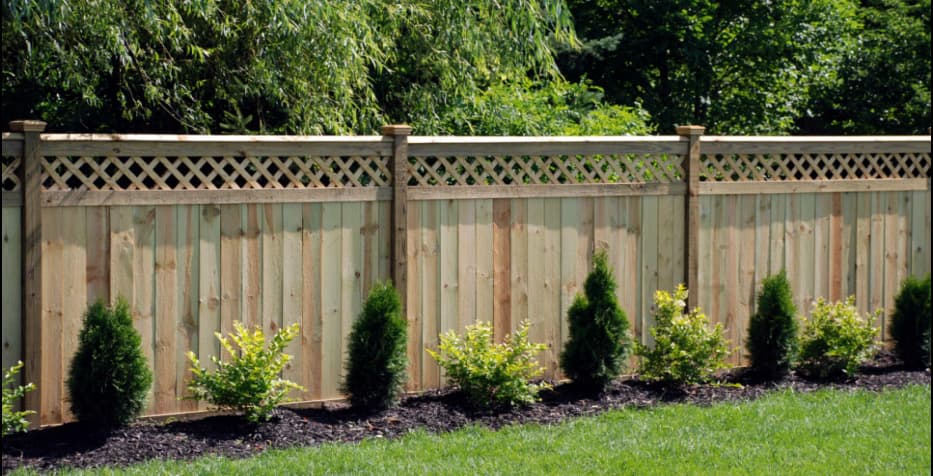
The common causes
The holes are too shallow. A short footing is a frequent cause. QUIKRETE's project sheet sizes a post hole at about three times the post's diameter and one-third of the post's overall length deep, plus 6 inches for a gravel base.[1] Its web guide uses one-third to one-half of the above-ground length, plus 6 inches.[2] A 6-foot fence on posts with only 18 inches in the ground has very little to resist a strong gust.
The concrete was disturbed before it set. QUIKRETE's fast-setting mix sets in 20 to 40 minutes and can take a heavy load after 4 hours,[1] but if the temperature is below 72 degrees, it needs more curing time.[1] Pulling braces early, or nailing rails and boards to posts the same afternoon on a cold day, can shift posts that are not yet firm.
The post was never truly plumb. QUIKRETE's directions brace each post on two adjacent sides and check plumb on both,[2] and they say to recheck plumb after the dry mix goes in.[1] A post checked on one face only can look straight from the street and lean along the line.
The backfill and soil. QUIKRETE's sheet says to tamp the sides and bottom of the hole until firm before the gravel goes in.[1] Loose soil around a footing lets the whole concrete collar tip. For posts in loose or sandy soil, it calls for a larger, dish-shaped hole,[1] and its web guide recommends a tube form.[2] Heavy clay that stays wet, common across much of Virginia, softens around a footing after long rains. Downspouts and sprinklers that soak one spot make it worse.
Frost heave. When wet soil freezes, it expands and can lift a shallow footing, often unevenly, so the post tips as it rises. Local design frost depths give a sense of how deep the freeze can reach: Loudoun County lists a frost depth of 24 inches,[4] Shenandoah County gives 24 inches from grade to the bottom of a footing,[5] and Powhatan County lists 18 inches.[6] Those figures are for building footings; fences are not required to meet them, but a short footing in wet clay in a 24-inch county is at real risk. Posts that were straight in September and lean in March point to this.
Wind and weight. A solid board fence takes far more wind than a picket or rail fence. Long spans between posts make it worse: Board fences typically have posts every 8 feet,[3] and stretching that distance puts more load on each post. Virginia Cooperative Extension notes that post strength is especially important for corner and gate posts.[3] If one gate post leans and the rest stand straight, the gate is the cause.
The wrong post. It is rare in a new fence, but a post that was not rated for ground contact can soften quickly at the ground line. Untreated sapwood of essentially all species has low resistance to decay,[7] and the Forest Products Laboratory says pressure-treated wood is recommended for the high hazard of ground contact.[7] Probe the post at grade with a screwdriver; soft, punky wood means replacement.
Reading the pattern
- One post leans: look at that footing. A soft spot, a buried rock that forced a shallow hole, or a downspout nearby.
- Every post leans the same way: wind on a solid fence, or posts that were all set too shallow.
- Corners and ends lean inward: the rails are pulling on posts that were not set heavy enough.
- Gate post leans toward the gate: the gate's weight. The latch side drops and the gate starts to drag.
- Posts lean in different directions after winter: frost heave or saturated soil.
Fixing it
A post that only leans slightly in soft soil beside a sound footing can sometimes be pushed back, tamped and braced. A post that rocks inside its concrete, or one whose footing turns out to be too shallow, needs to come out and be reset with a deeper, wider hole, gravel and new concrete. Digging around a post is excavation, and Virginia law requires a locate request to the notification center before any excavation,[8] so submit a Virginia 811 request first; the service is free.[9] How to set a fence post in concrete walks through resetting it, and QUIKRETE suggests a 6-inch gravel base and a concrete top that slopes away from the post to protect it from rot.[2]
If many posts are leaning, a full run was likely set short and it is usually better to reset the run than chase single posts. On a new fence, ask the installer first.
Stop and call a pro if
- Several posts or a whole run are leaning, or the fence is tilting toward a neighbour's yard, a driveway or a sidewalk.
- A post sits near utility marks, a buried line or an irrigation pipe.
- The fence is on a slope, on top of a retaining wall, or is a pool barrier.
- A heavy drive gate is sagging and pulling its post over.
If you hire it out, Virginia treats Class C contractors as those performing work where a single contract is over $1,000 but less than $30,000,[10] so check the business on DPOR's licence lookup. Read whether you need a permit for a fence and what a fence costs in Virginia, browse fence repair and installation businesses, all exterior answers, or exterior businesses around Blacksburg. To get it fixed, describe the leaning fence once and local businesses send written quotes.
Common questions
- Can I just push a leaning post back and brace it?
- Only if it leans because soft soil beside a sound footing gave way, and even then it tends to drift back. If the post rocks inside its concrete, or the footing is too shallow, it needs to be dug out and reset.
- Why is only the gate post leaning?
- A gate hangs its full weight off one post and gets swung and slammed, so gate posts take far more sideways force than line posts. Virginia Cooperative Extension stresses post strength for corner and gate posts. A heavier post set deeper, or a gate with a diagonal brace, usually fixes it.
- My posts were straight in summer and leaned after winter. Why?
- That pattern points to frost heave or wet soil. Water in the soil can freeze and expand around a shallow footing and lift it unevenly. Loudoun and Shenandoah counties list a frost depth of 24 inches and Powhatan County 18 inches, so a short footing in wet clay is at risk.
- Is a leaning new fence the installer's problem?
- Check your written contract and warranty first. If the posts were set shallower than the contract or the manufacturer's directions call for, ask the installer in writing to reset them. Keep photos and measurements of the depth you find.
- Should I add a metal post repair spike instead of resetting?
- A repair bracket driven beside a post can steady a fence whose post rotted at ground level, but it does not fix a footing that is too shallow or soil that keeps moving. On a new fence, resetting the post properly usually lasts longer.
Sources
- [1] Setting Posts Project (Fast-Setting Concrete), The QUIKRETE Companies. Checked October 26, 2026.
- [2] Setting Posts in Concrete, The QUIKRETE Companies. Checked October 26, 2026.
- [3] Fencing Materials for Livestock Systems, publication 442-131 (archived), Virginia Cooperative Extension, Virginia Tech. Checked October 26, 2026.
- [4] Building Codes and Regulations (structural design load criteria), Loudoun County, Virginia. Checked October 26, 2026.
- [5] Design Information, Shenandoah County, Virginia. Checked October 26, 2026.
- [6] Building Codes and design information, Powhatan County, Virginia. Checked October 26, 2026.
- [7] Wood Handbook, Chapter 14: Biodeterioration of Wood, USDA Forest Service, Forest Products Laboratory. Checked October 26, 2026.
- [8] Va. Code § 56-265.17, Notification required prior to excavation or demolition, Code of Virginia, Virginia General Assembly. Checked October 26, 2026.
- [9] Virginia 811: Safety is in Your Hands, Virginia 811. Checked October 26, 2026.
- [10] Va. Code § 54.1-1100, Definitions (Contractors), Code of Virginia, Virginia General Assembly. Checked October 26, 2026.
Want a pro to handle it?
Describe the job once. Licensed local businesses send quotes, and you pay only when you book one.
Get a quote for Roofing