How do I increase water pressure in my house?
First find out whether the pressure is really low: a gauge on an outdoor hose bib should read about 50 to 60 psi. If one fixture is weak, clean its aerator or showerhead and check its shutoff valve. If the whole house is weak, open the main valve fully, bypass any whole-house filter, and ask your water utility to test street pressure before a plumber looks at the pressure-reducing valve.
Free to ask. Local shops send quotes, and you pay only when you book one.
By Kasra Taheri, Founder, LoclisPublished
Researched and drafted with AI, then checked claim by claim against the sources listed below before it was published. Prices and rules change; the dates beside each source say when it was last checked.
Step by step
Read when to stop and call a pro, further down this page, before you start.
Step 1: Ask a neighbour
Ask someone on the same street whether their pressure is low too; if it is, call your water utility before you touch anything in the house.
Step 2: Measure the pressure
Screw a pressure gauge onto an outdoor hose bib, close every tap in the house, open the hose bib and read the gauge; 50-60 PSI and no higher than 80 PSI is the range to look for.[2]
Step 3: Open the main valve fully
Find the main shutoff where the water line enters the house and turn it all the way open, since a partly closed main valve restricts the flow.[1]
Step 4: Check the fixture shutoffs
At a weak sink, make sure both shutoff valves underneath are fully open before you look at the faucet itself.[5]
Step 5: Clean the aerators
Unscrew each weak faucet's aerator, rinse out grit and mineral crust, refit it and test; replace it if the flow is still low.[6]
Step 6: Clean the showerhead
Rinse or brush the showerhead's spray holes clear, and leave its built-in flow regulator in place.[7]
Step 7: Bypass the filter or softener
Turn a whole-house filter or softener to its bypass position and run a tap; if pressure comes back, the cartridge or media is the restriction.[9]
Step 8: Change a clogged cartridge
Replace a whole-house filter cartridge when the water flow is noticeably reduced, following the maker's instructions.[9]
Step 9: Ask for a pressure check
If the gauge still reads low with everything open, ask your water utility to test the pressure at your service connection.[1]
Step 10: Call a plumber for the valve
If the utility's pressure is normal but your house is not, have a licensed plumber test and service the pressure-reducing valve and the service line.
Most low pressure in a house comes from one of three places: a restriction at a fixture, a restriction or a worn valve where water enters the house, or weak supply from the street main or well. Prince William Water lists the usual suspects as pipe restrictions, such as the main valve being partially closed or the screens on individual faucets needing cleaning, or a malfunctioning pressure reducing valve (PRV).[1] Work through them in that order. The first checks cost little or nothing, and they tell a plumber where to look if you need one.

Measure before you change anything
Low pressure and low flow feel the same at the tap, but they have different fixes. Prince William Water notes that low pressure "may often be confused with low flow."[1] A pressure gauge that screws onto an outdoor hose bib, sold at most hardware stores, settles the question in a minute. Close every tap in the house, open the hose bib the gauge is on, and read it.
A. O. Smith, a water heater maker, says to check that water pressure is 50-60 PSI and no higher than 80 PSI.[2] The Virginia Plumbing Code sets the same ceiling: where water pressure within a building exceeds 80 psi static, an approved pressure-reducing valve with a strainer has to bring it down to no more than 80 psi.[3] So "more pressure" has a limit, and above it pipes, valves and appliances wear faster.
- If the gauge reads normal but one faucet or shower is weak, the problem is at that fixture or its supply line.
- If the gauge reads low, the restriction is upstream: the main valve, the pressure-reducing valve, a filter, the pipes, or the supply itself.
Clear the fixture first
Aerators are the most common cause of a single weak faucet. Moen notes that over time, aerators can accumulate debris and mineral deposits, which can restrict water pressure or distort the spray pattern.[4] Unscrew the aerator from the end of the spout, rinse out the grit and brush off the crust. Moen's advice is that if the problem persists after cleaning, replace the spout aerator.[6] Some aerators are concealed inside the spout and need the removal tool or hex wrench that came with the faucet.[4]
Look under the sink as well. Moen's first step for a weak faucet is to check that the water supply shut off valves under the sink have not been turned off.[5] A stop left half closed after a repair is easy to miss. If only the hot or only the cold side is weak at one faucet, Moen points to the cartridge, and some faucets have in-line filters in the supply lines that collect debris.[5] A faucet that is weak on one side usually needs that repair rather than more house pressure; see how to fix a dripping faucet for what a cartridge swap involves.
Leave flow restrictors alone. Moen explains that no adjustments can be made to the flow rates set under the 1992 Energy Policy Act. It adds that its showerheads include a pressure compensating flow regulator, and that removing it will actually diminish performance.[7] Under EPA's program, showerheads that earn the WaterSense label must use no more than 2.0 gpm, and they are tested for spray force and for delivering a minimum flow across a range of household water pressures.[8] A weak shower is usually a scaled showerhead, a weak mixing valve or low house pressure, not a missing restrictor.
Check the main valve, filters and softener
Find the main shutoff where the water line comes into the house, often in the basement, crawl space or near the water heater, and make sure it is all the way open.
A whole-house sediment filter chokes flow gradually as it loads. GE's instructions for its whole-house system say: "You should change your filter when the water flow is noticeably reduced or at least every 3 months."[9] Its bypass position lets water flow to the house without flowing through the filter,[9] which makes a quick test: if pressure comes back in bypass, the cartridge or the softener media is the restriction.
Water chemistry matters over years. Virginia Cooperative Extension notes: "In pipes, excessive mineral scaling can reduce water flow and pressure."[10] If your water is hard and the pipes are old, the fix may eventually be new piping rather than a valve.
The pressure-reducing valve
Many homes on public water have a pressure-reducing valve on the main line just inside the shutoff: a bell-shaped brass or bronze valve with an adjusting bolt on top.
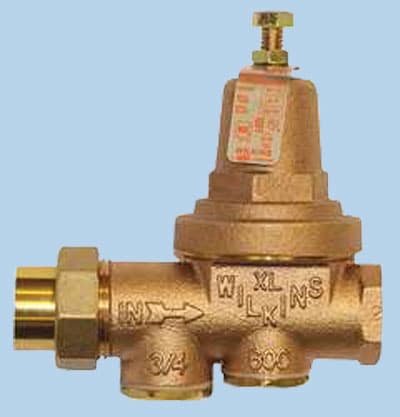
Prince William Water warns that a malfunctioning PRV can cause both high and low water pressure, and PRVs are the homeowner's responsibility to install and maintain.[1] The code requires the valve to be designed to remain open to permit uninterrupted water flow in case of valve failure,[3] but a worn diaphragm or a clogged strainer can still starve the house. Testing, resetting or replacing it is work for a licensed plumber, because the valve sits on the main supply and its setting has to stay at or below the code limit.
When the supply itself is low
No fixture work fixes low street pressure. Prince William Water explains that pressure at your tap is set by the difference between the water level in the tank serving your area and the elevation of your service connection,[1] so a house high on a hill gets less. Once you have checked the main valve and the fixtures, Prince William Water asks customers to call its Emergency Dispatch to schedule a pressure check at your service.[1] Other Virginia utilities have their own customer service lines for the same request.
Where the main or well cannot supply the minimum flow pressures the code requires at fixtures, the Virginia Plumbing Code requires a water pressure booster system.[3] That is a design, permit and plumber job. On a private well, low pressure throughout the house usually points to the pump, pressure switch or pressure tank, and Virginia law says only a certified individual may maintain or repair a water well system.[11] See why a well stops giving water.
Stop and call a pro if
- The gauge reads low with the main valve fully open and any filter bypassed, and your utility says the street pressure is normal. The pressure-reducing valve or the service line is next.
- The gauge reads above 80 psi, or the pressure swings up and down on its own.
- The water meter moves with every tap off, or you see water on a floor, ceiling or a soft wet spot in the yard over the service line. See what to do when a pipe bursts.
- The fix means replacing or rerouting pipe. Virginia's building code requires a permit before work that alters the water supply and distribution system.[12]
- You are on a well and the whole house is weak.
For what the repairs cost, see the cost of fixing low water pressure in Virginia, and for the signs that it is time to hire, when to call a plumber about low water pressure. You can browse all plumbing repair answers or find plumbers in Blacksburg.
If the pressure is still low after these checks, describe the low-pressure problem once and licensed local plumbers quote it.
Common questions
- What is normal water pressure in a house?
- A. O. Smith, a water heater maker, says pressure should be 50-60 psi and no higher than 80 psi. The Virginia Plumbing Code requires a pressure-reducing valve where static pressure inside a building exceeds 80 psi.
- Can I just turn up my pressure-reducing valve?
- The valve has an adjusting bolt, but the setting has to stay at or below 80 psi, and a valve that will not hold its setting is usually worn or clogged rather than set too low. Have a licensed plumber test and service it.
- Should I take the flow restrictor out of my showerhead?
- No. Moen says its showerheads use a pressure compensating flow regulator and that removing it will actually diminish performance. Federal law limits flow rates, so clean the showerhead or replace it with a WaterSense model instead.
- Why is only one faucet weak?
- Then the house pressure is probably fine and the restriction is at that fixture: a clogged aerator, a partly closed shutoff under the sink, a clogged in-line filter, or, if only hot or only cold is weak, a worn cartridge.
- Will a booster pump fix low pressure?
- Only when the supply itself is too low. The Virginia Plumbing Code calls for a booster system where the main cannot provide the minimum flow pressures at fixtures. It is a design, permit and licensed-plumber job, and it does nothing for a clogged aerator or a failing valve.
- I am on a well. Does this apply?
- The fixture checks do. Whole-house low pressure on a well usually points to the pump, pressure switch or pressure tank, and Virginia requires a certified water well systems provider for well system repair.
Sources
- [1] Water Pressure Issues, Prince William Water. Checked October 27, 2026.
- [2] Is Your Hot Water Not Getting Hot? Common Causes & What To Do About Them, A. O. Smith. Checked October 27, 2026.
- [3] Virginia Plumbing Code 2021, Chapter 6 Water Supply and Distribution, International Code Council, as published by UpCodes. Checked October 27, 2026.
- [4] Faucet Aerator Cleaning, Moen. Checked October 27, 2026.
- [5] Bathroom Faucet: Low Flow, Moen. Checked October 27, 2026.
- [6] Kitchen Faucet: Low Flow, Moen. Checked October 27, 2026.
- [7] Is there an adjustment that I can make to my faucet to increase the flow of the water?, Moen. Checked October 27, 2026.
- [8] Showerheads, U.S. Environmental Protection Agency, WaterSense. Checked October 27, 2026.
- [9] Installation Instructions: Heavy-Duty Water Filtration System GXWH40L (49-50220-4), GE Appliances. Checked October 27, 2026.
- [10] Virginia Household Water Quality Program: Hardness in Household Water (442-664), Virginia Cooperative Extension, Virginia Tech. Checked October 27, 2026.
- [11] Code of Virginia § 54.1-1129. Necessity for licensure, Code of Virginia, Virginia General Assembly. Checked October 27, 2026.
- [12] 13VAC5-63-80. Section 108 Application for permit (Virginia Uniform Statewide Building Code), Virginia Administrative Code, Virginia General Assembly. Checked October 27, 2026.
Want a pro to handle it?
Describe the job once. Licensed local businesses send quotes, and you pay only when you book one.
Get a quote for Plumbing Repair