Why is my water pressure suddenly low?
A sudden drop usually has one cause you can find: utility work such as hydrant flushing or a main break, a valve left partly closed, debris in aerators after the water was shut off, a clogged filter, a failing pressure-reducing valve, or a leak. Check whether neighbours are affected, whether it is one fixture or the whole house, and whether the water meter moves with every tap off.
Free to ask. Local shops send quotes, and you pay only when you book one.
By Kasra Taheri, Founder, LoclisPublished
Researched and drafted with AI, then checked claim by claim against the sources listed below before it was published. Prices and rules change; the dates beside each source say when it was last checked.
Step by step
Read when to stop and call a pro, further down this page, before you start.
Step 1: Ask a neighbour
Find out whether the house next door has low pressure too; if so, the cause is almost certainly in the public system.
Step 2: Look for utility work
Check for hydrant-flushing signs, crews on the street or a notice from your water utility, and wait a short while before doing anything else.[2]
Step 3: Test several fixtures
Run a few faucets and a shower on hot and cold to see whether the drop is everywhere, at one fixture, or on one temperature only.
Step 4: Clean the aerators
If the drop followed a shutoff or main repair, unscrew the aerators on weak faucets and rinse out any grit or debris.[7]
Step 5: Check the valves
Make sure the main shutoff and the stops under weak sinks are fully open, especially after any recent plumbing work.[6]
Step 6: Bypass the filter
Turn a whole-house filter or softener to bypass; if the pressure comes back, change the cartridge.[8]
Step 7: Watch the meter
Close every tap and fixture in the house, then look at the water meter; if it keeps moving, water is escaping somewhere.
Step 8: Call the utility
If none of this explains it, ask your water utility to check the pressure at your service connection.[1]
When water pressure drops overnight rather than over years, something specific changed, and it is usually easy to find. The common causes are work on the public water system, a valve left partly closed, debris in faucet aerators after the water was shut off, a clogged whole-house filter, a failing pressure-reducing valve, and a leak. Two quick questions sort most of them out: is it just your house, and is it every fixture or only some?
Is it just you?
Ask a neighbour. If their pressure is low too, the cause is almost certainly in the street, not your plumbing.
Hydrant flushing. Utilities flush mains to keep water quality up, and it can lower pressure for a short time. Prince William Water says most customers will not notice a drop, and "If a change in pressure does occur, it usually lasts for only 30 minutes or less."[2] Chesterfield County says flushing a line takes about 20 minutes, and customers may notice a slight drop in water pressure and/or temporary discolored water.[4] Its advice: "Running a faucet for a few minutes should clear up any discoloration."[4] Chesterfield also advises putting off laundry during flushing,[4] so discoloured water does not stain clothes.
Main breaks and outages. A break nearby can drop pressure for the whole neighbourhood. Report it to your utility; Prince William Water's Emergency Dispatch line is the number to report problems such as water main breaks and service outages,[1] and other utilities publish their own emergency numbers.
Is it one fixture or all of them?
Run a few faucets and a shower, on hot and on cold.

One or a few fixtures. Prince William Water's list of restrictions includes the main valve being partially closed or the screens on individual faucets needing cleaning.[1] A sudden drop at faucets right after the water was shut off, by you, a plumber or the utility, is often grit that broke loose and lodged in an aerator. Moen notes that aerators can accumulate debris and mineral deposits, which can restrict water pressure.[5] Moen's test for a blocked aerator is to unscrew it, remove any debris, refit it and try the water, and to replace the aerator if the problem persists.[7] Moen also notes that some faucets have in-line filters in the hot and cold supply lines, in the brass portion of the lines, with screens that can be rinsed clean.[6]
Hot or cold only, at one faucet. If only the hot or only the cold side is weak at one faucet, Moen points to the cartridge.[6] If hot is weak at every fixture and cold is fine, the restriction is usually at or near the water heater, which is a job for a licensed plumber.
A shower that suddenly weakens. Showerheads collect the same debris and scale as aerators. Clean the spray face before suspecting the valve.
Every fixture in the house. Look at the main valve first. A main left partly closed after a repair or a water heater swap is a common, free fix. Then look at anything installed on the main line.
A clogged filter or softener
Whole-house sediment filters can clog quickly when a main repair sends a slug of sediment through. GE's instructions for its whole-house system are direct: "You should change your filter when the water flow is noticeably reduced or at least every 3 months."[8] Put the filter or softener in bypass. If pressure jumps back, you have found it.
A failing pressure-reducing valve
Many houses on public water have a pressure-reducing valve just past the main shutoff. "A malfunctioning pressure reducing valve (PRV) can cause both high and low water pressure," Prince William Water warns, and PRVs are the homeowner's responsibility to install and/or maintain.[1]
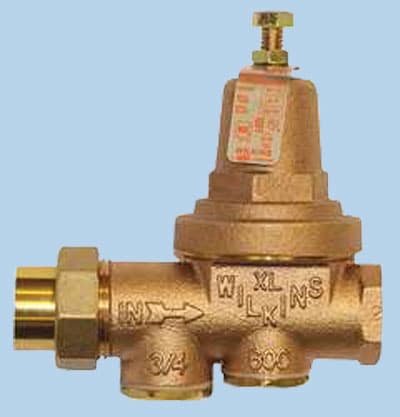
A worn valve can stick and starve the house, or the strainer inside it can clog with the same debris that blocks aerators. A hose-bib gauge tells the story: A. O. Smith, a water heater maker, says to check that water pressure is 50-60 PSI and no higher than 80 PSI.[9] A low reading with the main open and filters bypassed, while the utility reports normal pressure, points to the valve. Servicing it is plumber's work.
A leak
Water escaping from a broken pipe or service line is water that never reaches your taps. Close every tap and fixture, then watch the meter. If it moves, water is going somewhere. Prince William Water reminds customers that you as the customer are responsible for all water passing through the water meter, and Prince William Water staff can visit your property to check your meter for leaks.[3] Look for wet spots in the yard over the service line, damp crawl spaces and stained ceilings. In winter, a sudden drop can also be a frozen or burst pipe; see what to do when a pipe bursts.
On a well
On a private well, a sudden drop usually starts at the pump, the pressure switch, the pressure tank or a clogged sediment filter. Virginia law says only a certified individual may maintain or repair a water well system.[10] Check the filter, then call a certified well provider. See why a well stops giving water.
Stop and call a pro if
- The meter moves with every tap off, or you see water on a floor, ceiling or in the yard. Close the main valve if you can and call a plumber now.
- The whole house is weak, the main valve is fully open, filters are bypassed, and the utility says its pressure is normal.
- The pressure swings between low and high, or a gauge reads above 80 psi.
- Hot water is weak at every fixture.
- The fix means cutting or replacing pipe. Virginia's building code says a permit is required for installations or alterations involving the water supply and distribution system.[11]
For the checks that raise pressure, see how to increase water pressure in your house, and for when it is time to hire, when to call a plumber about low water pressure. Browse all plumbing repair answers or find plumbers in Blacksburg.
If the drop has not cleared up, describe the low-pressure problem once and licensed local plumbers quote it.
Common questions
- Why did my pressure drop after the water company worked on the main?
- Work on a main stirs up sediment, which can lodge in faucet aerators and in-line filters once the water comes back on. Clean the aerators first. If the whole house is still weak, call the utility, since the problem may be on its side.
- How long does low pressure from hydrant flushing last?
- Briefly. Prince William Water says most customers see no drop, and any change usually lasts 30 minutes or less. Chesterfield County says flushing a line takes about 20 minutes. If it lasts much longer, call your utility.
- Why is only my hot water pressure low?
- At a single faucet, a worn cartridge or a clogged in-line filter on the hot side is the usual cause. If hot is weak at every fixture, the restriction is usually at or near the water heater, which is work for a licensed plumber.
- Can a leak cause low water pressure?
- Yes. Water escaping from a broken pipe or service line is water that does not reach your taps. With every fixture off, a moving water meter is the quick sign. Prince William Water, for example, will send staff to check a meter for leaks.
- My pressure is low and then high. What is going on?
- That pattern points to the pressure-reducing valve. Prince William Water notes that a malfunctioning PRV can cause both high and low water pressure. Have a plumber test and service it.
- Why did the pressure drop suddenly on my well?
- On a well, a sudden drop usually starts at the pump, pressure switch or pressure tank, or a clogged sediment filter. Check the filter, then call a certified water well systems provider.
Sources
- [1] Water Pressure Issues, Prince William Water. Checked October 27, 2026.
- [2] How to... Water Pressure, Prince William Water. Checked October 27, 2026.
- [3] How to... Leak, Prince William Water. Checked October 27, 2026.
- [4] Flushing Water Lines at Hydrants, Chesterfield County, Virginia, Department of Utilities. Checked October 27, 2026.
- [5] Faucet Aerator Cleaning, Moen. Checked October 27, 2026.
- [6] Bathroom Faucet: Low Flow, Moen. Checked October 27, 2026.
- [7] Kitchen Faucet: Low Flow, Moen. Checked October 27, 2026.
- [8] Installation Instructions: Heavy-Duty Water Filtration System GXWH40L (49-50220-4), GE Appliances. Checked October 27, 2026.
- [9] Is Your Hot Water Not Getting Hot? Common Causes & What To Do About Them, A. O. Smith. Checked October 27, 2026.
- [10] Code of Virginia § 54.1-1129. Necessity for licensure, Code of Virginia, Virginia General Assembly. Checked October 27, 2026.
- [11] 13VAC5-63-80. Section 108 Application for permit (Virginia Uniform Statewide Building Code), Virginia Administrative Code, Virginia General Assembly. Checked October 27, 2026.
Want a pro to handle it?
Describe the job once. Licensed local businesses send quotes, and you pay only when you book one.
Get a quote for Plumbing Repair