How do I keep my water pressure steady?
Steady pressure comes from a healthy pressure-reducing valve and clear water paths. Check the pressure with a hose-bib gauge a few times a year and keep it near 50 to 60 psi and never above 80. Clean aerators and showerheads, change whole-house filter cartridges on schedule, deal with hard or iron-rich water, and have a plumber service the valve when readings drift.
Free to ask. Local shops send quotes, and you pay only when you book one.
By Kasra Taheri, Founder, LoclisPublished
Researched and drafted with AI, then checked claim by claim against the sources listed below before it was published. Prices and rules change; the dates beside each source say when it was last checked.
Step by step
Read when to stop and call a pro, further down this page, before you start.
Step 1: Take a baseline reading
With every tap closed, read a hose-bib pressure gauge and write the number and date down; A. O. Smith, a water heater maker, says to look for 50-60 PSI and no higher than 80 PSI.[2]
Step 2: Recheck through the year
Read the gauge again each season, including late at night once, and note any reading that has drifted from your baseline.
Step 3: Clean aerators and showerheads
Every few months, unscrew faucet aerators and rinse out debris and mineral deposits, and clean showerhead spray faces.[4]
Step 4: Change filter cartridges
Replace a whole-house filter cartridge when the flow is noticeably reduced or at least every 3 months, or on its maker's schedule.[6]
Step 5: Test your water
If you see scale or rust-coloured stains, have the water tested for hardness, iron and manganese before choosing any treatment.[7]
Step 6: Know your main valve
Find the main shutoff and the pressure-reducing valve, label them, and confirm the main is fully open after any plumbing work.
Step 7: Listen for warning signs
Note banging pipes, a dripping water heater relief valve or faucet washers that wear out fast, all signs of pressure running too high.[1]
Step 8: Book valve service
When readings drift or swing, have a licensed plumber test and service the pressure-reducing valve rather than adjusting it by guesswork.
Water pressure in a house is only as steady as two things: the pressure-reducing valve that holds back the street pressure, and the water paths after it. Keep the valve working, keep aerators, showerheads and filters clear, and keep an eye on the numbers, and pressure tends to stay where you want it. Most of that is a few minutes a season.
Why pressure moves around
Pressure from a public system is not fixed. Prince William Water explains that the pressure at your tap depends on the difference between the water level in the tank serving your area and the elevation of your service connection.[1] Street pressure is not constant, and the Virginia Plumbing Code plans for that: "Where street water main pressures fluctuate, the building water distribution system shall be designed for the minimum pressure available."[3] It also requires that pipe sizes are chosen so that, under conditions of peak demand, every fixture still gets at least the flow and pressure the code's table sets.[3]
So some dip when two fixtures run at once is normal. A shower that goes weak every time a toilet fills is not. That usually points to scaled or undersized pipe, or a valve that cannot keep up.
Know your numbers
Buy a pressure gauge that threads onto an outdoor hose bib. With every tap closed, open the hose bib and read it. A. O. Smith, a water heater maker, says to check that pressure is 50-60 PSI and no higher than 80 PSI.[2] The code sets the ceiling: where water pressure within a building exceeds 80 psi static, an approved pressure-reducing valve with a strainer must hold the house at no more than 80 psi.[3]
Write down the reading and the date. Check it again each season, and once late at night: GE's filter instructions note that household pressure may reach higher levels at night.[6] A change from your baseline tells you something has started to go wrong long before you notice it in the shower.
Look after the pressure-reducing valve
If you are on public water, there is a good chance a pressure-reducing valve sits on the main line just past the shutoff.
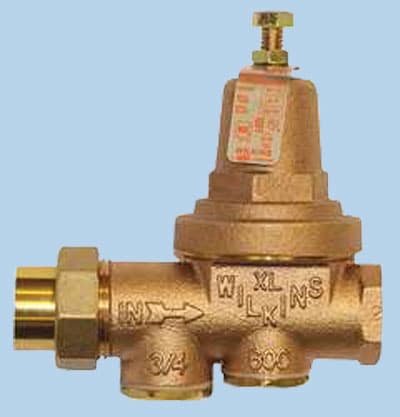
Prince William Water puts it plainly: "A malfunctioning pressure reducing valve (PRV) can cause both high and low water pressure. PRVs are the homeowner's responsibility to install and/or maintain."[1] It also describes what too much pressure looks like: internal plumbing lines that bang, a hot water pressure relief valve that trips, or faucet washers that wear out very quickly.[1]
The code requires these valves to be built and installed to permit repair or removal of parts without breaking a pipeline,[3] so a worn valve may be serviceable in place. When your readings drift, swing or creep toward 80 psi, have a licensed plumber test it. Turning the adjusting bolt by guesswork can push the house over the limit or hide a failing valve.
Keep fixtures clear

Moen notes that over time, aerators can accumulate debris and mineral deposits, which can restrict water pressure or distort the spray pattern.[4] Unscrew and rinse them every few months, more often if your water is hard, and after any time the water has been shut off. Clean showerhead spray faces the same way.
Leave the flow regulators in. Moen's showerheads include a pressure compensating flow regulator, and Moen warns that removing it will actually diminish performance.[5]
Change filters on schedule
A whole-house sediment filter loses flow as it loads, so a cartridge left too long slowly lowers the pressure for the whole house. GE's instructions for its whole-house system: "You should change your filter when the water flow is noticeably reduced or at least every 3 months."[6] Follow your own system's schedule, and write the date on the housing when you change it. The same goes for a softener: keep salt and service on the maker's schedule.
Deal with hard or iron-rich water
Scale builds up out of sight. Virginia Cooperative Extension notes: "In pipes, excessive mineral scaling can reduce water flow and pressure."[7] It adds: "Hard water can also reduce the efficiency and life span of water heaters."[7] Iron and manganese do similar damage; Extension notes that buildup of iron and manganese in pipelines, pressure tanks, water heaters, and water softeners is often associated with decreased water pressure.[8]
If you see white crust on fixtures or rust-coloured stains, test the water before you buy treatment. Extension advises "Testing your water annually" on private supplies, and its Virginia Household Water Quality Program runs county-based household water sampling clinics through local Extension offices.[7]
On a well
On a private well, steady pressure depends on the pump, the pressure switch and the pressure tank. Change the sediment filter yourself on schedule, and leave the rest to a certified provider: Virginia law says only a certified individual may maintain or repair a water well system.[9] See why a well stops giving water.
Stop and call a pro if
- The gauge reads above 80 psi at any time, or pipes bang when taps close.
- The water heater's relief valve drips or discharges.
- Pressure swings between high and low, or drifts steadily from your baseline.
- A fixture is weak even after its aerator and supply have been cleared.
- The fix needs new pipe or a booster pump. Virginia's building code says a permit is required for installations or alterations involving the water supply and distribution system.[10]
If the pressure is already low, see why water pressure is suddenly low and how to increase water pressure in your house. For water heater upkeep, see what maintenance a water heater needs each year. Browse all plumbing repair answers or find plumbers in Blacksburg.
When the valve or pipes need attention, describe the low-pressure problem once and licensed local plumbers quote it.
Common questions
- Why does my pressure drop when someone else uses water?
- Some drop is normal when two fixtures run at once. A large drop, such as a shower going weak whenever a toilet fills, usually means undersized or scaled supply piping or a pressure-reducing valve that cannot keep up. The code sizes piping so fixtures keep their minimum flow at peak demand.
- Why is my pressure higher at night?
- GE's filter instructions note that pressure may reach higher levels at night. A working pressure-reducing valve keeps the house steady anyway. If your gauge climbs at night, have the valve checked.
- How often should a pressure-reducing valve be serviced?
- There is no single interval. Watch the gauge: when readings drift from your baseline, swing, or climb toward 80 psi, have a licensed plumber test it. The code requires these valves to be repairable without breaking the pipeline, so service may be possible without replacing the valve.
- Does a water softener lower water pressure?
- Any softener or filter adds some restriction, and a clogged cartridge or worn media adds more. Putting it in bypass is the quick test. Hard water itself also lowers pressure over time, because Virginia Cooperative Extension notes that mineral scaling in pipes can reduce flow and pressure.
- How do I keep pressure steady on a well?
- On a well, steady pressure depends on the pump, the pressure switch and the pressure tank, plus a clean sediment filter. Change the filter on schedule yourself, and leave the tank, switch and pump to a certified water well systems provider.
Sources
- [1] Water Pressure Issues, Prince William Water. Checked October 27, 2026.
- [2] Is Your Hot Water Not Getting Hot? Common Causes & What To Do About Them, A. O. Smith. Checked October 27, 2026.
- [3] Virginia Plumbing Code 2021, Chapter 6 Water Supply and Distribution, International Code Council, as published by UpCodes. Checked October 27, 2026.
- [4] Faucet Aerator Cleaning, Moen. Checked October 27, 2026.
- [5] Is there an adjustment that I can make to my faucet to increase the flow of the water?, Moen. Checked October 27, 2026.
- [6] Installation Instructions: Heavy-Duty Water Filtration System GXWH40L (49-50220-4), GE Appliances. Checked October 27, 2026.
- [7] Virginia Household Water Quality Program: Hardness in Household Water (442-664), Virginia Cooperative Extension, Virginia Tech. Checked October 27, 2026.
- [8] Virginia Household Water Quality Program: Iron and Manganese in Household Water (442-656), Virginia Cooperative Extension, Virginia Tech. Checked October 27, 2026.
- [9] Code of Virginia § 54.1-1129. Necessity for licensure, Code of Virginia, Virginia General Assembly. Checked October 27, 2026.
- [10] 13VAC5-63-80. Section 108 Application for permit (Virginia Uniform Statewide Building Code), Virginia Administrative Code, Virginia General Assembly. Checked October 27, 2026.
Want a pro to handle it?
Describe the job once. Licensed local businesses send quotes, and you pay only when you book one.
Get a quote for Plumbing Repair