When should I call a plumber about low water pressure?
Call a plumber when the whole house stays weak after you have opened the main valve, cleaned the aerators and bypassed any filter, and your water utility says street pressure is normal. A failing pressure-reducing valve, scaled or leaking pipe, or a needed booster pump is licensed plumbing work. Call the utility first if neighbours are affected, and a certified well provider if you are on a well.
Free to ask. Local shops send quotes, and you pay only when you book one.
By Kasra Taheri, Founder, LoclisPublished
Researched and drafted with AI, then checked claim by claim against the sources listed below before it was published. Prices and rules change; the dates beside each source say when it was last checked.
Step by step
Read when to stop and call a pro, further down this page, before you start.
Step 1: Check the neighbours
Ask a neighbour or check your utility's notices; if the street is affected, the utility, not a plumber, is the call.
Step 2: Narrow it down
Note whether the low pressure is at one fixture or all of them, on hot, cold or both, and when it started.
Step 3: Clean the aerators
Clean the aerator on any weak faucet, because debris and mineral deposits there can restrict water pressure.[4]
Step 4: Open the main valve
Make sure the main shutoff is fully open, since a partly closed main valve is one of the common causes.[1]
Step 5: Bypass any filter
Put a whole-house filter or softener in bypass and see whether pressure recovers.[6]
Step 6: Read a gauge
Take a hose-bib pressure reading with all taps closed and write it down for the plumber; A. O. Smith, a water heater maker, says to look for 50-60 PSI and no higher than 80 PSI.[3]
Step 7: Ask for a utility check
Ask your water utility to check the pressure at your service connection before you book a plumber.[1]
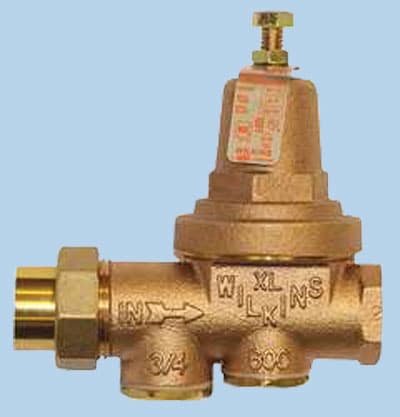
Call a plumber when the low pressure is in the whole house, you have ruled out the simple causes, and your water utility tells you the pressure coming to your property is normal. At that point the problem is on your side of the meter, usually in the pressure-reducing valve or the pipes, and that is licensed plumbing work in Virginia. Before then, the right call is often the utility, or a few minutes cleaning an aerator.
Who to call first
Your water utility, when it is not just you. If neighbours have weak pressure too, or it began with work on your street, the cause is in the public system. Prince William Water lists the main valve being partially closed, faucet screens that need cleaning, or a malfunctioning pressure reducing valve (PRV) as the usual reasons for low pressure at a home.[1] Prince William Water asks customers to rule out those restrictions first, then call its Emergency Dispatch to schedule a pressure check at the service.[1] It also says it can check your water pressure and will arrange for a service technician to visit your home.[2] Other utilities have their own customer service lines for the same request.
Nobody yet, when it is one fixture. A single weak faucet or shower is usually a clogged aerator, a half-closed stop valve or a worn cartridge. If only the hot or only the cold side is weak at one faucet, Moen points to the cartridge.[5] How to increase water pressure in your house walks through those checks.
A certified well provider, when you are on a well. Whole-house low pressure on a private well usually starts at the pump, pressure switch or pressure tank. Under Virginia law, only a certified individual may maintain or repair a water well system.[8] See why a well stops giving water and well pump services.
Signs it is time for a plumber
- The gauge reads low with everything open. A. O. Smith, a water heater maker, says to check that water pressure is 50-60 PSI and no higher than 80 PSI.[3] A low reading at an outdoor hose bib, with the main valve open, any filter bypassed and normal pressure confirmed by the utility, points to the pressure-reducing valve or the service line.
- The pressure swings or creeps up. Prince William Water warns that a malfunctioning PRV can cause both high and low water pressure, and PRVs are the homeowner's responsibility to install and/or maintain.[1] It describes high pressure as plumbing lines that bang, a water heater relief valve that trips, or faucet washers that wear out very quickly.[1] Where water pressure within a building exceeds 80 psi static, the Virginia Plumbing Code requires an approved pressure-reducing valve.[7]
- Pressure has faded over years. Gradual loss across the whole house, especially with old pipe or hard water, can mean scale or corrosion inside the pipe. A plumber can tell you how much pipe is affected.
- Hot is weak everywhere, cold is fine. The restriction is usually at or near the water heater, such as a valve, fitting or connector. Water heaters are work for a licensed plumber.
- There are signs of a leak. A water meter that keeps moving with every tap off, a damp spot in the yard over the service line, or stains on a ceiling all mean water is escaping.
- The supply is simply too low. When the main cannot deliver the flow pressures the code sets for fixtures, the code requires a water pressure booster system.[7] Booster design and installation is a plumber's job with a permit.
What licence to look for
Plumbing in Virginia is licensed trade work. Under Virginia law, no individual may work as a tradesman unless licensed, unless they work under the supervision of a tradesman licensed in that specialty.[8] For the business, the contractor statute says: "The Board shall require a master tradesmen license as a condition of licensure for electrical, plumbing, and heating, ventilation, and air conditioning contractors."[9]
The Board for Contractors adds that work valued at $1,000 or more requires a valid Virginia Contractor's License,[10] and warns: "A license number in an advertisement or on a business card does not necessarily mean the contractor's license is valid."[10] Check the licence on DPOR's lookup before you book. Virginia law requires all licensed contractors to provide a written contract for residential work,[10] so get the price, the scope and the pressure the valve will be set to in writing.
Permits
Under Virginia's building code, a permit is required for installations or alterations involving the water supply and distribution system.[11] Prince William County, for example, lists any work involving alterations to the house plumbing as needing a permit,[12] and exempts replacing existing plumbing fixtures where no alteration to the supply or drain, waste and vent systems is involved.[12] Repiping and booster pumps need one. For a valve swap, ask the plumber whether your locality requires a permit and who will pull it.
What to tell the plumber
You will get a faster, more accurate quote if you can say:
- the gauge reading with all taps closed, and what the utility found;
- whether it is every fixture or a few, and hot, cold or both;
- when it started, and any work done just before it (a new fixture, a water heater, work on the street);
- whether you have a pressure-reducing valve, a whole-house filter or a softener, and where they are;
- the age and type of pipe, if you know it.
Stop and call a pro if
- Water is showing on a floor, ceiling or wall, or the meter turns with every tap off. Close the main valve and call now; see what to do when a pipe bursts.
- The gauge reads above 80 psi, or pipes bang when taps close.
- The house is still weak after the utility confirms normal street pressure.
- The fix needs pipe cut, a valve replaced or a booster added.
- You are on a well and the whole house is weak.
For what the repairs typically involve and how they are priced, see the cost of fixing low water pressure in Virginia. Browse all plumbing repair answers or find plumbers in Blacksburg.
When it is time, describe the low-pressure problem once and licensed local plumbers quote it.
Common questions
- Should I call the water company or a plumber first?
- The water company, when neighbours have the same problem or the drop started with work on your street. A plumber, when your utility says the street pressure is normal and your house is still weak after you have checked the main valve, aerators and any filter.
- Is low pressure an emergency?
- Usually not on its own. It becomes urgent when it comes with water where it should not be, a meter that keeps turning with every tap off, or no water at all. Shut the main valve if water is escaping and call a plumber right away.
- What licence should a plumber have in Virginia?
- Individuals doing plumbing work must hold a tradesman licence or work under a licensed plumber's supervision, and a plumbing contracting business needs a contractor's licence with a master plumber behind it. You can check both on DPOR's licence lookup.
- Does a plumber need a permit to replace a pressure-reducing valve?
- Virginia's building code requires a permit for alterations involving the water supply and distribution system, such as new piping or a booster. Whether a like-for-like valve swap needs one is your local building department's call, so ask the plumber who will pull it.
- Who do I call if I have a well?
- A certified water well systems provider. Virginia law limits the maintenance and repair of water well systems to certified individuals, and on a well low pressure usually starts at the pump, pressure switch or pressure tank.
Sources
- [1] Water Pressure Issues, Prince William Water. Checked October 27, 2026.
- [2] How to... Water Pressure, Prince William Water. Checked October 27, 2026.
- [3] Is Your Hot Water Not Getting Hot? Common Causes & What To Do About Them, A. O. Smith. Checked October 27, 2026.
- [4] Faucet Aerator Cleaning, Moen. Checked October 27, 2026.
- [5] Bathroom Faucet: Low Flow, Moen. Checked October 27, 2026.
- [6] Installation Instructions: Heavy-Duty Water Filtration System GXWH40L (49-50220-4), GE Appliances. Checked October 27, 2026.
- [7] Virginia Plumbing Code 2021, Chapter 6 Water Supply and Distribution, International Code Council, as published by UpCodes. Checked October 27, 2026.
- [8] Code of Virginia § 54.1-1129. Necessity for licensure, Code of Virginia, Virginia General Assembly. Checked October 27, 2026.
- [9] Code of Virginia § 54.1-1100. Definitions, Code of Virginia, Virginia General Assembly. Checked October 27, 2026.
- [10] What You Should Know Before You Hire a Contractor, Virginia Board for Contractors, DPOR. Checked October 27, 2026.
- [11] 13VAC5-63-80. Section 108 Application for permit (Virginia Uniform Statewide Building Code), Virginia Administrative Code, Virginia General Assembly. Checked October 27, 2026.
- [12] Do I Need a Permit?, Prince William County, Virginia, Building Development Division. Checked October 27, 2026.
Want a pro to handle it?
Describe the job once. Licensed local businesses send quotes, and you pay only when you book one.
Get a quote for Plumbing Repair