How do I keep a fence gate from sagging?
Hang the gate on a stiff, well-set hinge post, keep its frame square with a diagonal brace running from the bottom hinge corner up to the latch side or an anti-sag cable, use strong coated hinges with long screws, and keep the wood off wet ground. Then check it each spring and fall: tighten screws and adjust the hinges or turnbuckle before the latch starts to drag.
Free to ask. Local shops send quotes, and you pay only when you book one.
By Kasra Taheri, Founder, LoclisPublished
Researched and drafted with AI, then checked claim by claim against the sources listed below before it was published. Prices and rules change; the dates beside each source say when it was last checked.
Step by step
Read when to stop and call a pro, further down this page, before you start.
Step 1: Check the hinge post
Twice a year, hold a level on two faces of the hinge post and push on it; a post that has moved needs resetting before anything else.
Step 2: Tighten the hinge screws
Drive every hinge and latch screw snug, and swap any that spin for longer exterior screws into solid wood.
Step 3: Measure the diagonals
Tape the gate corner to corner both ways; if the two measurements drift apart, the frame has started to rack.
Step 4: Adjust the cable or hinges
Give an anti-sag turnbuckle a turn to take up slack, or use the hinge adjusters if the gate has them, until the latch meets its catch without lifting.[3]
Step 5: Look at the brace
Check that a wood brace still sits tight from the bottom hinge corner to the top latch corner and that its screws have not pulled out.
Step 6: Clear the bottom
Rake soil, mulch and leaves away from the bottom of the gate and the hinge post so the wood can dry after rain.[6]
Step 7: Probe for rot
Push a screwdriver into the bottom rail and the post at the soil line; soft wood there means a repair is due.
Step 8: Check the hardware
Replace hinges or brackets that show heavy rust or bending with coated or galvanized hardware rated for treated wood.[5]
Step 9: Refinish exposed wood
Renew paint or stain on the gate, paying attention to the top edges and the bottom rail where water sits longest.
Keep the hinge post from moving, keep the frame square, and keep the wood dry. A gate that has all three rarely sags, and a quick check each spring and fall catches the small slips before the latch starts to drag. If your gate has already dropped, how to fix a sagging fence gate covers squaring it and fitting a brace or cable first.
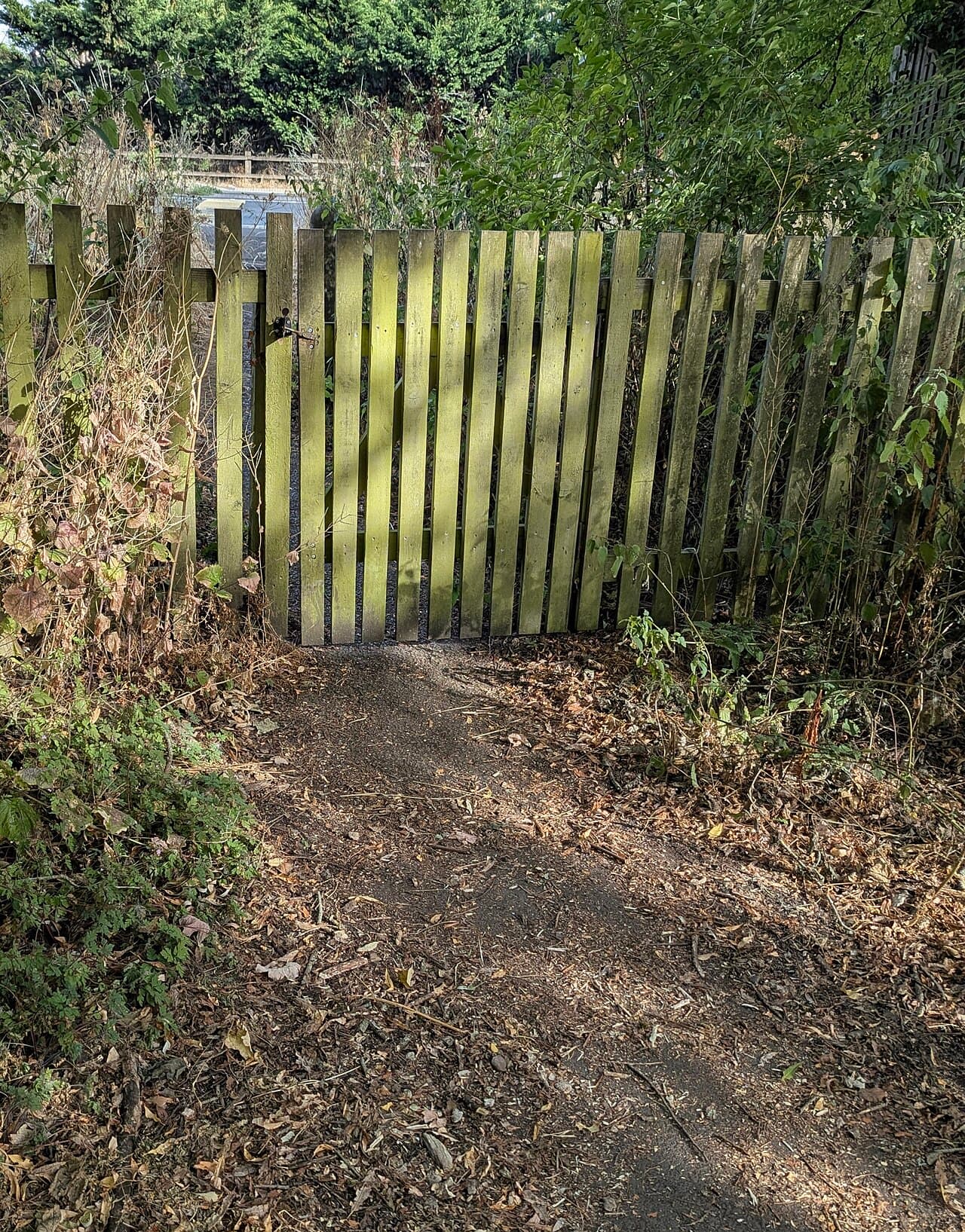
Start with a hinge post that cannot move
Post strength is especially important for corner and gate posts,[1] because the gate hangs all its weight off one post and levers on it every time it swings. Most gates that keep sagging are hanging on a post that is slowly tipping.
When a gate post is set or reset, the usual concrete-post method calls for a post hole three times the post's width and one-third to one-half of the post's above-ground length deep, plus 6 inches, with 6 inches of gravel or crushed stone in the bottom.[2] Finishing the concrete so it slopes away from the post helps protect it from rot.[2] Give the concrete time before the gate goes on: one gate maker says to set gate posts 2 to 3 days before the gate is hung, because of concrete cure times,[3] and notes that a hinge post that is not tied to a fence panel may need extra stiffening.[3]
For the post itself, the Forest Products Laboratory recommends pressure-treated wood for the high hazard of ground contact.[6] Resetting a post means digging, and Virginia law requires a locate request to the notification center before any excavation.[7] Virginia 811 asks homeowners to contact it three days before any digging project, fences included, and the service is free.[8]
Keep the frame square
A gate is a rectangle that wants to become a parallelogram. Two things stop it.
A diagonal brace from the bottom corner on the hinge side up to the top corner on the latch side. In that direction it pushes the latch side up and carries the load into the bottom hinge. It should fit tight against the rails and be screwed to every board it crosses. A brace that runs the other way, from the top hinge corner down to the bottom latch corner, does little to stop the sag.
An anti-sag cable with a turnbuckle, running from the top of the hinge side down to the bottom of the latch side. For large gate panels, an anti-sag cable may be needed to stop the sag,[3] even on a gate that already has a brace. The cable's advantage for upkeep is that it can be tightened again with a quarter turn.
Corner brackets add stiffness too: galvanized corner connectors in the frame's corners hold them at 90 degrees.[4]
Use hardware that outlasts the wood
Hinges are where most of the gate's weight lands, so they should be rated for its size and fixed with long exterior screws into solid wood, not short screws into a board's edge. A tall privacy gate often needs three hinges rather than two.
Rust matters more than it looks. Metal connectors and fasteners can corrode and lose carrying capacity in corrosive conditions, and preservative-treated wood, soils and long periods of wetness are among the causes.[5] Choose coated or galvanized hinges, brackets and screws rated for treated lumber, and replace any that are flaking or bent.
On a double gate, a drop rod on the inactive leaf drops into a hole or sleeve in the ground[3] so that leaf stays put while the other swings. A missing or bent drop rod lets both leaves hang off their hinges and sag together.
Keep the bottom dry
Decay fungi need mild temperatures, moisture and air,[6] and wood gets wet enough for serious decay only when rain, condensation or wet ground soaks it.[6] On a gate, that means the bottom rail and the base of the hinge post. Leave clearance under the gate, keep mulch and soil pulled back from the post, turn sprinklers away, and keep a finish on the top edges and the bottom rail. Soft wood cannot hold a screw, and a gate whose hinge screws sit in rot will sag however well it is braced. How to make a wood fence last longer covers finishes and drainage for the rest of the fence.
A twice-a-year routine
Weather and temperature changes can mean periodic hinge adjustment to keep the latch connecting,[3] so put the gate on the same spring and fall list as cleaning gutters. The steps on this page are a short job: check the post, tighten the screws, measure the diagonals, give the cable a turn, and clear the bottom. Discourage children from riding the gate as it swings, and do not hang heavy planters or bikes from it.
Stop and call a pro if
- The hinge post moves when you push it, is soft at the soil line, or has a crack running down from the hinges.
- The gate is a heavy drive gate, a double gate across a driveway, or has an electric opener.
- The gate is part of a swimming pool barrier and no longer closes and latches by itself.
- The frame is rotted at the bottom rail or stiles. Rebuilding the gate is usually the better repair.
- The gate post is part of a deck, porch or retaining wall rather than a freestanding fence.
For heavier repairs, browse fence repair businesses, all exterior answers, or exterior businesses around Blacksburg. To have it done, describe the gate once and local businesses send written quotes.
Common questions
- What is the single biggest thing that keeps a gate from sagging?
- A hinge post that does not move. Post strength is especially important for corner and gate posts, because the gate hangs its whole weight off that one post. A square frame and good hinges help, but none of them survive a post that tips.
- Is a cable kit or a wood brace better?
- Both work when they are installed the right way round. A wood brace runs from the bottom hinge corner up to the top latch corner and pushes. A cable runs from the top of the hinge side to the bottom of the latch side and pulls, and its turnbuckle can be tightened again later, which makes it handy for maintenance.
- How often should I adjust my gate?
- Check it in spring and fall. Weather and temperature changes can mean periodic hinge adjustment to keep the latch connecting, and a quarter turn on a turnbuckle or a few snugged screws at the first sign of dragging is far easier than squaring a gate that has dropped an inch.
- Does a wider gate sag more?
- Yes. The farther the latch side sits from the hinges, the more leverage its weight has on the hinges and the post. For a wide opening, two narrower leaves on a double gate are often easier to keep level than one wide one, with a drop rod holding the inactive leaf.
- Should the bottom of the gate touch the ground?
- No. Leave clearance so the gate swings freely over the ground and does not sit in wet soil or leaves. Wood gets wet enough for serious decay only when rain, condensation or wet ground soaks it, and a bottom rail resting on soil stays wet.
Sources
- [1] Fencing Materials for Livestock Systems, publication 442-131 (archived), Virginia Cooperative Extension, Virginia Tech. Checked October 26, 2026.
- [2] Setting Posts in Concrete, The QUIKRETE Companies. Checked October 26, 2026.
- [3] Trex Seclusions Double Gate Installation Guide (2013), Trex Company. Checked October 26, 2026.
- [4] Fence Repair (DIY sheet DIY-CSFNCRPR13, 2013, archived), Simpson Strong-Tie Company Inc.. Checked October 26, 2026.
- [5] Corrosion Information for all Simpson Strong-Tie Product Lines, Simpson Strong-Tie Company Inc.. Checked October 26, 2026.
- [6] Wood Handbook, Chapter 14: Biodeterioration of Wood, USDA Forest Service, Forest Products Laboratory. Checked October 26, 2026.
- [7] Va. Code § 56-265.17, Notification required prior to excavation or demolition, Code of Virginia, Virginia General Assembly. Checked October 26, 2026.
- [8] Virginia 811: Safety is in Your Hands, Virginia 811. Checked October 26, 2026.
Want a pro to handle it?
Describe the job once. Licensed local businesses send quotes, and you pay only when you book one.
Get a quote for Roofing