Why is my fence leaning after a storm?
A storm finds the weakest part of a fence. Most often that is posts already rotting at the ground line, footings too small for soaked soil, or a tree or limb that landed on the run. Look at the posts at the ground first: a sound post that tipped can usually be reset, while a rotted or snapped one has to be replaced.
Free to ask. Local shops send quotes, and you pay only when you book one.
By Kasra Taheri, Founder, LoclisPublished
Researched and drafted with AI, then checked claim by claim against the sources listed below before it was published. Prices and rules change; the dates beside each source say when it was last checked.
Step by step
Read when to stop and call a pro, further down this page, before you start.
Step 1: Look for wires first
If a power line is down or touching the fence, stay at least 35 feet from the line and anything touching it and report it.[1]
Step 2: Photograph everything
Take wide shots and close-ups of each leaning section, broken post and fallen limb before you move anything, for insurance and for quotes.
Step 3: Leave trees to a tree pro
If a trunk or large limb is lying on the fence, do not cut it free yourself; tree removal is work for a tree service.
Step 4: Walk the whole run
Note which posts lean, which way, and whether the concrete footing has tipped with the post or the post has broken above it.
Step 5: Probe the posts
Push a screwdriver into each leaning post just below the soil line; wood that is soft or crumbles has rotted and needs replacing.
Step 6: Prop the leaning sections
Brace each leaning panel with a 2x4 angled from the rail to a stake in the ground so wind and weight do not pull it the rest of the way down.
Step 7: Unlatch any gate
Open or unlatch a gate on a leaning post and prop its latch side so it stops levering on the post.
Step 8: Call your insurer if it is large
For a long run, a tree strike or damage near the house, call your insurance company before repairs begin and ask how fences are covered on your policy.[5]
Step 10: Reset or replace
Reset sound posts plumb in fresh concrete and replace rotted or snapped ones with posts rated for ground contact.[2]
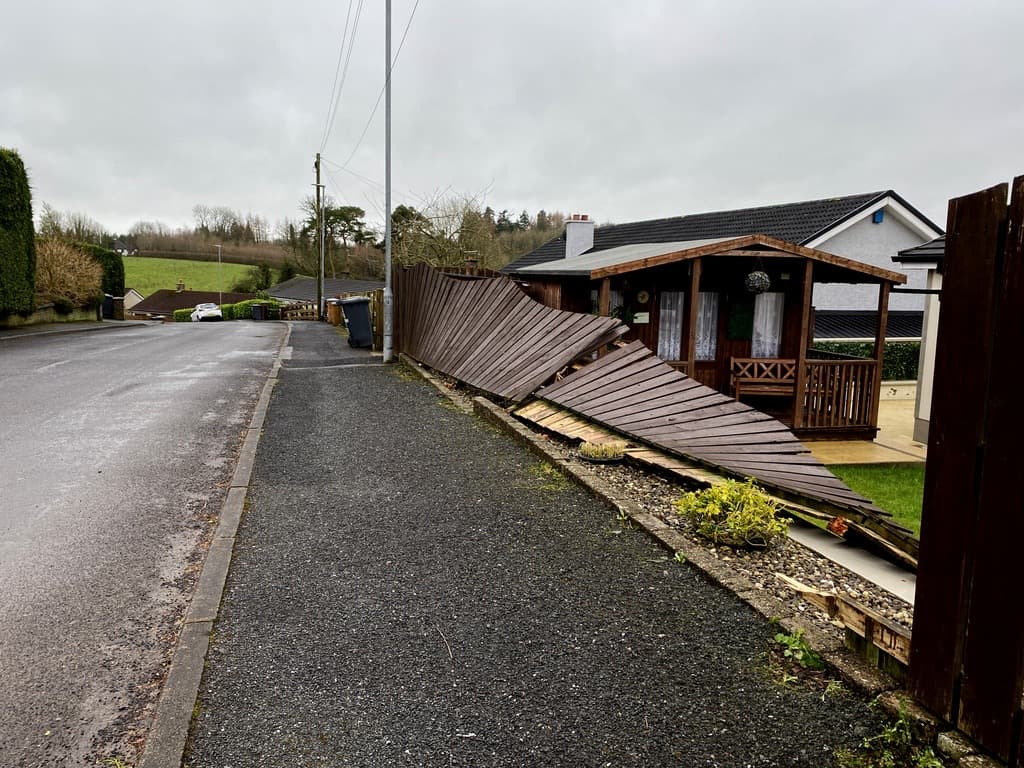
A storm pushes on a fence harder than any ordinary day, and the weakest part gives first. On most fences that is the posts, at or just below the ground: wood that has been rotting quietly for years, footings that were too small for soaked soil, or a tree or limb that landed on the run. Before you prop anything, find out which of those you have, because it decides whether the fence can be straightened or has to be rebuilt.
First, make it safe
Look up before you walk over. If a power line is down on or near the fence, stay at least 35 feet from the line and from anything touching it, treat the line as energized, and report it to the utility or 911.[1]
If a trunk or a large limb is lying on the fence, leave it there. Cutting a tree free of a fence is work for a tree service, not a fence repair.
Read the lean
Walk the whole run and look at each leaning post where it enters the ground.
- The post and its concrete collar have tipped together, and the wood is hard. The footing moved in wet soil. The post can usually be dug out on one side, pushed plumb and reset.
- The post snapped or bent at the soil line. That is rot, not wind alone. The post has to be replaced.
- The post rocks inside a concrete collar that stayed put. The wood has shrunk or rotted inside the concrete. Probe it: soft wood means replacement.
- One section is crushed or pushed over and the posts on either side are fine. Something hit it, usually a limb. The panel and perhaps one post need replacing.
- Only the gate post leans. Post strength is especially important for corner and gate posts,[4] and a gate levers on its post in every gust. How to fix a sagging fence gate covers the gate once the post is sound.
Why storms find weak posts
Rot at the ground line. Decay fungi need mild temperatures, moisture and air,[2] and serious decay happens only when wood is wetter than its fiber saturation point, which averages 30% moisture.[2] The few inches of post just below the soil sit at that wetness for months. A post that is half rotted there still holds a fence on a calm day and breaks in the first big wind. For replacements, the Forest Products Laboratory recommends pressure-treated wood for the high hazard of ground contact.[2] Why a wood fence rots at the bottom explains the pattern in more detail.
Soaked soil. Long rain before and during a storm turns clay soft, and a footing that held in dry ground lets go. Low spots, downspouts that empty toward the fence and sprinkler-soaked beds make it worse.
Footings too small for the fence. The usual concrete-post method calls for a post hole three times the post's width and one-third to one-half of the post's above-ground length deep, plus 6 inches.[3] For loose or sandy soil, a tube form is recommended.[3] Posts set shallower than that often stand for years and then go over together in one storm.
Wind on a solid fence. A solid privacy fence catches wind like a sail, while a picket or open board fence lets much of it through. Board fences typically have posts every 8 feet,[4] and a wider span puts more of that load on each post.
If several neighbouring posts all lean the same way, the cause is the footings or the soil along the whole run, and resetting the run at once usually beats chasing single posts. Why new fence posts lean covers that pattern on newer fences.
Insurance and a fallen tree
Photograph the damage before anything is moved. Then read your policy or call your insurer, because fence coverage varies. The Bureau of Insurance's summary of the common HO-3 policy lists, among the usual exclusions, damage to fences by freezing, thawing, or the pressure or weight of ice or water.[5] Many insurers have a separate deductible for wind, hail or named storms, written either as a flat amount or as a percentage of the dwelling coverage,[5] and a wind deductible can apply after a thunderstorm or a tropical storm, not only a hurricane.[6] For a short run, the repair may cost less than the deductible.
When a tree comes down, most policies pay for the reasonable cost of cleaning up and removing a tree that falls and damages your fence.[6] If it was the neighbor's tree, unless negligence can be proven, the neighbor's policy covers the neighbor's property and yours covers yours, and if the tree came down in a storm, the owner generally would not be considered negligent.[6] For a fence on the boundary, who is responsible for a fence between neighbors covers how Virginia splits the repair.
Fixing it
Resetting or replacing posts means digging, and Virginia law requires a locate request to the notification center before any excavation.[7] Virginia 811 asks homeowners to contact it three days before any digging project, fences included, and the service is free.[8] How to fix a leaning fence post walks through straightening a sound post, and how to set a fence post in concrete covers a replacement.
Stop and call a pro if
- A power line is down, sagging or touching the fence, or a tree is lying on it.
- Several posts or a whole run are down, or the fence is leaning over a sidewalk, driveway or a neighbor's yard.
- The fence is a swimming pool barrier, sits on a retaining wall, or holds back soil.
- The posts are close to utility marks, or you have not had a Virginia 811 locate.
- You are filing an insurance claim and need a written repair estimate.
A Class C contractor's licence covers jobs where a single contract is over $1,000 and under $30,000,[9] so check the business on DPOR's licence lookup before you sign. Browse fence repair businesses, all exterior answers, or exterior businesses around Blacksburg. To get it fixed, describe the storm damage once and local businesses send written quotes.
Common questions
- My fence stood for years. Why did one storm knock it over?
- Because the storm found a weakness that was already there. Posts often rot slowly at the ground line for years while the fence still looks fine, and a hard wind on soaked soil is the first load big enough to finish the break.
- Can I just push the fence back up?
- Only if the posts are sound and the footings tipped in soft soil, and even then it needs to be braced and reset in concrete rather than packed with dirt. A post that snapped or rotted at the ground will lean again. Probe each one before you decide.
- Does homeowners insurance cover a fence blown over by wind?
- It depends on your policy, so ask your insurer. Look for how fences are covered, what wind or named-storm deductible applies, and whether the repair would cost more than the deductible. A tree that falls and damages the fence is often handled differently from wind alone.
- My neighbor's tree fell on our fence. Who pays?
- unless negligence can be proven, the neighbor's policy covers the neighbor's property and yours covers yours, and if the tree came down in a storm, the owner generally would not be considered negligent. Report it to your own insurer and talk to your neighbor about the fence itself.
- How soon do I have to fix it?
- Prop it right away so it does not fall the rest of the way, especially along a sidewalk or a neighbor's yard. Fix it promptly if it encloses a pool, keeps a dog in, or is a shared boundary fence your neighbor relies on.
Sources
- [1] Stay Clear of Downed Power Lines, Rappahannock Electric Cooperative. Checked October 26, 2026.
- [2] Wood Handbook, Chapter 14: Biodeterioration of Wood, USDA Forest Service, Forest Products Laboratory. Checked October 26, 2026.
- [3] Setting Posts in Concrete, The QUIKRETE Companies. Checked October 26, 2026.
- [4] Fencing Materials for Livestock Systems, publication 442-131 (archived), Virginia Cooperative Extension, Virginia Tech. Checked October 26, 2026.
- [5] Virginia Homeowners Insurance Guide, Virginia State Corporation Commission, Bureau of Insurance. Checked October 26, 2026.
- [6] When Disaster Strikes: Insured Homeowners Loss, Virginia State Corporation Commission, Bureau of Insurance. Checked October 26, 2026.
- [7] Va. Code § 56-265.17, Notification required prior to excavation or demolition, Code of Virginia, Virginia General Assembly. Checked October 26, 2026.
- [8] Virginia 811: Safety is in Your Hands, Virginia 811. Checked October 26, 2026.
- [9] Va. Code § 54.1-1100, Definitions (Contractors), Code of Virginia, Virginia General Assembly. Checked October 26, 2026.
Want a pro to handle it?
Describe the job once. Licensed local businesses send quotes, and you pay only when you book one.
Get a quote for Roofing