How do I fix a sagging fence gate?
Find what moved first. Most sagging wood gates have loose hinge screws, a frame that has racked out of square, or a hinge post that leans. Tighten or upsize the hinge screws, prop the latch side until the frame is square, then hold it there with corner brackets, a diagonal brace or an anti-sag cable. A leaning hinge post has to be reset first.
Free to ask. Local shops send quotes, and you pay only when you book one.
By Kasra Taheri, Founder, LoclisPublished
Researched and drafted with AI, then checked claim by claim against the sources listed below before it was published. Prices and rules change; the dates beside each source say when it was last checked.
Step by step
Read when to stop and call a pro, further down this page, before you start.
Step 1: Find what moved
Hold a level on the hinge post, check whether the hinges rock when you lift the latch end, and measure the gate's two diagonals.
Step 2: Fix a leaning post first
If the hinge post is out of plumb or rocks in the ground, reset or replace it before you work on the gate, or the sag comes straight back.
Step 3: Tighten the hinges
Drive every hinge screw home and replace stripped ones with longer exterior-rated screws that bite into solid wood in the post and the gate.
Step 5: Check for square
Measure corner to corner both ways; when the two diagonals match, the frame is square.
Step 6: Add corner brackets
Screw galvanized corner connectors into the inside corners of the frame so they hold each corner at 90 degrees.[1]
Step 7: Or add a wood brace
Fit a diagonal board tight between the rails, running from the bottom hinge corner up to the top latch corner, and screw it to the rails and boards.
Step 8: Or add an anti-sag cable
Fix the upper cable bracket on the hinge side near the top and the lower bracket on the latch side near the bottom, then tighten the turnbuckle to take up slack.[2]
Step 9: Remove the prop and test
Pull the block out, swing the gate several times, and check that it clears the ground and the latch closes without lifting the gate.
Step 10: Reset the latch
If the latch still misses, move the latch or its catch to meet the gate where it now hangs instead of forcing the gate.
Find what moved before you fix anything. A wood gate sags for one of three reasons: the hinges have loosened, the frame has racked out of square so the latch corner drops, or the hinge post itself is leaning. The first two are an afternoon's work with a drill, a level and a few brackets. The third means resetting the post, and no brace on the gate will hold until that is done.
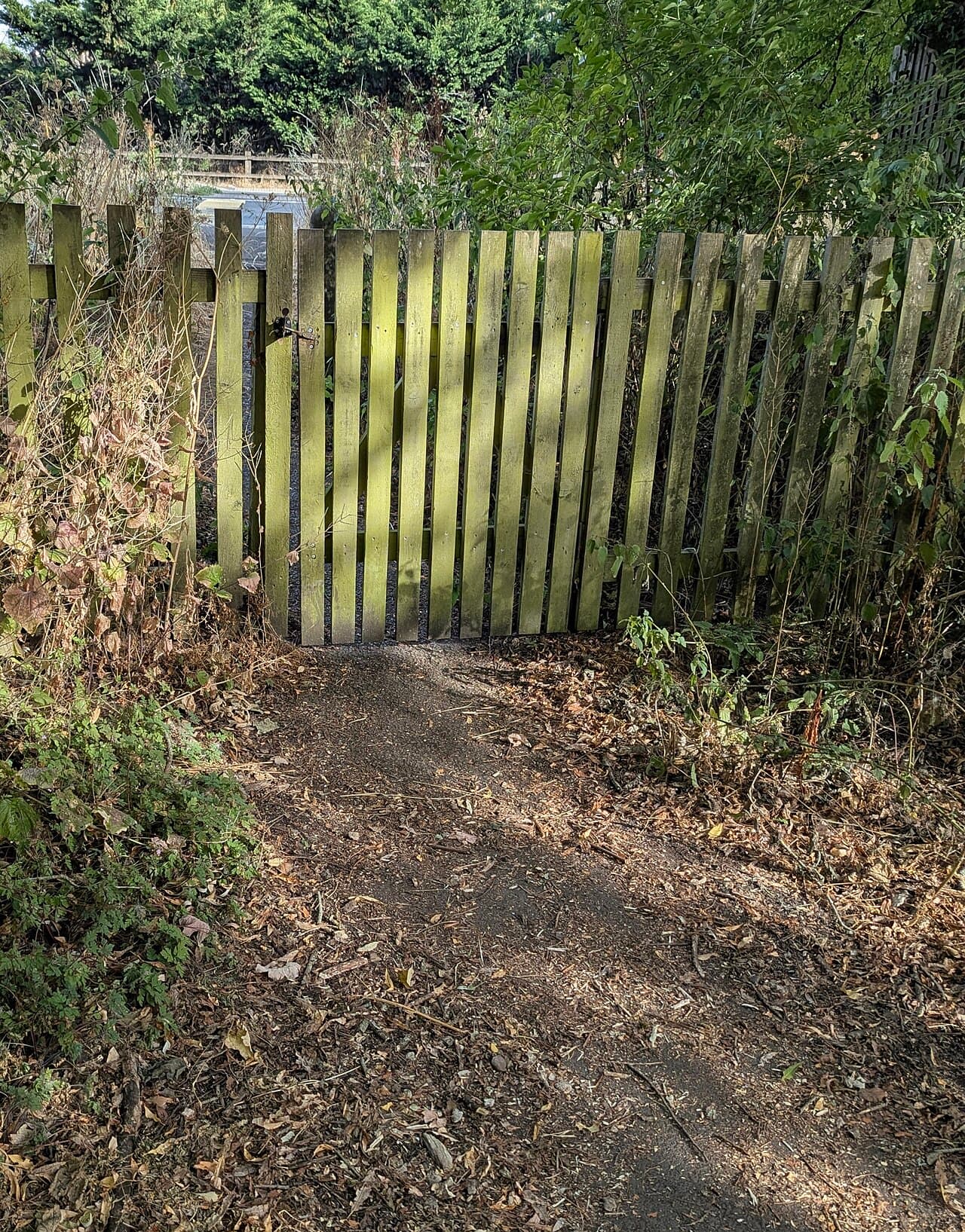
What makes a gate sag
Loose or undersized hinges. Short hinge screws in soft wood work loose as the gate swings. A light strap hinge on a tall privacy gate bends slowly under the weight.
A racked frame. A gate is a rectangle hanging from one side. Without a brace, its own weight pulls the latch corner down until the frame becomes a parallelogram and the latch no longer meets its catch.
A leaning hinge post. Post strength is especially important for corner and gate posts,[4] because a gate hangs all its weight off one post and pulls on it every time it swings. A post that tips even a little drops the latch side a lot.
Rot. Decay fungi need mild temperatures, moisture and air,[5] so the bottom rail, the base of the hinge post and any board touching soil soften first. Screws pull out of soft wood however tight you drive them.
Diagnose it in five minutes
- Level the hinge post. Hold a level on two faces. If it is out of plumb, or it moves when you push on it, the post is the repair. How to fix a leaning fence post covers straightening and resetting it.
- Lift the latch end. If the hinge leaves or screw heads move as you lift, the hinges are loose.
- Measure the diagonals. Tape from top left to bottom right, then top right to bottom left. If they differ, the frame has racked.
- Probe the wood. Push a screwdriver into the bottom rail and the post at the soil line. Soft wood means replacing parts, not adjusting them.
Fix the hinges first
Drive every hinge screw home. Replace any that spin with longer exterior-rated screws that reach solid wood, or shift the hinge slightly so the screws land in fresh wood. If a hinge is bent or rusted through, replace it with a heavier one rated for the gate's size. Metal connectors and fasteners can corrode and lose carrying capacity in contact with corrosive materials, and preservative-treated wood is one of them,[3] so use coated or galvanized hardware rated for treated lumber.
Square the frame and hold it there
The repair is simple: lift the latch side until the frame is square again, prop it there, and fit metal corner connectors in the frame's corners to hold them at 90 degrees.[1] Simpson Strong-Tie recommends its ZMAX galvanized connectors for exterior projects and for work with preservative-treated wood.[1] Brackets alone suit a small, light gate. A larger gate also needs a brace or a cable.
A wood brace runs from the bottom corner on the hinge side up to the top corner on the latch side. It works in compression: the latch side's weight pushes down the brace into the bottom hinge and the post. Cut it to fit tight between the rails, then screw it to the rails and to every board it crosses.
An anti-sag cable runs the other way, because a cable pulls instead of pushes: the upper bracket goes on the hinge side near the top of the gate and the lower one on the latch side near the bottom.[2] Tightening the turnbuckle takes up the slack,[2] and propping the latch side on a block of wood at the height you want makes the cable easier to fit.[2] A cable kit is the quickest fix on a gate you do not want to take apart, and it can be tightened again later.
Whichever you use, weather and temperature changes can mean periodic hinge adjustment,[2] so expect to retighten once or twice a year. How to keep a fence gate from sagging covers the seasonal checks and the build details that stop the problem coming back.
When the post is the problem
If the hinge post leans or rocks, square the gate only after the post is fixed. Resetting a post means digging beside it, and Virginia law requires a locate request to the notification center before any excavation.[6] Virginia 811 asks homeowners to contact it three days before any digging project, fences included, and the service is free.[7]
A new or reset post set in concrete needs time before it carries a gate, and one gate maker sets gate posts 2 to 3 days before hanging the gate because of concrete cure times.[2] Hang the gate the same afternoon and the post can tip in the soft concrete. How to set a fence post in concrete covers the hole, the gravel base and the pour.
What you need
A drill-driver, a 4-foot level, a tape measure, a framing square, a few wood blocks or shims, exterior screws, galvanized angle brackets, and either a straight 2x4 or 2x6 for a brace or an anti-sag cable kit with a turnbuckle.
Stop and call a pro if
- The hinge post is rotted, snapped or set so shallow that it moves when you push it, and you have not requested a Virginia 811 locate.
- The gate is a heavy drive gate, a double gate across a driveway, or a metal gate with welded hinges or an electric opener.
- The gate is part of a swimming pool barrier, where the latch and self-closing hardware have to work every time.
- The bottom rail and stiles are soft with rot. A rebuilt or new gate usually costs less than chasing repairs on rotten wood.
- The gate hangs on a post that is part of a deck, porch or retaining wall rather than a freestanding fence.
If you hire it out, a Class C contractor's licence covers jobs where a single contract is over $1,000 and under $30,000,[8] so check the business on DPOR's licence lookup before you sign. Browse fence repair businesses, all exterior answers, or exterior businesses around Blacksburg. To get it fixed, describe the sagging gate once and local businesses send written quotes.
Common questions
- Which way should the diagonal brace on a wood gate run?
- From the bottom corner on the hinge side up to the top corner on the latch side. In that position the brace pushes the latch side up and carries the load into the bottom hinge. Run the other way, it does little to stop the sag.
- Which way does an anti-sag cable run?
- The opposite way to a wood brace, because a cable pulls instead of pushes. The upper bracket goes on the hinge side near the top and the lower bracket on the latch side near the bottom, and the turnbuckle takes up the slack.
- Can I fix a sagging gate without taking it off its hinges?
- Usually, yes. Tightening hinge screws, squaring the frame on a prop, adding corner brackets and fitting a brace or cable can all be done with the gate hanging. Take it down only when the hinges need moving or the frame needs rebuilding.
- The gate is fine but the post leans. What now?
- Then the post is the repair. A leaning hinge post has to be straightened and reset, or replaced if it has rotted at the ground. That involves digging, and Virginia law requires a locate request before any excavation, so contact Virginia 811 first.
- Why does my gate sag again every winter?
- Wood swells and shrinks with the seasons, screws loosen in softened wood, and frost can move a shallow post. Weather and temperature changes can mean periodic hinge adjustment, so check the hinges, brace and cable each fall and spring.
Sources
- [1] Fence Repair (DIY sheet DIY-CSFNCRPR13, 2013, archived), Simpson Strong-Tie Company Inc.. Checked October 26, 2026.
- [2] Trex Seclusions Double Gate Installation Guide (2013), Trex Company. Checked October 26, 2026.
- [3] Corrosion Information for all Simpson Strong-Tie Product Lines, Simpson Strong-Tie Company Inc.. Checked October 26, 2026.
- [4] Fencing Materials for Livestock Systems, publication 442-131 (archived), Virginia Cooperative Extension, Virginia Tech. Checked October 26, 2026.
- [5] Wood Handbook, Chapter 14: Biodeterioration of Wood, USDA Forest Service, Forest Products Laboratory. Checked October 26, 2026.
- [6] Va. Code § 56-265.17, Notification required prior to excavation or demolition, Code of Virginia, Virginia General Assembly. Checked October 26, 2026.
- [7] Virginia 811: Safety is in Your Hands, Virginia 811. Checked October 26, 2026.
- [8] Va. Code § 54.1-1100, Definitions (Contractors), Code of Virginia, Virginia General Assembly. Checked October 26, 2026.
Want a pro to handle it?
Describe the job once. Licensed local businesses send quotes, and you pay only when you book one.
Get a quote for Roofing