How do I keep my kitchen sink from clogging?
Keep grease and food out of the drain. Pour cooled fat into a can for the trash, wipe greasy pans with a paper towel before washing, scrape plates into the garbage and keep a strainer in the drain. If you have a disposal, run cold water while it grinds, feed it slowly, and skip fibrous scraps and large amounts of eggshell.
Free to ask. Local shops send quotes, and you pay only when you book one.
By Kasra Taheri, Founder, LoclisPublished
Researched and drafted with AI, then checked claim by claim against the sources listed below before it was published. Prices and rules change; the dates beside each source say when it was last checked.
Step by step
Read when to stop and call a pro, further down this page, before you start.
Step 1: Can the grease
Pour used cooking fat and oil into a can or covered container, let it cool, and put it in the trash.[2]
Step 2: Dry-wipe pans and plates
Wipe grease off cookware and dishes with a paper towel and throw the towel away before washing.[1]
Step 3: Scrape scraps into the trash
Scrape food scraps from plates into the garbage rather than rinsing them down the drain.[1]
Step 4: Keep a strainer in the drain
Keep a strainer in the kitchen sink drain to catch small bits of food, and clean it after each use.[4]
Step 5: Skip cloth for greasy dishes
Use paper, not cloth rags, on greasy dishes, because washing the cloth sends the grease into the sewer.[1]
Step 6: Run cold water with the disposal
Turn on cold water first, then the disposal, and keep the water running for several seconds after grinding.[5]
Step 7: Feed the disposal slowly
Feed vegetable peels in gradually with the water and disposal already running, never a full load at once.[5]
Step 8: Leave out fibrous scraps
Keep large amounts of eggshell and fibrous scraps such as corn husks and artichokes out of the disposal.[5]
Step 9: Keep chemicals out
Do not pour paint, solvents, household chemicals or caustic drain cleaners into the disposal or drain.[5]
Step 10: Act on a slow drain early
If the sink starts draining slowly, plunge it or clean the trap then, before it stops completely.[4]
Most kitchen sink clogs are made in the kitchen, one meal at a time, from grease and food scraps. Keeping those out of the drain prevents most of them. The habits are simple: grease goes in a can, scraps go in the trash, a strainer catches what slips past, and a disposal, if you have one, gets cold water and small loads.
Grease is the main culprit
Grease does not look like a clog when it goes down. King George County's service authority explains: "When mixed in small amounts with hot water, F.O.G. flows easily. But once it cools, it hardens inside pipes."[1] Each layer that sticks to the pipe wall narrows it and catches food particles, until the sink stops draining.
It is the same story in the public sewer. More than 80% of clogs that occur in Prince William Water's sewer lines are the result of fats, oils and grease (FOG) being poured down drains.[2] The pipe under your sink and the main line out of your house are smaller than a sewer main, so they clog first.
Habits that keep grease out
Can it. Prince William Water's advice: "Pour FOG into a tin can and let it cool before tossing it into the trash."[2] King George County's service authority says a covered container of used oil, grease and fat can go out with your regular garbage.[1] Liquid oils count too. The City of Salem says: "Never pour fats, oils, or grease (FOG) down the drain, even if they are liquid at room temperature."[3]
Wipe before you wash. Use a paper towel to dry-wipe grease and oil from dishes and cookware before you wash them, and throw the wipe away.[1] This matters more than it sounds, because rinsing does the opposite of what people expect. King George County warns: "Hot water will melt the fats, oils & grease off the dishes and into the sewer pipes, where it will later cool and begin to accumulate, creating a clog and sewage backup."[1]
Skip the dishcloth on greasy pans. "Do not use cloth towels or rags to wipe plates or to clean greasy, oily dishes. When you wash the cloth, the fats, oils & grease will end up in the sewer."[1]
Watch the hidden sources. Bacon drippings are obvious. Less obvious: salad dressing, sauces, butter and the fat skimmed off soup or gravy. If it would set in the fridge, it will set in the pipe.
Keep food out of the drain
"Scrape food scraps from your dishes into the garbage."[1] A scraper or spatula clears a plate in seconds and keeps coffee grounds and starchy scraps, which can pack together with grease, out of the trap.
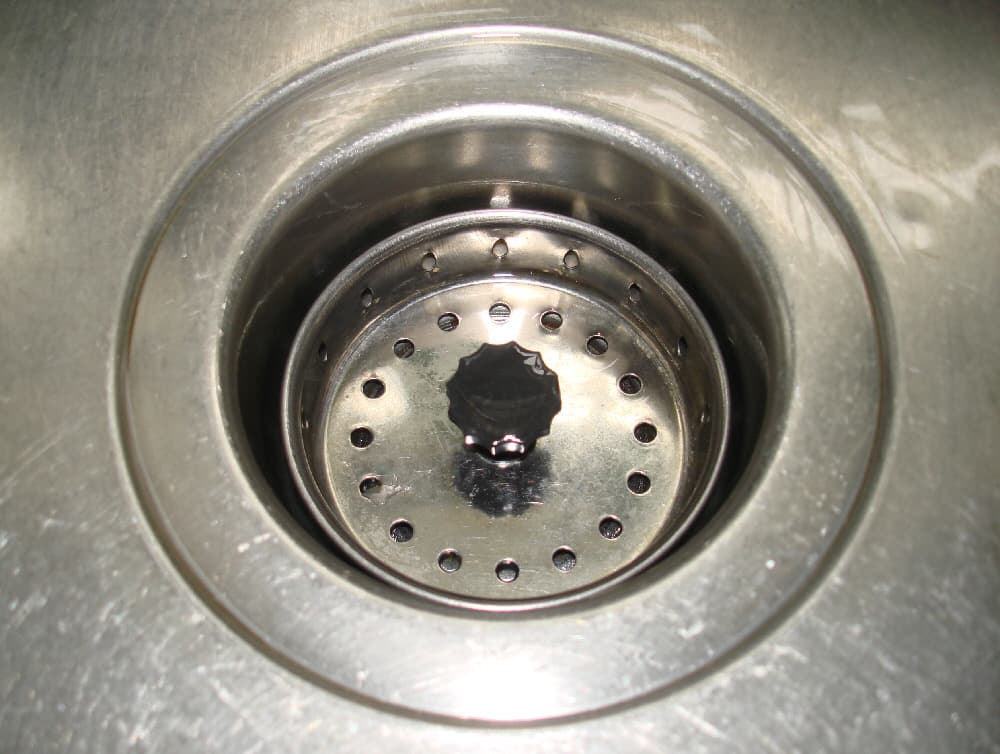
A strainer catches the rest. The old extension advice still holds: "Keep the drain strainer in your kitchen sink to catch small bits of food. Clean the strainer after each use."[4] A basket strainer like the one pictured above does the job; empty it into the trash, not by tapping it out over the drain.
If you have a garbage disposal
A disposal grinds food small, but it does not make the drain line bigger, so it needs water and patience. Salem's water department goes further: "Use garbage disposals sparingly or not at all. If your disposal is used make sure you flush the sewer lines thoroughly."[3]
InSinkErator's own care instructions:
- Cold water. Turn on cold water first and then the disposal, and keep cold water running for several seconds after grinding is completed to flush the drain line.[5] The manual adds: "Don't use hot water when grinding food waste. It is OK to drain hot water into the disposer between grinding periods."[5]
- Small loads. Instead of filling the disposal with vegetable peels all at once, turn the water and disposal on first and feed the peels in gradually.[5]
- The wrong scraps. "Don't grind large amounts of egg shells or fibrous materials like corn husks, artichokes, etc., to avoid possible drain blockage."[5] InSinkErator says its Standard Series models can grind any food apart from stringy and fibrous materials such as banana peel, celery and rhubarb.[6]
- Things that are not food. InSinkErator also lists clam or oyster shells, caustic drain cleaners, glass, china, plastic and metal among the things not to put into a disposal, along with paints, solvents, household cleaners and chemicals.[5]
For the full list, see what you should never put down a garbage disposal.
Homes on septic
Everything that goes down the sink ends up in the tank. On a septic system, the EPA says to eliminate or limit the use of a garbage disposal, which significantly reduces the fats, grease and solids that enter the tank and could clog the drainfield.[7] Virginia Cooperative Extension adds: "Kitchen waste such as grease and oil can also clog the system." and "Waste from garbage disposal units accelerates the accumulation of solids in the septic tank."[8]
Catch it early
A sink that drains a little slower each week is giving you notice. Deal with it while water still moves: most sink clogs sit in the trap[4], and a plunger or a quick trap cleaning clears it in minutes. The method is in how to unclog a kitchen sink without chemicals. Skip monthly chemical treatments: chemical drain cleaners are caustic and can damage pipes or fixture finishes.[4]
Stop and call a pro if
- The sink keeps clogging even with these habits, which points to buildup further down the line.
- Water rises in another fixture, such as a floor drain or a tub, when the sink drains.
- Several drains in the house are slow at once. See why several drains clog at once.
- The pipes under the sink leak after you clean the trap.
For related help, read how to keep drains from clogging and when a clog needs a plumber, browse plumbing repair answers, or look up plumbers in Blacksburg.
Sink already slow? Describe the clog once and licensed local plumbers quote it.
Common questions
- Is it fine to pour grease down the sink with plenty of hot water?
- No. Hot water only carries the grease further before it cools. King George County's service authority explains that it melts off dishes into the sewer pipes, where it later cools and accumulates into a clog and a sewage backup. Pour it into a can, let it cool, and put it in the trash.
- What about cooking oil that stays liquid?
- It still does not belong in the drain. The City of Salem says never to pour fats, oils or grease down the drain, even if they are liquid at room temperature. Collect it in a covered container for the trash.
- Should I run hot or cold water with the garbage disposal?
- Cold while grinding. InSinkErator's manual says to turn on cold water first, keep it running for several seconds after grinding to flush the line, and not to use hot water while grinding. Hot water between grinding periods is fine.
- Do monthly drain cleaners or enzyme treatments prevent clogs?
- Keeping grease and scraps out of the drain does more than any product. InSinkErator lists caustic drain cleaners among the things not to put into a disposal, and on a septic system Virginia Cooperative Extension cautions that additives should never take the place of checking and pumping the tank.
- I am on septic. Should I use the disposal at all?
- As little as possible. The EPA says to eliminate or limit garbage disposal use on septic, and Virginia Cooperative Extension notes that disposal waste speeds up the build-up of solids in the tank, which means more frequent pumping.
Sources
- [1] Fats, Oils & Grease, King George Service Authority, King George County, Virginia. Checked October 26, 2026.
- [2] Put Grease in Its Place, Prince William Water. Checked October 26, 2026.
- [3] Water & Sewer: Backup vs. Overflow, frequently asked questions, City of Salem, Virginia. Checked October 26, 2026.
- [4] Making Simple Repairs: Clogged Drains (FCS5234-05, archived fact sheet), UF/IFAS Extension, University of Florida. Checked October 26, 2026.
- [5] Standard Series Installation, Care and Use Manual, InSinkErator. Checked October 26, 2026.
- [6] Garbage Disposal FAQ, InSinkErator. Checked October 26, 2026.
- [7] How to Care for Your Septic System, U.S. Environmental Protection Agency. Checked October 26, 2026.
- [8] Septic System Best Management Practices (SPES-380), Virginia Cooperative Extension, Virginia Tech. Checked October 26, 2026.
Want a pro to handle it?
Describe the job once. Licensed local businesses send quotes, and you pay only when you book one.
Get a quote for Plumbing Repair