How do I keep raccoons and squirrels out of my attic?
Take away the reasons to come and the ways in. Stop feeding wildlife, lock down trash and pet food, keep feeders away from the house, and cut back limbs that reach the roof. Then have every opening into the house closed with metal, including chimney and vent caps, but only after a pro confirms nothing is inside. Check the outside of the house every year.
Free to ask. Local shops send quotes, and you pay only when you book one.
By Kasra Taheri, Founder, LoclisPublished
Researched and drafted with AI, then checked claim by claim against the sources listed below before it was published. Prices and rules change; the dates beside each source say when it was last checked.
This is a job for a licensed pro in Virginia
This page explains what the work involves, the permits, what a licensed pro does and what drives the cost. It does not give step-by-step instructions, because this work needs a licence, a permit or both, and doing it wrong can injure someone. Before you hire, check the licence on Virginia's DPOR record.
Keeping raccoons and squirrels out of an attic comes down to two things: give them no reason to come, and leave them no way in. Remove the food around the house, cut back the limbs that bridge to the roof, and have every opening closed with metal or another material they cannot chew through, including chimney and vent caps. The repair part is only done once a professional has confirmed nothing is living inside. After that, a yearly look around the outside of the house catches new damage early.
Why prevention beats removal
Taking an animal out without changing the house rarely lasts. Fairfax County's wildlife management guidance puts it simply: unless the resource attracting the animal, such as food, water or a den site, is found and changed or removed, the conflict will not be resolved.[7] Virginia Cooperative Extension says the same in its own terms. Conflicts are rarely solved just by removing an animal, because if the conditions stay the same, another animal will soon replace it.[6]
Take away the food
Most of this is in your hands, and the Virginia Department of Wildlife Resources lists the basics:
- If you are feeding wildlife, stop; it makes them lose their natural fear of people.[1]
- Keep trash inside until the morning of pickup, or in an animal-proof container such as a metal can with latching lids.[1]
- Do not leave pet food outside, and keep pet feeding areas clean.[1]
- Clear fallen fruit from around trees.[1]
DWR says it is the homeowner's responsibility to make sure they are not attracting wildlife to the yard.[4] Bird feeders count. DWR notes that waste birdseed below feeders can attract squirrels and small rodents, which in turn can attract foxes or coyotes.[4] If you keep feeding birds, DWR's squirrel advice is to place feeders at least 15 feet from anything a squirrel can jump from, and put a metal exclusion device on the feeder post.[2]
DWR also names fruit trees and barbecue grills among the things that draw raccoons and foxes to houses.[4] A DWR prevention article adds smaller habits: keeping compost well away from buildings, storing firewood and yard debris away from the house, and not over-mulching around the foundation.[5]
Take away the ladders
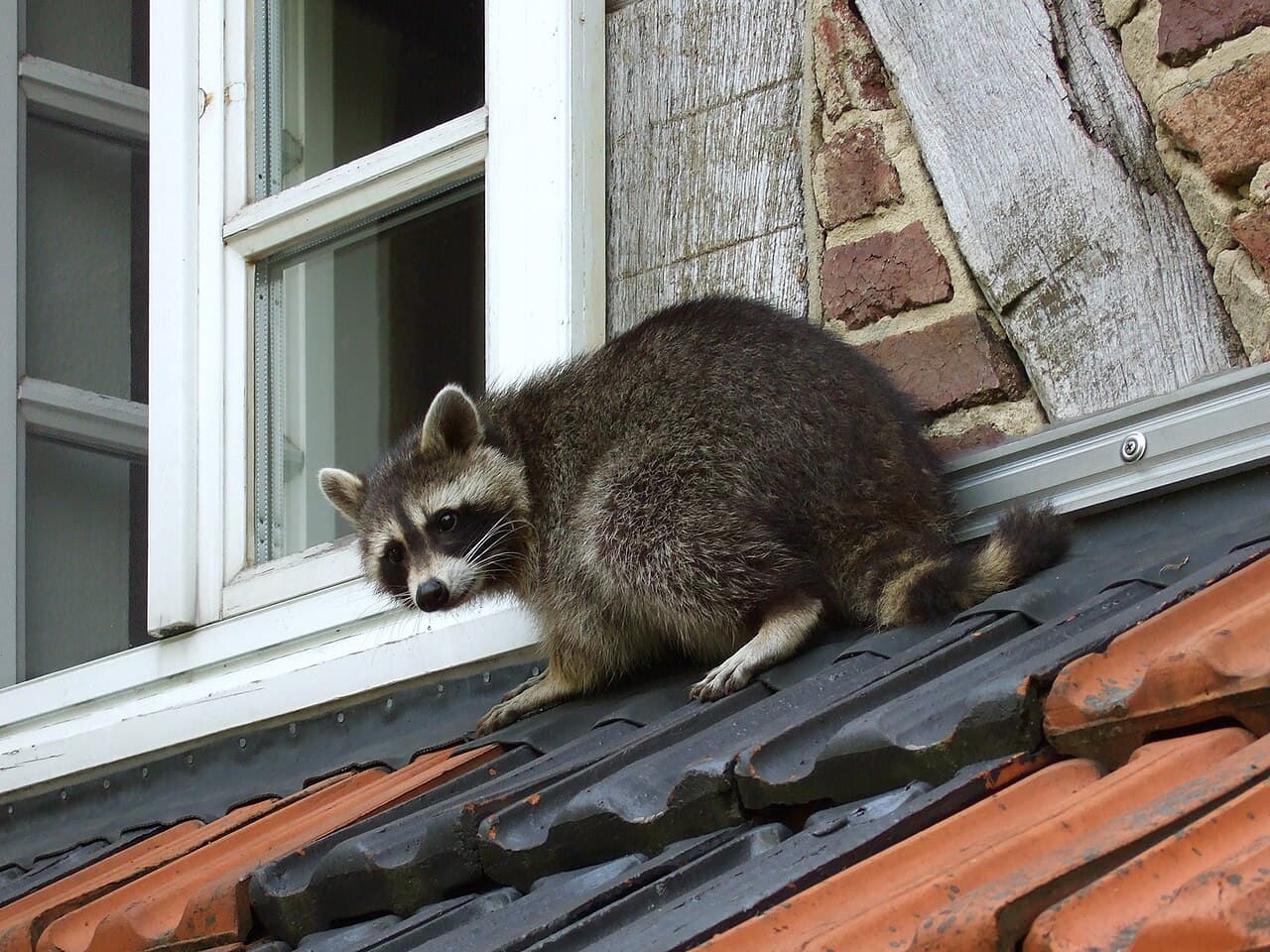
Squirrels and raccoons often reach a roof by tree. DWR's advice: Clear overhanging tree limbs and branches that may be giving wildlife access to the house.[1] Cutting limbs over the roof, or any cutting that needs a ladder or a climb, is work for a tree service.
Close the ways in
DWR's core rule is to close up all openings under and into your buildings, because animals look for places to den and raise their young.[3] The places to watch come from a DWR prevention article: inspecting around the home every year for holes or crevices, such as under the eaves, around the soffits and window frames, under siding panels and around exterior doorways.[5]
The same article's list of fixes is the checklist to give a contractor: covering the chimney, septic vent pipes and exhaust fan outlets with a hardware wire cap or other tight-fitting exclusion device, sealing foundation openings with wire mesh, sheet metal or concrete, and putting a fence or mesh barrier around the base of an open porch or deck.[5] Ask what material each patch will be, and expect metal at any spot an animal has already chewed.
Most of these openings are at the roofline, which makes this a job for a wildlife control operator or a licensed contractor with roof-safe equipment, not a ladder project.
Timing matters: never seal an animal in
The most common mistake is sealing a hole with an animal, or a litter, still inside. DWR stresses for attic squirrels that the entry should be closed only once they have left, and only after making sure no young have been left behind inside.[2] In Fairfax County, raccoons establish dens and give birth in April and May, and the young often den with their mother through the first winter.[8]
A mother sealed out with young still inside will often try hard to get back in. That is why sealing usually comes after a professional inspection, and often after a one-way exit has been in place for a while. See how wildlife removal companies get animals out of an attic.
What does not last
Gadgets fade. Reflective tape, lights or noise sometimes work, but animals get used to them, so they are only a temporary solution.[3] For raccoons and flying squirrels, Extension's 2026 guide lists repellents as registered but largely ineffective or not proven effective.[6]
Some shortcuts are against the law. Using unregistered products or home-remedy concoctions on wildlife is illegal.[6] It is illegal to poison any animal other than rats and mice.[9] Trapping and moving the animal is not an option either; see is it legal to trap and relocate wildlife in Virginia.
A yearly check
Once a year, and after big storms, walk around the house with binoculars. Look for new holes or chewed edges at soffits, fascia and vents, gaps around the chimney cap, loose siding, and torn screens on crawl space vents. Listen in the attic now and then, especially in spring. If you hear something, read what animal is living in my attic before you do anything to the hole.
When to call a licensed pro
Call a permitted wildlife control operator when an animal may be inside, and have the exclusion repairs done by someone licensed for them. Virginia's definition of a contractor covers repair or improvement of a building, and a Class C licence covers single jobs over $1,000 but less than $30,000.[10] Residential contracting needs a legible written contract, signed by both sides before work starts or payment is taken.[11]
Ask for a quote that lists every opening to be sealed, the material for each, and any warranty if an animal gets back in. For prices, see what wildlife removal costs in Virginia. Browse wildlife removal businesses, find pest control businesses in Blacksburg, or read more pest control answers.
Describe the openings you have found and local wildlife control businesses can quote the exclusion work.
Common questions
- What keeps squirrels out of an attic for good?
- Having every way in closed with material they cannot chew through, after a pro has confirmed none are inside and no young are left behind. Ask the company what it will use at each opening and what its warranty covers. Cutting back limbs near the roof and moving feeders at least 15 feet from anything they can jump from makes the house less tempting.
- Do repellents or noise devices keep raccoons away?
- Not for long. Virginia Cooperative Extension lists repellents for raccoons and flying squirrels as registered but largely ineffective or unproven, and DWR says lights, noise and reflective tape work only until animals get used to them. Sealing the openings and removing food is what lasts.
- Can I put out poison for squirrels or raccoons?
- No. In Virginia it is illegal to poison any animal other than rats and mice, and Extension warns that using unregistered products or home remedies on wildlife is also illegal.
- When is the best time to seal up the house?
- When nothing is living inside. In Fairfax County, raccoons give birth in April and May and the young often stay with their mother through the first winter, and squirrels can have young in the attic too. DWR stresses making sure no young are left inside before a squirrel entry is closed. A wildlife pro can confirm the attic is empty.
- Does a chimney cap keep raccoons out?
- A sturdy, tight-fitting cap is one of the standard fixes. A DWR prevention list includes covering the chimney, septic vent pipes and exhaust fan outlets with a hardware wire cap or similar exclusion device. Have it fitted by a chimney or wildlife pro, since it means working on the roof.
Sources
- [1] Problems with Raccoons, Virginia Department of Wildlife Resources. Checked October 26, 2026.
- [2] Problems with Squirrels, Virginia Department of Wildlife Resources. Checked October 26, 2026.
- [3] Help with Human-Wildlife Conflicts, Virginia Department of Wildlife Resources. Checked October 26, 2026.
- [4] Wildlife Among Us: Dealing With Neighborhood Wildlife Furbearers, Virginia Department of Wildlife Resources. Checked October 26, 2026.
- [5] When Wildlife Overstays Its Welcome (Virginia Wildlife, July 2003), Virginia Department of Wildlife Resources. Checked October 26, 2026.
- [6] Other Animals: Conflicts with Vertebrates (2026 Pest Management Guide, ENTO-634-H), Virginia Cooperative Extension, Virginia Tech. Checked October 26, 2026.
- [7] Wildlife Management, Fairfax County, Virginia. Checked October 26, 2026.
- [8] Raccoon, Fairfax County, Virginia. Checked October 26, 2026.
- [9] Problems with Bats, Virginia Department of Wildlife Resources. Checked October 26, 2026.
- [10] Va. Code § 54.1-1100, Definitions, Code of Virginia, Virginia General Assembly. Checked October 26, 2026.
- [11] 18VAC50-22-260, Filing of charges; prohibited acts, Virginia Administrative Code, Board for Contractors. Checked October 26, 2026.
Want a pro to handle it?
Describe the job once. Licensed local businesses send quotes, and you pay only when you book one.
Get a quote from a local pro