How do I keep a retaining wall from failing?
Keep water out from behind it and weight off the top. That means drain outlets kept open, downspouts, sprinklers and runoff sent away from the wall, no new patio, driveway, pool or steeper slope above it without an engineer, and a look at it a couple of times a year for lean, bulges and cracks. The rest depends on how well it was built.
Free to ask. Local shops send quotes, and you pay only when you book one.
By Kasra Taheri, Founder, LoclisPublished
Researched and drafted with AI, then checked claim by claim against the sources listed below before it was published. Prices and rules change; the dates beside each source say when it was last checked.
This is a job for a licensed pro in Virginia
This page explains what the work involves, the permits, what a licensed pro does and what drives the cost. It does not give step-by-step instructions, because this work needs a licence, a permit or both, and doing it wrong can injure someone. Before you hire, check the licence on Virginia's DPOR record.
Keep water out from behind it and weight off the top. A wall fails when the soil and water behind it push harder than it can resist, and once it is built, water and load are the two things an owner controls. Upkeep cannot make up for missing drainage or poor backfill, but it can keep a sound wall sound, and regular checks catch movement while a repair is still small.
Keep water away from the wall
The design and performance of most retaining walls depend on keeping the area behind the wall relatively dry.[1] Everything on this list serves that one goal.
- Surface water. Allan Block's design guide says surface drainage must drain away from the top and bottom of the wall, and slopes above walls should have swales so water does not flow over the top.[2] Anchor's guide calls for 6 inches of low-permeability soil at the finished grade, seeded or planted, and a swale where needed to divert water away from the wall.[3] If soil has settled into a low spot along the top of your wall, that is where water is getting in.
- Downspouts. Anchor asks wall builders to plan where downspouts will expel water and whether there is an underground sprinkler.[3] A downspout that empties above a wall sends roof runoff straight into its backfill. Extending a downspout is a simple fix that helps both the wall and the house.
- Irrigation. Allan Block's design guide calls for check valves or similar provisions to stop flooding from broken irrigation lines or heads above walls.[2] Water lightly above a wall, and fix a leaking line or broken head there promptly.
Keep the drains open
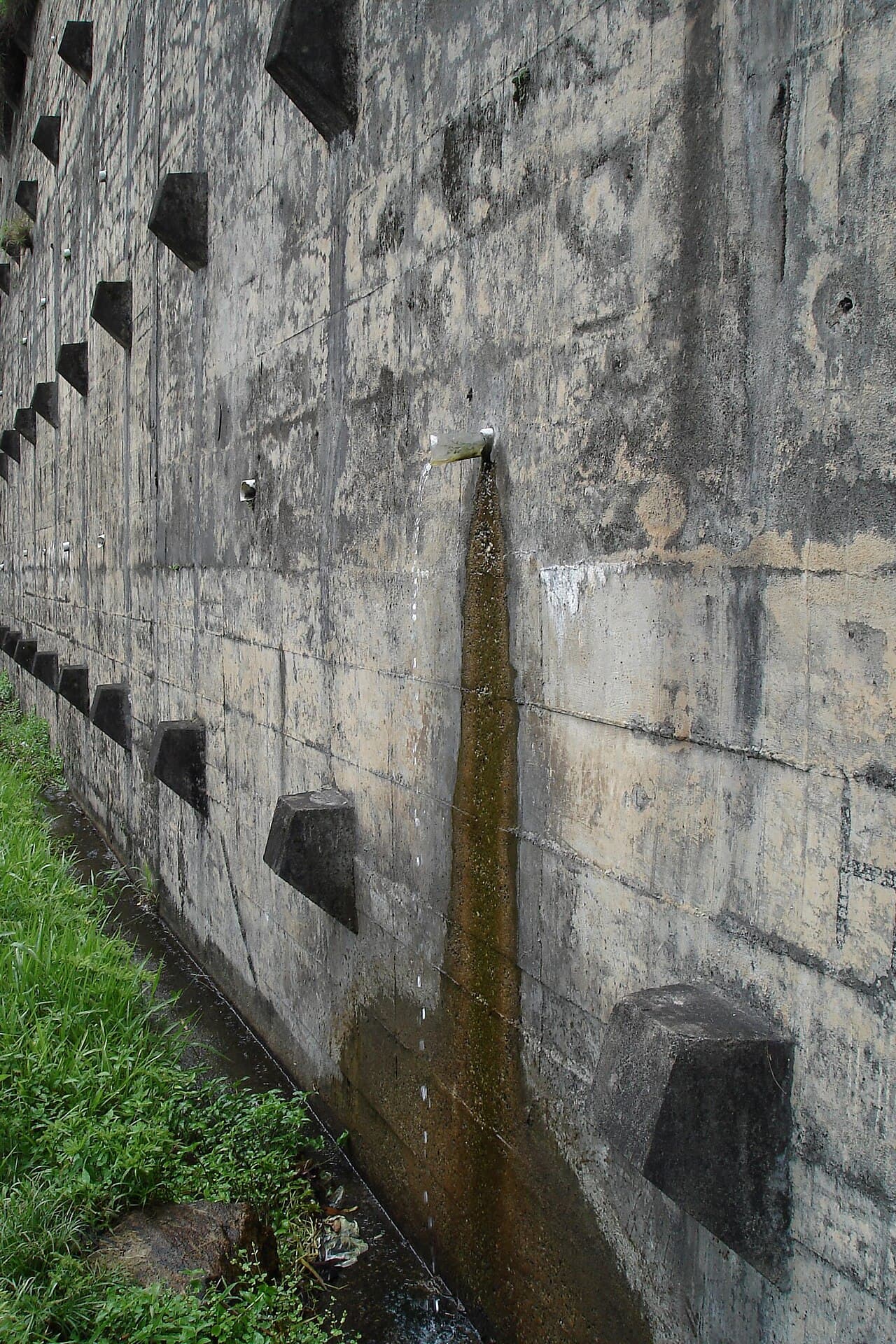
A wall with drainage only works while the water has a way out. Allan Block says drains must be vented to daylight or connected to a storm sewer and protected from fine soil washing into them,[1] and notes that rodent screens on outlet pipes let water through while keeping the pathway clear of debris.[1] Fairfax County's typical details show a 4-inch perforated drain pipe that outlets to daylight at each end or through weep holes 8 feet on center.[4]
Find your wall's outlets and keep them uncovered. Mulch, soil, leaves and new landscaping are the usual culprits. After a soaking rain, outlets that run are doing their job; outlets that stay dry while the face of the wall weeps suggest the drain is blocked or missing, which is a job for the contractor.
Keep weight off the top
A wall is designed for the soil and load it was built to hold. Patios, swimming pools and driveways are common residential surcharges,[1] and Allan Block advises against slopes steeper than 3 to 1 above a wall without first consulting a local engineer.[1] Even temporary loads count: Fairfax County's details require that heavy equipment stays back from the wall a distance equal to the wall's height.[4] Keep delivery trucks, soil and mulch piles, and parked vehicles back from the top.
Adding a load also changes the paperwork. Virginia's building code exempts from a permit only retaining walls supporting less than three feet of unbalanced fill that do not support a surcharge other than ordinary unbalanced fill,[6] so a new patio or driveway above a short wall can bring it into the permit rules. See the permit answer.
Plants, roots and digging
Vegetation is mostly a help: Anchor notes that planting in front of and on top of a wall helps reduce erosion.[3] For reinforced block walls, Allan Block's design guide says plantings in the reinforced zone are generally acceptable, provided an engineer checks that root balls will not disrupt the geogrid layers,[2] and that augers should never be used within the reinforced grid zone.[2] Before digging fence-post or planting holes behind a wall, find out whether it has geogrid and how far back it runs.
Winter and de-icing salt
Allan Block's design guide says durability concerns occur where there are saturated conditions in repeated freezing and thawing.[2] It advises builders to avoid using segmental wall block for steps or walkways where de-icing salts will be used, and to keep salty runoff from flowing down the wall.[2] Pile shovelled snow and salted slush away from the face and top of the wall rather than against it.
Loose cap blocks are a small sign worth noting. Allan Block's design guide calls for caps secured with a high quality flexible exterior grade masonry sealant,[2] and a contractor can reset caps that have come loose.
Check it twice a year
A walk along the wall in spring and fall, and after very heavy storms, catches movement early. Look for:
- The top tipping out toward the low side, or a bulge in the face.
- New or widening cracks, open joints, or blocks shifting out of line.
- Soil washing out at the base or ends, or settling along the top.
- Wet patches on the face that never dry, or outlets that stay dry after rain.
Take photos from the same spots each time; slow movement is easier to see side by side. On clay soils, change can take years to show. Fairfax County's Marine Clay guide says Marine Clay should never be placed in the backfill behind foundation or retaining walls,[5] and notes that house problems usually develop slowly at first and then become more serious as years go by.[5] Why a retaining wall leans explains what each sign usually means.
When to call a licensed pro
Call a licensed contractor if the wall leans out, bulges, cracks wider over time, sheds blocks or caps, or drains stop working, and an engineer as well before you add any load above it. Rebuilding drainage, replacing backfill or resetting a wall is structural work, not upkeep. The Board for Contractors says work valued at $1,000 or more requires a valid Virginia contractor's licence in the right category,[8] and Virginia's landscape service contracting specialty (LSC) includes construction of retaining walls for landscaping purposes.[7] What building a retaining wall involves covers what a well-built replacement includes.
Loclis lists DPOR-licensed businesses with their licence number and class. Browse retaining wall businesses, look up concrete and hardscaping contractors in Blacksburg, or see all concrete and hardscaping answers.
Describe the wall once and licensed local businesses quote an inspection or repair.
Common questions
- How often should I check a retaining wall?
- A look in spring and fall, and after any very heavy rain, catches most problems early. Walk the length of the wall, sight along the top for lean or bulges, check that drain outlets are open and running after rain, and note any new cracks or loose caps. Photos from the same spots make slow movement easy to see.
- Is water coming out of the bottom of my wall a bad sign?
- Usually not. Many walls are built with drain pipes or weep holes so water can get out, and water running from them after rain means the drainage is working. Water seeping through the face of a wall with no drains, or a wet patch that never dries, is worth a professional look.
- Can I plant shrubs or trees along the top of my wall?
- Small plants help hold the soil, and Anchor's guide says planting in front of and on top of a wall helps reduce erosion. On a reinforced block wall, ask whether roots or planting holes would disturb the geogrid: Allan Block's design guide says augers should never be used within the reinforced grid zone.
- Should I seal my block retaining wall?
- Not usually as routine upkeep. Allan Block's design guide suggests considering periodic silane or siloxane water repellents for walls repeatedly exposed to snow removal equipment. Keeping water from soaking the wall in the first place matters more than a coating.
- Can I add a patio or hot tub above an existing wall?
- Not without an engineer checking the wall first. A patio, pool, hot tub or driveway above a wall is a surcharge, added load the original design may not have allowed for, and it also takes a wall out of Virginia's permit exemption.
Sources
- [1] AB Residential Retaining Walls installation guide, Allan Block. Checked October 27, 2026.
- [2] Best Practices for Allan Block Segmental Retaining Wall Design for Residential and Commercial Applications (rev. 8/16/2024), Allan Block. Checked October 27, 2026.
- [3] Installation Guide featuring the Diamond Pro Retaining Wall System, Anchor Diamond Group. Checked October 27, 2026.
- [4] Typical Retaining Wall Details, based on the 2021 Virginia Residential Code, Fairfax County Land Development Services. Checked October 27, 2026.
- [5] Homeowner's Guide to Overcoming Problems with Marine Clay-Marumsco Soils in Fairfax County, Fairfax County. Checked October 27, 2026.
- [6] 13VAC5-63-80. Section 108 Application for permit (Virginia Uniform Statewide Building Code), Virginia Administrative Code. Checked October 27, 2026.
- [7] 18VAC50-22-30. Definitions, Virginia Administrative Code (Board for Contractors). Checked October 27, 2026.
- [8] What You Should Know Before You Hire a Contractor, Virginia Board for Contractors, DPOR. Checked October 27, 2026.
Want a pro to handle it?
Describe the job once. Licensed local businesses send quotes, and you pay only when you book one.
Get a quote from a local pro