How do I keep sprinkler heads from breaking?
Keep heads from breaking by flagging them before mowing, trimming grass around each one so the stem rises freely, setting them level with the turf, replacing cracked parts early and keeping pressure in range. Rain Bird says most systems run best at 45-75 PSI. Open the main valve slowly each spring.
Free to ask. Local shops send quotes, and you pay only when you book one.
By Kasra Taheri, Founder, LoclisPublished
Researched and drafted with AI, then checked claim by claim against the sources listed below before it was published. Prices and rules change; the dates beside each source say when it was last checked.
Step by step
Read when to stop and call a pro, further down this page, before you start.
Step 1: Flag each head
Run each zone in daylight and mark every head with a small flag before you mow.
Step 2: Trim around the heads
Trim grass and weeds back from each head so the stem can pop up freely.[2]
Step 3: Reset sunken or tilted heads
Dig carefully by hand around a tilted head and level it so the cap sits at the turf surface, after Virginia 811 has marked the lines.[5]
Step 4: Replace cracked parts
Swap out cracked caps, chipped nozzles and worn heads before they fail.[1]
Step 6: Open the main valve slowly
At spring start-up, open the main valve slowly to avoid water hammer.[2]
Most broken heads come from mowers, vehicles and pressure
Keep sprinkler heads whole by keeping them clear of grass, keeping them at the right height, marking them before you mow and keeping water pressure in range. Rain Bird puts it plainly: nozzles and sprinkler heads are designed to withstand normal wear and tear of irrigation, but are no match for errant lawn mowers, the neighbor's dog or snowplows.[1]
Mark the heads before you mow
A head you cannot see is a head you will hit. EPA notes that missing or broken sprinkler heads can be hard to find because most irrigation systems run overnight or early in the morning.[3] So find them during the day. Run each zone, then flag every head with a small stake or a wire flag. Take the flags out as you mow and put them back after, or trim around each head with a string trimmer first.
Grass and soil also bury heads over time. Rain Bird's advice is to use pruning shears to trim around the head, allowing the stem to pop up easily.[2] A stem that cannot rise sprays into the turf, and one that sticks up unevenly is the one a blade clips. EPA's checklist adds to look for heads that do not pop up fully or are tilted,[3] which are the first ones to be hit.
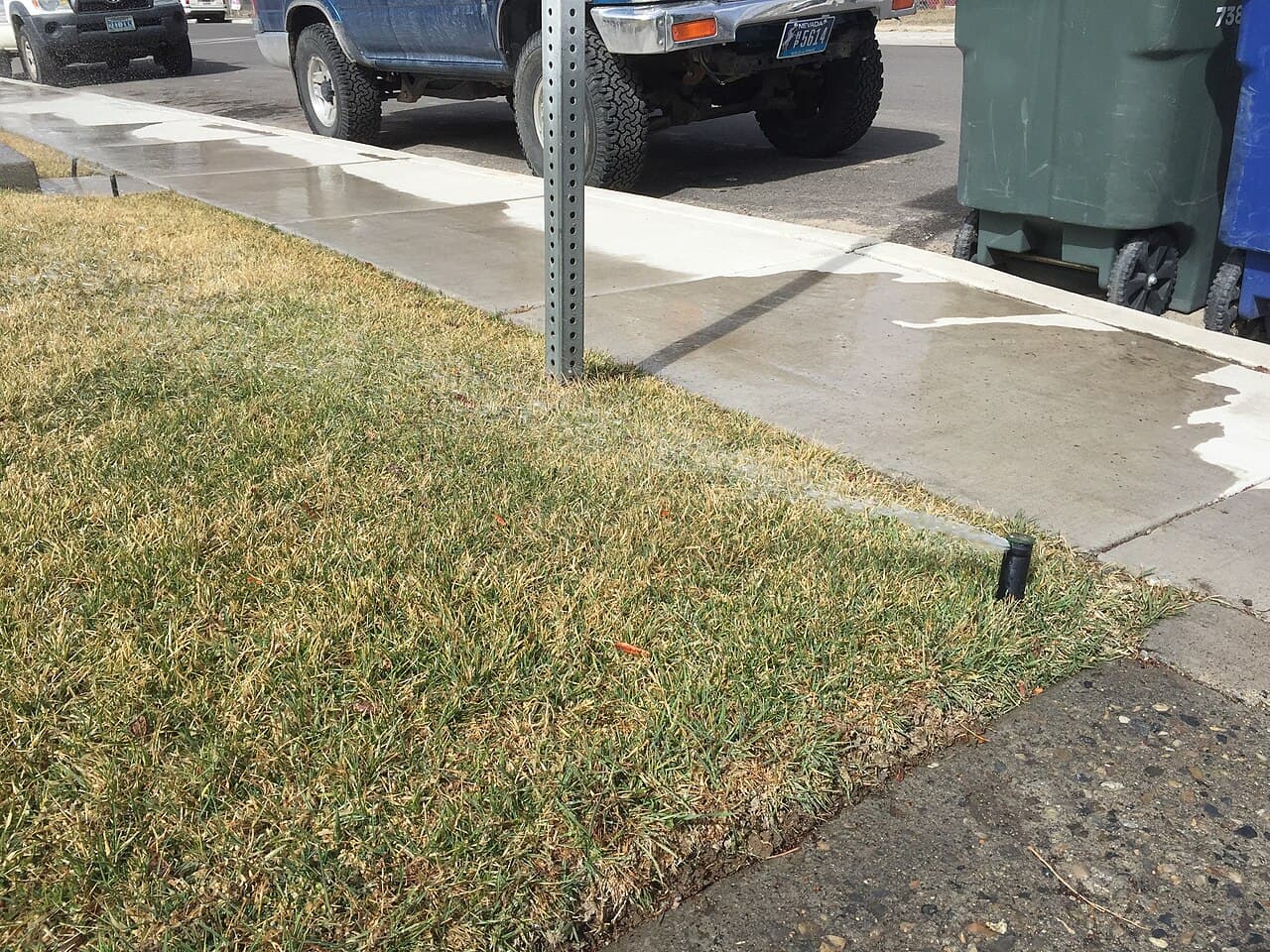
Keep heads level and flush
A head that has sunk below the turf collects debris, and one that sits proud of it is easy to clip. When you see one tilting, reset the soil around it. Dig by hand and take care in not damaging any underground pipe or fittings.[4] Contact Virginia 811 before any digging project.[5] Setting a head level so the cap sits at the surface of the grass is what keeps a mower deck above it.
Keep vehicles and trailers off heads near driveways and curbs. If a head keeps getting struck, ask a pro whether it can be moved a few inches or swapped for a model with a lower profile.
Replace cracked parts early
A cracked cap or chipped nozzle fails faster than a clean one. Rain Bird says to replace cracked, chipped or worn components, such as sprinkler heads, nozzles, valves or pipes.[1] A broken sprinkler can wreak havoc on lawns, gardens, and water bills, so it is important to check and replace them periodically.[1] EPA warns that running an irrigation system with broken and damaged sprinkler heads can cause overflowing and flooding of water on the landscape.[3]
Do a short walk-through of the zones each spring and midsummer. If you find one, EPA suggests a simple method: place a flag next to the broken sprinkler so you will be able to work on it later.[3] Replacing a broken head is a job most homeowners can do.
Keep the water pressure in range
Too much pressure splits heads and joints and makes the fine mist that wastes water. Rain Bird says a system with too much pressure will result in cracked pipes, busted valves, sprinkler head leaks and inefficient watering.[1] It says most automatic sprinkler systems operate best between 45-75 PSI,[2] though its tune-up checklist gives a typical range of 40-65 PSI,[1] so check the range printed for your own heads. It adds that if water is "misting" out of your sprinkler heads, your pressure is too high and should be reduced.[1] A pressure gauge that connects to a hose faucet will show you the pressure.[1]
Open the main valve slowly each spring. Turning the main valve on too quickly can create "water hammer," or a surge of high-water pressure that can damage pipes and valves.[2]
Stop and call a pro if
- Heads leak or mist on several zones, or the gauge reads high. That points to high pressure, and Rain Bird says that above the suggested range a pressure regulator may be required.[1]
- Heads leak at the joint, or water pools near them. EPA says leaking joints can also be a sign of too much water pressure or particles in the water.[3]
- A head breaks off at the riser. Rain Bird's repair guide describes checking the threaded riser or other connector under the head, and replacing it with the proper fitting thread and length.[4] If the pipe is cracked, hire it out.
- You are not sure what is buried nearby. Contact Virginia 811 and wait for the marks.[5]
Getting help in Virginia
For costs, see what sprinkler repair costs in Virginia and whether to repair or replace the system. For the other common failure, read why a sprinkler zone will not turn on. Browse more irrigation answers or irrigation businesses.
When you would rather hand it off, describe the sprinkler problem once and licensed local contractors can quote it.
Common questions
- What breaks sprinkler heads most often?
- Mowers, vehicles and foot traffic, plus age and pressure. Rain Bird says heads are built to withstand normal wear but are no match for errant lawn mowers, the neighbor's dog or snowplows.
- Should I cut the grass around my sprinkler heads?
- Yes. Trim back grass and weeds so the stem rises freely and the head is easy to see when you mow. Rain Bird's advice is to use pruning shears to trim around the head.
- Why do my heads spray a fine mist?
- That usually means pressure is too high. Rain Bird says that if water is misting out of your sprinkler heads, your pressure is too high and should be reduced, and a pressure regulator may be required.
- How often should I walk the system?
- At spring start-up and again in midsummer is enough for most yards. EPA's tip is to flag any broken head right away so you find it again.
Sources
- [1] Springtime Sprinkler Tune-Up Checklist, Rain Bird Corporation (manufacturer). Checked October 27, 2026.
- [2] Is Your Sprinkler System Ready for Spring? Here's How to Get Started, Rain Bird Corporation (manufacturer). Checked October 27, 2026.
- [3] Sprinkler Spruce-Up, U.S. Environmental Protection Agency, WaterSense. Checked October 27, 2026.
- [4] 3 Simple Repairs and Upgrades for Your Pop-Up Sprinklers This Spring, Rain Bird Corporation (manufacturer). Checked October 27, 2026.
- [5] Homeowners FAQ, Virginia 811. Checked October 27, 2026.
Want a pro to handle it?
Describe the job once. Licensed local businesses send quotes, and you pay only when you book one.
Get a quote from a local pro