Why won't one of my sprinkler zones turn on?
Test the zone by hand: run it from the controller, make sure the main water is open, then turn the solenoid on the valve to open it manually. If it sprays by hand, the fault is power, usually a broken wire or a bad solenoid. If not, the valve or the supply is blocked, and a pro should open it.
Free to ask. Local shops send quotes, and you pay only when you book one.
By Kasra Taheri, Founder, LoclisPublished
Researched and drafted with AI, then checked claim by claim against the sources listed below before it was published. Prices and rules change; the dates beside each source say when it was last checked.
Step by step
Read when to stop and call a pro, further down this page, before you start.
Step 1: Run the dead zone by itself
Set the controller to manual and start only that zone, then start a working zone for comparison.[1]
Step 2: Check the date, time and program
Make sure the controller's date and time are correct and the zone is in a running program.[1]
Step 3: Confirm the main water is on
Open the main shutoff, gate valve or master valve fully if it is partly closed.[2]
Step 4: Open the valve box
Lift the lid on the valve for that zone and look for standing water, leaks or a loose connection.[3]
Step 5: Open the valve by hand
Turn the solenoid handle counter clockwise 1⁄4 to 3⁄4 turn and see whether the heads pop up.[2]
Step 6: Close it again
Hand tighten the solenoid to close the valve; do not over-tighten.[2]
Step 7: Try cleaning the solenoid
With the water off, unscrew the solenoid, flush its seat and rinse it in clean water, then screw it back on.[2]
Step 8: Swap with a neighbour
With the water off, swap the solenoid with one from a working valve without cutting wires; if the problem follows the solenoid, replace it.[2]
Test the zone by hand first
A zone that will not start has one of four problems: the controller is not telling it to run, power is not reaching the valve, the valve itself is stuck, or water is not reaching the valve. You can sort out which in about ten minutes with no tools beyond a screwdriver, and it saves a service call that would only start with the same test.
Start at the controller. Rain Bird says to set your controller to manual watering mode to test each station individually.[1] Run the dead zone by itself and watch whether the heads pop up. Then run a zone that works for comparison. If the dead zone does nothing and the others are fine, the problem is local to that zone. If several zones are dead, look at the main supply and the controller before the valve.
While you are there, make sure the schedule is real: check that the date and time are correct.[1] A controller that lost power and reset can skip a program without any sign on the lawn until the grass browns.
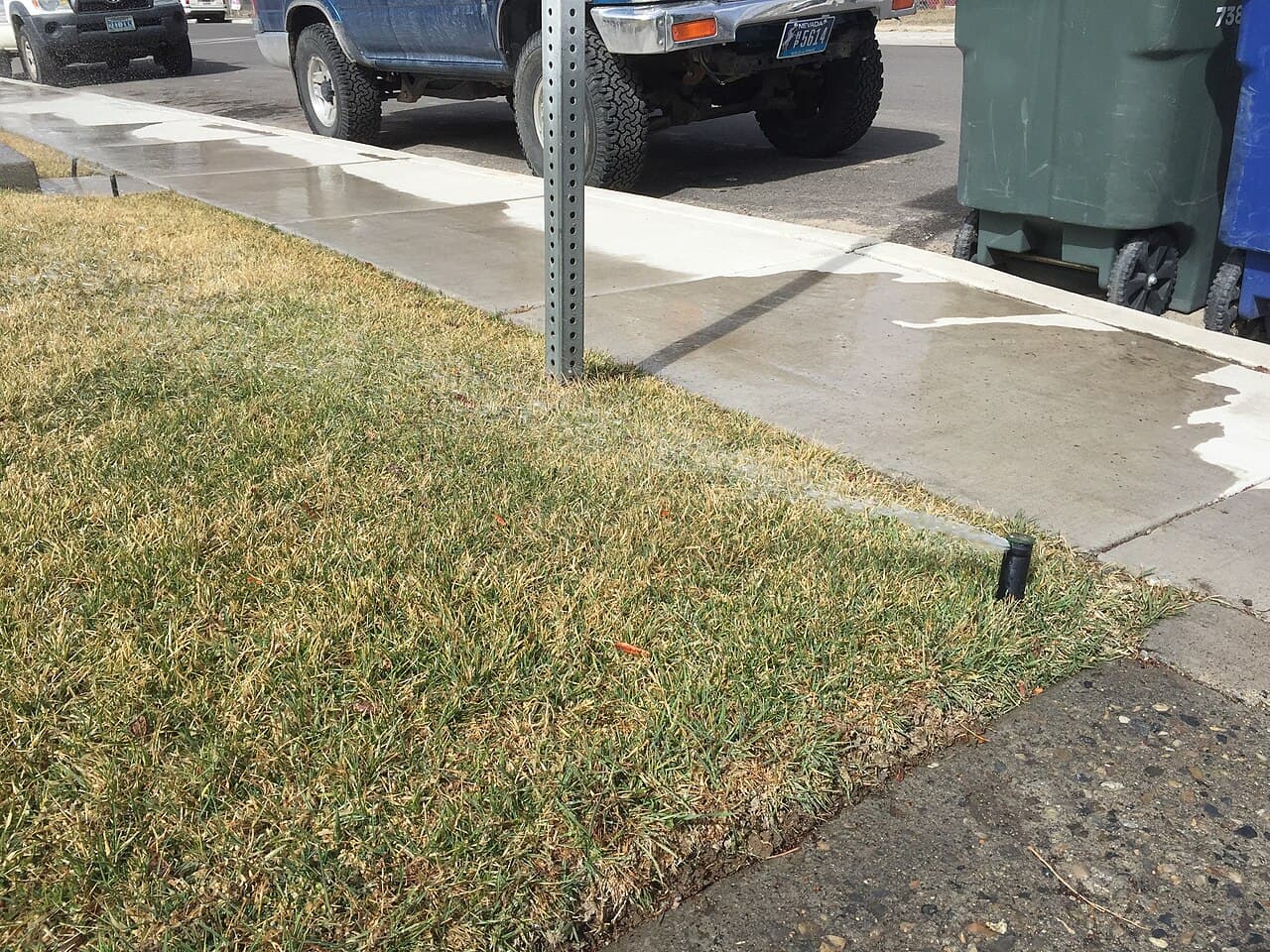
Check the water supply
If a zone is slow or weak instead of dead, the cause may be flow, not electricity. Rain Bird's valve guide lists several: the flow control stem is turned all the way down,[2] too many sprinklers are operating at one time,[2] or there is an obstruction in the mainline pipe.[2] For a valve that does nothing at all, its guide says to locate main gate or master valve and open it.[2] If the whole system was shut off for winter and you restarted it, a gate valve or the main shutoff that was not fully reopened is a common culprit.
Open the valve by hand
Most home zones are run by an automatic valve in a plastic box in the lawn, usually with a green lid. Open the lid and look. EPA advises checking the connections inside valve boxes and that the valves can shut.[3] Water pooling on the surface can be a sign of an underground leak.[3]
The valve has a built-in manual control. On Rain Bird valves, you turn the solenoid handle counter clockwise 1⁄4 to 3⁄4 turn or until you hear water flowing through the valve.[2] Go to the zone and see whether the heads come up. Then close it: only hand tighten the solenoid to close the valve.[2] Over-tightening can damage the seat.
The result tells you where the fault is. If the heads spray when you open the valve by hand, the valve and the pipe are fine and the problem is on the electrical side, in the controller or the wire. If nothing comes up even by hand, the problem is water supply or the valve itself. Other brands work similarly, so check the label on the valve and the maker's guide.
When the valve works by hand but not from the controller
Rain Bird's order of checks is to check the controller for output power to the valve.[2] That needs a multimeter and some comfort with low-voltage wiring, and it is where most homeowners should stop. The guide's conclusion is the one to remember: if output is detected at the controller, but no input is detected at the solenoid, then a power wire is broken or damaged.[2] A buried wire cut by a shovel or aeration is the usual cause, and finding the break needs a locating tool.
If power does reach the valve, the solenoid is next. Rain Bird's test is to swap solenoids with the next valve, and says: without cutting wires, swap solenoids with the next valve (if present). If other solenoid operates valve, replace solenoid.[2] Turn the water to the system off before you unscrew a solenoid.
A solenoid that has simply gone sticky can sometimes be revived. The guide lists dirt as a cause: dirt is interfering with proper solenoid operation.[2] The fix it gives is to turn off the water supply and turn the solenoid counter-clockwise to remove and flush solenoid seating bowl in bonnet with clean water.[2]
Stop and call a pro if
- The zone does not run by hand either. The diaphragm, the supply or a blockage in the pipe is involved, and that means opening the valve or the line.
- There is power at the controller but none at the solenoid. That points to a broken wire, which has to be traced and spliced with waterproof connectors.
- A swapped solenoid still will not open the valve. The valve needs servicing or replacement.
- Several zones are dead at once, or the controller shows nothing at all. Look to the controller or main supply.
- You see pooling water or a soggy patch near the valve box. That suggests a leak under the lawn. Contact Virginia 811 before you dig.[4]
Getting help in Virginia
If the repair grows beyond one valve, see what sprinkler repair costs in Virginia, whether to repair or replace a system, and how to replace a broken head. Browse more irrigation answers or irrigation businesses.
When you would rather hand it off, describe the sprinkler problem once and licensed local contractors can quote it.
Common questions
- Why won't just one of my sprinkler zones come on?
- When only one zone is dead, the cause is local to it: a bad solenoid, a broken wire to that valve, a stuck valve or a closed flow control. The controller, main supply and the other zones are working. Run the zone by hand at the valve to see which side the fault is on.
- What does the solenoid do?
- It is the electrical part on top of the valve. When the controller sends a signal, the solenoid lets the valve open. A solenoid can fail electrically, or dirt can make it stick, and swapping it with a working valve's solenoid is a standard test.
- How do I know if it is the wire or the valve?
- If the zone runs when you turn the solenoid by hand but never from the controller, the water side is fine and the cause is power or the wire. Rain Bird's guide says that if output is detected at the controller, but no input is detected at the solenoid, then a power wire is broken or damaged.
- Can I replace a solenoid myself?
- Often yes, and it is a common homeowner repair when the part is a standard type. Turn off the water supply first, unscrew the old solenoid counter-clockwise and screw on a matching one. Leave any cut or damaged wire to a pro.
- Do I need a licence to fix a sprinkler valve?
- Swapping a head or a solenoid on your own system is simple maintenance. Work on buried pipe, backflow devices or a new installation is a job for a contractor; ask for their licence class and look it up with DPOR before you sign.
Sources
- [1] Is Your Sprinkler System Ready for Spring? Here's How to Get Started, Rain Bird Corporation (manufacturer). Checked October 27, 2026.
- [2] PEB & PESB Valve Installation and Operating Instructions Troubleshooting Guide, Rain Bird Corporation (manufacturer). Checked October 27, 2026.
- [3] Sprinkler Spruce-Up, U.S. Environmental Protection Agency, WaterSense. Checked October 27, 2026.
- [4] Homeowners FAQ, Virginia 811. Checked October 27, 2026.
Want a pro to handle it?
Describe the job once. Licensed local businesses send quotes, and you pay only when you book one.
Get a quote from a local pro