How do I measure a room for carpet?
Sketch the room, measure its longest length and width wall to wall in feet, include closets and doorway thresholds, and round up. Then compare with the roll width: most carpet is made in 12-foot rolls, so a larger room needs a seam and extra material. Treat your figure as a budget number, because the installer's estimator confirms the final order.
Free to ask. Local shops send quotes, and you pay only when you book one.
By Kasra Taheri, Founder, LoclisPublished
Researched and drafted with AI, then checked claim by claim against the sources listed below before it was published. Prices and rules change; the dates beside each source say when it was last checked.
Step by step
Read when to stop and call a pro, further down this page, before you start.
Step 1: Sketch the room
Draw a rough floor plan and mark every closet, alcove and doorway that will be carpeted.
Step 2: Measure longest length and width
With a steel tape, measure wall to wall in feet and inches, using the longest dimension each way.
Step 3: Split odd shapes
For an L-shaped or bay room, divide it into rectangles and measure each.
Step 4: Round up
Round each measurement up to the next half foot and write it on the sketch.
Step 5: Compare with the roll width
Most carpet is made in 12-foot rolls, with 15-foot rolls also available, so a room wider than the roll needs a seam.[1]
Step 6: Note pattern and pile direction
A large pattern repeat needs extra material for matching.[1]
Step 7: Ask the estimator to confirm
Give the estimator your sketch and ask for the final yardage and layout in writing.[1]
To measure a room for carpet, sketch the room, measure its longest length and width in feet, include closets and doorway thresholds, then compare the result with the roll width. Most carpet is manufactured in 12-foot rolls, although 15-foot rolls are available as well.[1] Your measurement gets you a budget figure. The installer's estimator decides the final order.
What you are really measuring
Carpet is cut from a roll of fixed width, so the amount you buy is not simply the floor area. A room 10 feet by 11 feet is 110 square feet, but on a 12-foot roll you may pay for a piece 12 feet wide. If your room is larger than the roll, seams come into it, and additional material may need to be ordered to account for seaming.[1]
Pattern changes the math too. A patterned carpet with a large pattern repeat needs more material to account for matching the pattern.[1] A plain cut-pile carpet in a simple rectangle wastes the least.
Measure it in six moves
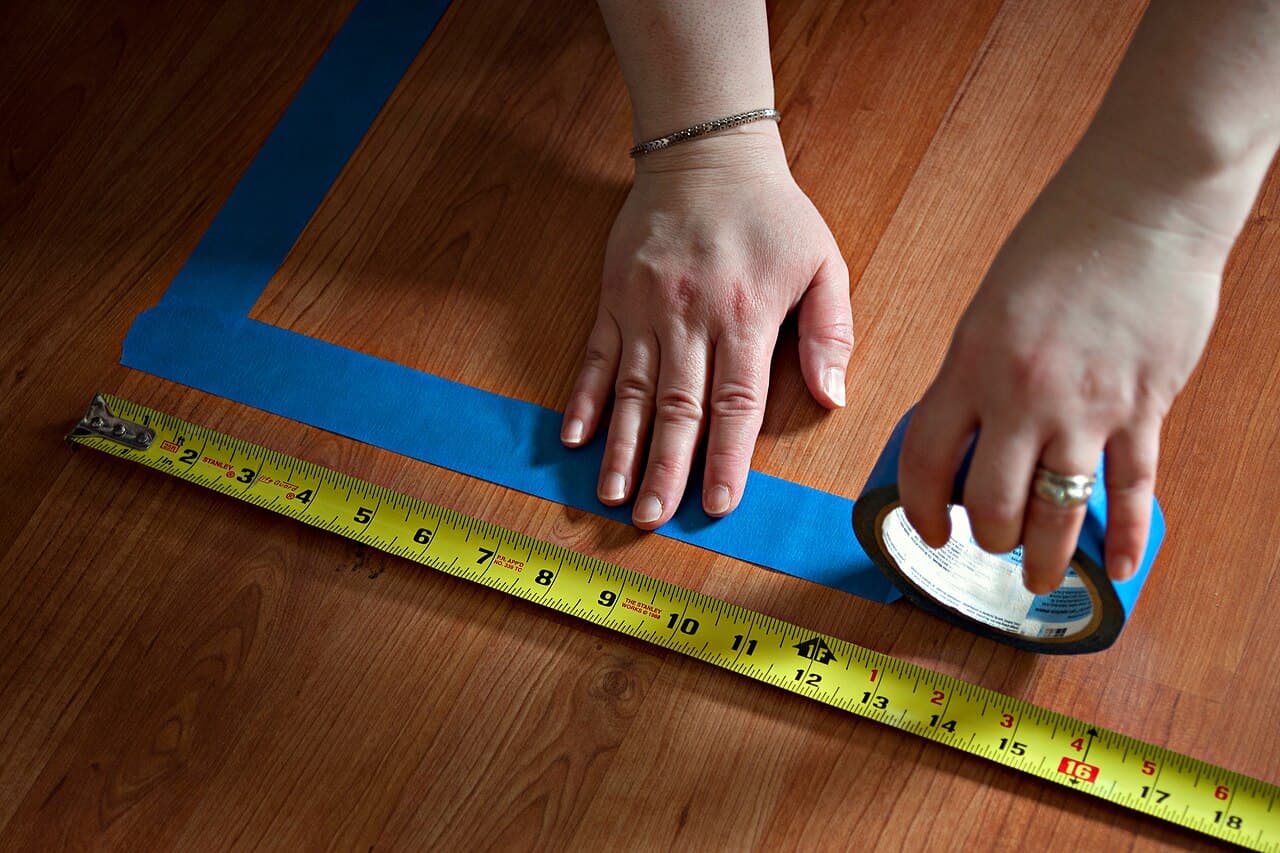
Use a steel tape, a notepad and a pencil. Work in feet and inches, then round up.
- Draw a rough floor plan, even for a square room.
- Measure the longest length and the longest width wall to wall, including any alcove, bay or closet that will be carpeted.
- For an L-shaped room, split it into rectangles and measure each one.
- Measure across doorways to the middle of the door, because carpet usually ends under the door or at a transition strip.
- Write each measurement on the sketch, then round every one up to the next half foot.
- Multiply length by width for square feet. Divide by 9 for square yards, which is how many stores quote carpet.
Mark where the seams could fall and which direction you want the pile to run. Those two choices change the amount of carpet more than the tape measure does.
Compare with the roll width
Lay your sketch against the roll width. If one wall of the room is 12 feet or less, the carpet can often run the other way in one piece, which means no visible seam. If both dimensions are over the roll width, expect a seam and extra yardage.
Rooms near the roll width are the awkward ones, since a room 12 feet 3 inches wide cannot be cut from a 12-foot roll without a seam. Tell the estimator about those cases so the layout is planned before any carpet is cut.
Let the estimator confirm
An estimator determines exactly how much carpet you need to buy.[1] Give them your sketch and ask for the layout in writing, including seam locations, pattern direction and the size of any leftover piece. Many homeowners find an exact measurement from you cuts the number of surprises later, but the estimator's figure is the one the order should rest on.
Ask who is responsible if the order comes up short. A written quote that names the yardage and the layout answers that question. See what a carpet installation quote should include for the full checklist.
Measure before the old floor comes up
Measure with the old floor in place, then again before the carpet is ordered if walls or doors change. Before the crew arrives, you clear the room of furniture and belongings, and remove any existing flooring such as old carpet or tile.[1] Once the room is bare, the installer inspects the subfloor and installs tack strip before the cushion goes down.[1] Tack strip runs along the walls, so measure to the wall, not to the strip.
Stop and call a pro if
- The room has curved walls, a stair, a landing or a built-in that makes a simple rectangle impossible. A flooring estimator should measure these in person.
- Old resilient flooring under the carpet could contain asbestos. The EPA advises not to sand or try to level asbestos flooring or its backing.[2] Do not sand, scrape or tear it up to measure; ask a professional.
- The subfloor is soft, wet or uneven, or the room has a structural problem. Measuring is not the fix for that.
- You cannot reconcile your numbers with the quote. Ask the estimator to walk the room with you.
Next steps
Once you have your figures, read how much carpet installation costs in Virginia and how to choose a flooring installer. More guides are in flooring answers, and you can browse licensed pros under flooring.
When you are ready, describe your carpet job and licensed local flooring contractors will quote it.
Common questions
- How much extra carpet should I order?
- It depends on the roll width, seams and pattern, so there is no single percentage. A patterned carpet with a large repeat needs more, and a room larger than the roll needs extra for seaming. Ask the estimator to quote the yardage and layout in writing.
- How wide is a roll of carpet?
- Most carpet is manufactured in 12-foot rolls, although 15-foot rolls are available as well, according to Shaw Floors.
- How do I convert square feet to square yards?
- Divide the square feet by 9. A 12 by 15 foot room is 180 square feet, or 20 square yards.
- Should I measure the closet?
- Yes, if it will be carpeted. Add each closet and alcove to your sketch and tell the estimator.
- Do I measure before or after the old carpet comes out?
- Either works, because the old carpet is thin compared with the room. Measure wall to wall, and confirm again once the room is bare if anything changes.
Sources
- [1] Carpet Installation Planning, Shaw Floors. Checked October 27, 2026.
- [2] Protect Your Family from Exposures to Asbestos, U.S. Environmental Protection Agency. Checked October 27, 2026.
Want a pro to handle it?
Describe the job once. Licensed local businesses send quotes, and you pay only when you book one.
Get a quote from a local pro