How do I replace a toilet?
Shut off and drain the old toilet, disconnect the supply line, unbolt it and lift it off the floor flange. Scrape off the old wax, check that the flange is sound and level with the floor, then set the new toilet straight down onto a new wax ring and new bolts, tighten evenly, reconnect the water and check for leaks.
Free to ask. Local shops send quotes, and you pay only when you book one.
By Kasra Taheri, Founder, LoclisPublished
Researched and drafted with AI, then checked claim by claim against the sources listed below before it was published. Prices and rules change; the dates beside each source say when it was last checked.
Step by step
Read when to stop and call a pro, further down this page, before you start.
Step 1: Measure the rough-in
Measure from the finished wall behind the toilet to the center of the floor bolts, and buy a new toilet made for that distance.
Step 2: Shut off and drain
Close the valve behind the toilet, flush while holding the handle down, and sponge or absorb the water left in the bowl and trap.[6]
Step 3: Disconnect the supply
Unscrew the supply line from the tank and keep a towel under the valve to catch drips.
Step 4: Unbolt the old toilet
Pop off the bolt caps, take off the nuts, rock the bowl gently to break the seal and lift it straight up with a helper.[5]
Step 5: Clean and inspect the flange
Scrape all old wax off the flange with a putty knife and check it for cracks, rust and height against the finished floor.[5]
Step 8: Tighten evenly
Tighten the nuts a little at a time, alternating sides, until the bowl is firm; overtightening can crack the porcelain.[10]
Step 9: Mount the tank
On a two-piece toilet, fit the tank gasket and bolts that came with it and tighten them evenly by hand, alternating sides.[9]
Step 10: Reconnect the water
Attach the supply line hand-tight plus a quarter turn with a wrench, open the valve and let the tank fill.[5]
Step 11: Check for leaks
Flush several times and wipe the base, tank bolts and both ends of the supply line with a dry paper towel to spot any seepage.
Replacing a toilet is a one-afternoon job for most homeowners who have a helper, an adjustable wrench, a putty knife, a new wax ring and new floor bolts. The new toilet sits on the same drain and the same water supply, so a like-for-like swap in Virginia usually needs no permit; in a special flood hazard area the building official can require one.[1] What decides whether the job ends dry is the flange under the old toilet and how you set the new one down.
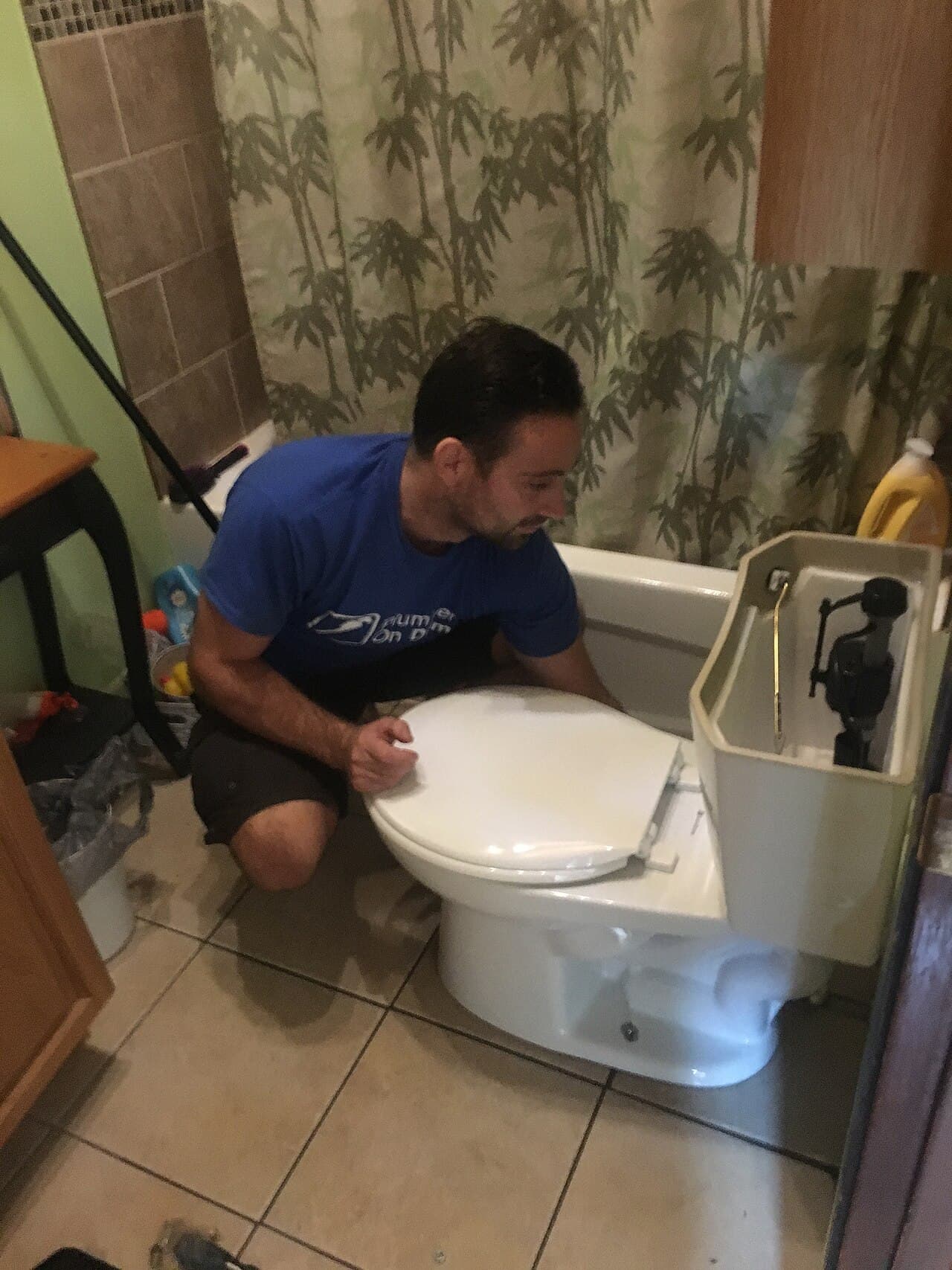
Before you buy the new toilet
Measure the rough-in. With the old toilet still in place, measure from the finished wall behind it (not the baseboard) to the center of the bolts that hold the bowl to the floor. Buy a toilet made for that distance, or it will sit too far from the wall or will not fit at all.
Choose an efficient model. Federal rules have capped a new gravity-tank toilet at 1.6 gallons per flush since January 1, 1994.[2] Toilets with EPA's WaterSense label use 1.28 gallons per flush or less, 20 percent less than that standard, and are independently certified for performance as well as efficiency.[3] EPA notes that the "low-flow" toilets of the 1990s were sometimes associated with performance issues such as double flushing, and that labeled toilets sold today far outperform toilets from the 1980s and 1990s.[3]
Check for a rebate first. Since October 2024, City of Charlottesville residents can get a rebate of up to $150 per toilet, for up to three toilets, when they replace a toilet that uses 1.6 gallons per flush or more with a WaterSense labeled model, and the rebate can cover the toilet, the installation or both.[4] The rebate needs the receipt and a form, and the city says the program depends on funding and may be discontinued at any time.[4] Ask your own water utility whether it runs something similar before you buy.
Gather the parts. You need a wax ring (or a wax-free seal), new closet bolts, a braided supply line, a putty knife, a sponge and bucket, rubber gloves, and cardboard or an old towel to set the old toilet on. Oatey recommends replacing the closet bolts whenever you replace the wax ring,[5] and suggests considering a new supply line at the same time.[7]
Getting the old toilet out
Close the valve behind the toilet, then flush while holding the handle down so the tank and bowl empty. Some water stays in the bowl and trap, and water left there can splash out when the toilet comes off the flange,[6] so sponge it out, use a wet-dry vacuum, or use a water-absorbing gel made for the purpose.
Unscrew the supply line, pop off the decorative bolt caps and take the nuts off. Rock the bowl gently to break the old seal, then lift it straight up.[5] A toilet is heavy and porcelain chips, so get a helper. Stuff an old rag into the drain opening to block sewer gas while you work, and take it out before the new toilet goes on.
Check the flange before anything goes back
The flange is the fitting in the floor that the toilet bolts to and that joins it to the drain. Scrape every bit of old wax off it with a putty knife, then look at it closely.
- Height. The flange should sit flush with or slightly above the finished floor.[5] One that sits lower, which often happens after thicker tile goes down over old vinyl, needs a flange spacer or an extra-thick wax ring.[5]
- No stacking. Never stack two wax rings to make up height; use an extra-thick ring or a flange extender instead.[5]
- Cracks and rust. A broken flange is the usual reason a toilet rocks even when the bolts are tight. A broken flange ring can often be fixed with a repair ring screwed down over it, but when the drain section of the flange is damaged, a licensed plumber is needed to replace the flange.[7]
- Soft floor. If a leak brought you here, press on the floor around the opening. Oatey warns that water-damaged subfloor can weaken the fasteners that hold the flange in place.[5]
Setting the new toilet
Set the new bolts in the flange slots, centered with the flange opening and parallel with the wall behind the tank.[7] Center the new wax ring on the flange, or on the toilet's outlet if its instructions say so. Lower the bowl straight down over the bolts and press it into the wax with a slight side-to-side twist. Do not rock it: Oatey explains that wax has no memory, so rocking compresses it unevenly and leaves several leak paths.[9]
Tighten the nuts a little at a time, alternating sides, until the bowl sits firm on the floor. Stop there, because overtightening can crack the porcelain.[10] If the bowl still rocks on an uneven floor, use plastic toilet shims rather than more force.
A wax ring is single use. Once a wax ring has been compressed it cannot be reused, even if you lift the toilet minutes after setting it.[8] If you have to pull the toilet back up for any reason, put a new ring on. Wax-free seals are reusable and mess-free, but they may not seal as well on an uneven or damaged flange.[11]
On a two-piece toilet, fit the tank to the bowl with the gasket and bolts supplied, tightening them by hand and evenly. Connect the supply line hand-tight plus a quarter turn with a wrench, open the valve and let the tank fill.[5] Flush several times and run a dry paper towel around the base, the tank bolts and both ends of the supply line. Oatey's advice is to caulk the base only after the toilet has passed several flushes with no leaks.[5]
Stop and call a pro if
- The flange's drain section is cracked, rotted or broken, or it is a brass flange on cast iron. Oatey notes that an old lead bend under a brass flange may have deteriorated beyond repair and need replacing.[8]
- The floor around the toilet is soft or the ceiling below is stained. The subfloor may need repair before any toilet goes back down.
- The shutoff valve will not close fully, or it leaks when you turn it. Replacing it means working on the supply pipe.
- You want to move the toilet or change the drain. Virginia's building code exempts from a permit the replacement of plumbing fixtures without alteration of the water supply and distribution systems, sanitary drainage systems, or vent systems.[1] A new drain location is an alteration and a job for a licensed plumber. See whether you can replace your own plumbing fixtures in Virginia.
- The new toilet still leaks at the base after a fresh ring on a sound, level flange. Read why water leaks around the base of a toilet.
Getting help on Loclis
If you would rather not lift porcelain, licensed plumbers on Loclis install toilets. Browse toilet repair and installation, find plumbers in Blacksburg, read what a toilet replacement costs in Virginia, or see every plumbing answer.
When you are ready, describe the toilet job once and licensed local plumbers quote it.
Common questions
- Do I need a permit to replace a toilet in Virginia?
- Usually not for a straight swap. Virginia's Uniform Statewide Building Code exempts replacing plumbing fixtures when the water supply, drainage and vent piping is not altered, but if the home is in a special flood hazard area the building official can require a permit for exempted work, so ask your building department first. Moving the toilet, adding a new drain or running new supply pipe is an alteration; ask your local building department and hire a licensed plumber for that.
- Can I reuse the old wax ring?
- No. Oatey, which makes wax rings, says a compressed ring cannot be reused even if the toilet comes up minutes after it was set. Any time a toilet is lifted off the flange, it goes back down on a new ring.
- Should I use a wax ring or a wax-free seal?
- Either works on a sound, level flange. Wax-free rubber or foam seals are reusable and less messy, but Oatey notes they may not seal as well on an uneven or damaged flange, where a wax ring conforms better.
- Should I caulk around the base of the new toilet?
- Oatey suggests caulking the base for a finished look only after several test flushes show no leaks. Make sure the base is dry and the toilet is firm before you caulk.
- What do I do with the old toilet?
- Porcelain is heavy and bulky, so check with your county or city solid waste office before you put it at the curb. If a plumber installs the new toilet, ask whether hauling the old one away is included in the written quote.
Sources
- [1] 13VAC5-63-80. Section 108 Application for permit (Virginia Uniform Statewide Building Code), Virginia Administrative Code, Virginia General Assembly. Checked October 26, 2026.
- [2] 10 CFR 430.32 Energy and water conservation standards and their compliance dates, Electronic Code of Federal Regulations, U.S. Department of Energy. Checked October 26, 2026.
- [3] WaterSense: Residential Toilets, U.S. Environmental Protection Agency. Checked October 26, 2026.
- [4] WaterSense Labeled Toilet Rebates, City of Charlottesville, Virginia. Checked October 26, 2026.
- [5] How to Replace a Toilet Wax Ring, Oatey. Checked October 26, 2026.
- [6] How to Easily Remove Water from a Toilet, Oatey. Checked October 26, 2026.
- [7] How to Repair a Toilet Flange, Oatey. Checked October 26, 2026.
- [8] Five Best Practices When Installing a Toilet Flange, Oatey. Checked October 26, 2026.
- [9] How to Fix a Leaking Toilet: Causes and Repairs, Oatey. Checked October 26, 2026.
- [10] 5 Signs It's Time to Replace Your Toilet Bolts, Oatey. Checked October 26, 2026.
- [11] Oatey 101: What Is a Toilet Wax Ring and When Should You Replace It?, Oatey. Checked October 26, 2026.
Want a pro to handle it?
Describe the job once. Licensed local businesses send quotes, and you pay only when you book one.
Get a quote for Plumbing Repair