Why is water leaking around the base of my toilet?
Water that appears at the base after a flush usually means the wax ring under the toilet has failed or the flange it seals to is broken or loose. Water that is there all the time usually comes from higher up: the supply line, the fill valve nut, the tank bolts or tank gasket, or condensation running down a sweating tank.
Free to ask. Local shops send quotes, and you pay only when you book one.
By Kasra Taheri, Founder, LoclisPublished
Researched and drafted with AI, then checked claim by claim against the sources listed below before it was published. Prices and rules change; the dates beside each source say when it was last checked.
Step by step
Read when to stop and call a pro, further down this page, before you start.
Step 1: Dry everything
Wipe the floor, the base, the tank and the supply line completely dry so you can see where new water first appears.
Step 2: Check the supply line
Run a dry paper towel along the supply line and both of its nuts; moisture there points to a supply line leak.[1]
Step 3: Check under the tank
Feel under the tank at the fill valve nut and the tank bolts; water there points to a fill valve or gasket leak.[1]
Step 4: Look for sweating
On a humid day, check whether the outside of the tank and bowl is beaded with water all over, which suggests condensation.
Step 5: Add food coloring
Put a few drops of food coloring in the tank and check the floor before anyone flushes; colored water there means the leak is from the tank, not the drain.
Step 6: Flush and watch
Flush a few times and watch the joint where the bowl meets the floor; water that seeps out right after a flush points to the wax ring or flange.[1]
Step 7: Check for rocking
Press on the bowl from side to side; a toilet that moves suggests loose or broken bolts, or a damaged flange.[4]
Step 8: Snug the bolts gently
If the bowl moves, snug the floor bolt nuts a little at a time on each side, stopping as soon as it is firm so the porcelain does not crack.[4]
Water around the base of a toilet comes from one of two places: from under the toilet, where the bowl joins the drain, or from higher up, running down to the floor. When it appears right after a flush, the seal under the toilet is the usual suspect. When it is there all the time, look up: the supply line, the tank, or a tank that is sweating. A few minutes with a dry towel will usually tell you which.
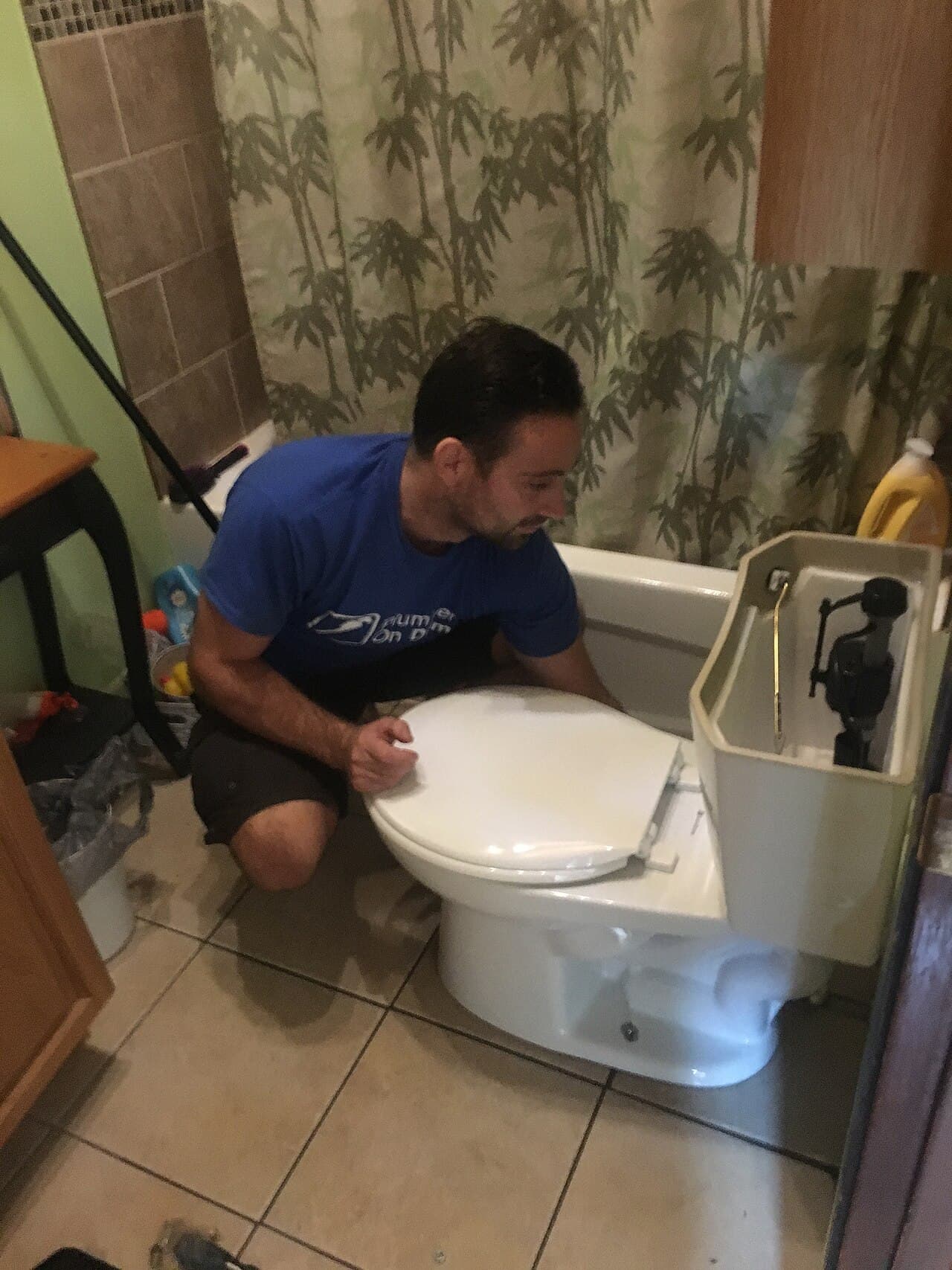
Find where the water starts
Dry everything first: the floor, the base, the tank and the supply line. Then wait and watch where new water appears. The clues are consistent: water pooling around the base usually points to a wax ring or flange failure, while water beneath the tank indicates a fill valve or gasket leak, and moisture near the supply line suggests a supply line leak.[1]
A drop of food coloring in the tank helps, as long as you look before anyone flushes. If colored water turns up on the floor while the toilet sits unflushed, it is tank water running down from above. Once you flush, the dyed water passes through the bowl, so a failed wax ring would color the floor too, and the test no longer tells the two apart.
A failed wax ring
A wax ring sits between the toilet's outlet and the flange in the floor and seals in both water and sewer gas.[3] It is the most common reason for water at the base that shows up after a flush.
Rings usually fail because something moved. Oatey explains that a wax ring that was installed badly or compressed unevenly, often because the toilet was rocked into place, leaves leak paths.[1] Signs that the wax ring has failed include water around the base, a toilet that rocks, and sewer odors.[2] A sewer smell near the toilet with no visible water is often the same problem at an earlier stage.
The flooring can be the cause too. If you recently laid thicker flooring, such as tile over vinyl, the flange may now sit below the finished floor, where the wax ring cannot seal properly.[2]
There is no patching a wax ring. A wax ring is single use: once it has been compressed it cannot seal again, so the toilet always goes back down on a new one.[6]
Loose bolts or a broken flange
The two bolts at the base hold the toilet down on the ring. Oatey notes that water pooling at the base is often due to loose or damaged bolts, which can compromise the wax ring,[4] and that a rocking toilet often means the bolts are loose, broken or improperly installed.[4] Rusty, discolored or flaking bolts are a sign they need replacing.[4]
Snugging the nuts can stop a slight wobble, but be careful not to overtighten them, because that can crack the porcelain.[4] If the toilet keeps moving, Oatey says repeated movement could point to a damaged flange that must be fixed before new bolts go in.[4] A broken flange lets the toilet move, and the constant rocking will likely break the wax seal, letting water reach the floor and the ceiling below when the toilet is flushed.[5] Water spots on the ceiling directly below the toilet are a warning sign of a broken flange.[5]
Leaks that start higher up
The supply line. The flexible line from the shutoff valve to the tank is a common culprit. A supply line can crack or loosen from water pressure, vibration or a knock,[1] and Oatey suggests replacing it every three to five years.[1] Check both nuts, at the valve and under the tank.
The fill valve nut. The fill valve is held to the bottom of the tank by a nut and a rubber gasket. If the fill valve nut has loosened or its rubber gasket has cracked, water can leak to the floor beneath the tank.[1] Oatey's fix is to hand-tighten the nut without overtightening, and to replace the fill valve if the leak persists.[1]
The tank bolts and tank gasket. On a two-piece toilet, the bolts through the bottom of the tank and the large gasket between tank and bowl can weep. Oatey notes that a damaged tank-to-bowl gasket leaks at the tank base,[1] and the drips run down the back of the bowl to the floor, which looks like a base leak.
Condensation. On humid summer days, a tank full of cold water can sweat. If the outside of the tank and bowl is beaded with water all over and the puddle comes and goes with the weather, condensation is the likely cause rather than a leak.
A crack. Oatey notes that leaks around the base or from the tank can indicate worn-out seals or cracks in the porcelain.[7] Look along the bowl's foot and around the tank with a flashlight. A cracked bowl or tank means a new toilet; see whether to repair or replace an old toilet.
Stop and call a pro if
- The ceiling below is stained or the floor around the toilet is soft. The subfloor may be damaged and need repair before the toilet goes back.
- The flange is broken, cracked through to the drain or badly corroded. Oatey rates flange repair as an expert job and highly recommends a professional plumber.[1]
- The shutoff valve behind the toilet leaks or will not close. Replacing it means working on the supply pipe.
- The leak comes back after a new wax ring on a level, sound flange.
- Sewage, not clean water, is coming up around the base, or other drains back up when the toilet is flushed. That points to the drain line, not the toilet.
- You want to move the toilet or change the drain. Virginia's building code exempts from a permit the replacement of plumbing fixtures without alteration of the water supply and distribution systems, sanitary drainage systems, or vent systems;[8] new drain work is an alteration.
Resetting a toilet on a new ring means lifting it off the flange, and Oatey rates wax ring and flange replacement as an expert job, highly recommending a professional plumber.[1] If you are comfortable lifting a toilet and checking the flange yourself, the steps are the same as in how to replace a toilet; otherwise this is a short job for a plumber. For leaks elsewhere in the house, see how to find a hidden water leak.
Getting help on Loclis
Licensed plumbers on Loclis fix toilet leaks and reset toilets. Browse toilet repair and installation, find plumbers in Blacksburg, or see every plumbing answer.
Describe the toilet leak once, including whether it shows up after a flush, and licensed local plumbers quote it.
Common questions
- Is a leak at the base of a toilet dangerous?
- It is rarely an emergency, but it is not one to leave. Water from a failed wax ring has been through the bowl, and it soaks into the subfloor where you cannot see it. Oatey warns that a broken flange can let water reach the floor and the ceiling below each time the toilet is flushed.
- Can I just caulk around the base to stop the leak?
- No. Caulk around the base is a finishing touch, not a seal. If the wax ring or flange is leaking, caulk only hides the water and holds it against the floor. Fix the seal first, and caulk only after test flushes show no leaks.
- Why does my toilet leak only when I flush?
- Water that appears at the base right after a flush is usually water from the bowl escaping past a failed wax ring or a broken flange. Water that is there all the time, flush or not, is more often the supply line, the fill valve nut, the tank bolts or condensation.
- How do I tell condensation from a leak?
- Condensation tends to show up on humid days as beads of water all over the outside of the tank and bowl, and it comes and goes with the weather. A leak shows up in one spot, such as a supply line nut, a tank bolt or the joint at the floor, whatever the weather.
- Do I need a permit to reset or replace a leaking toilet in Virginia?
- Usually not for resetting it or replacing it like for like. Virginia's building code exempts replacing plumbing fixtures when the supply, drainage and vent piping is not altered, although in a special flood hazard area the building official can require a permit for exempted work. Replacing a damaged drain flange connection or moving the toilet is different; a licensed plumber should handle that.
Sources
- [1] How to Fix a Leaking Toilet: Causes and Repairs, Oatey. Checked October 26, 2026.
- [2] How to Replace a Toilet Wax Ring, Oatey. Checked October 26, 2026.
- [3] Oatey 101: What Is a Toilet Wax Ring and When Should You Replace It?, Oatey. Checked October 26, 2026.
- [4] 5 Signs It's Time to Replace Your Toilet Bolts, Oatey. Checked October 26, 2026.
- [5] How to Repair a Toilet Flange, Oatey. Checked October 26, 2026.
- [6] Five Best Practices When Installing a Toilet Flange, Oatey. Checked October 26, 2026.
- [7] How to Unclog a Toilet, Oatey. Checked October 26, 2026.
- [8] 13VAC5-63-80. Section 108 Application for permit (Virginia Uniform Statewide Building Code), Virginia Administrative Code, Virginia General Assembly. Checked October 26, 2026.
Want a pro to handle it?
Describe the job once. Licensed local businesses send quotes, and you pay only when you book one.
Get a quote for Plumbing Repair