How do I store a chainsaw for the off-season?
Clean the saw, deal with the fuel, and store it dry with the bar covered. Gas begins to degrade in as little as 30 days, so either drain the tank and run the engine dry or use stabilized fuel, whichever your manual calls for. Clean the air filter and cooling fins, sharpen the chain, and keep spare fuel in an approved can.
Free to ask. Local shops send quotes, and you pay only when you book one.
By Kasra Taheri, Founder, LoclisPublished
Researched and drafted with AI, then checked claim by claim against the sources listed below before it was published. Prices and rules change; the dates beside each source say when it was last checked.
Step by step
Read when to stop and call a pro, further down this page, before you start.
Step 2: Store spare mix safely
Keep any leftover fuel in a labelled UL-listed or Factory Mutual approved safety can, away from the saw.[4]
Step 3: Clean the air filter
Clean or replace the air filter so dust does not sit in it all winter.[1]
Step 4: Clear the fins and cooling inlets
With the saw off and cool, brush sawdust from the cooling inlets and cylinder fins.[1]
Step 5: Clean the bar and chain
Take off the bar, clear the groove and oil hole, wipe the bar and chain and leave a light film of oil on the chain.
Step 6: Sharpen the chain now
If the chain is dull, sharpen it so the saw is ready next season.
Step 7: Cover and store dry
Fit the bar cover and store the saw in a dry, ventilated place away from ignition sources.
The short version
Store a chainsaw clean, with its fuel dealt with and the chain covered. Fuel is the part that matters most. Gas begins to degrade in as little as 30 days, which can clog the fuel system so the saw will not start next season.[2] Either run the tank dry or fill it with stabilized fuel, and which one your saw needs is in its manual.
Deal with the fuel
Two-cycle engines are the touchy ones. University of Missouri Extension says that if you operate the chain saw infrequently, you should drain the fuel tank and add a stabilizer to the fuel mixture to prevent deposits from building up in the carburetor.[1]
Briggs & Stratton takes a slightly different route for its own engines. It says fuel stabilizer eliminates the need to drain fuel before storage by keeping fuel fresh for up to 24 months, and that keeping the tank full will minimize accumulation of moisture.[2] It says to add the stabilizer according to package directions and run the engine for a few minutes to circulate it through the carburetor.[2] For a saw, treat that as a general principle and defer to your saw maker on whether to drain.
Whichever you choose, do not leave untreated ethanol blends sitting. Penn State Extension says ethanol is water soluble, so it can pick up contaminants and deposit them inside the engine, and that rarely or seasonally used engines such as chainsaws are especially prone to difficulties.[3]
Pour any leftover mix into an approved container for use in a few weeks or for proper disposal. Fuel should be carried in a UL-listed or Factory Mutual approved safety can, and Extension says never to refuel a hot engine.[4]
Clean it before it goes away
Sawdust holds moisture and hides problems. Extension's maintenance table lists cleaning or replacing the air filter, cleaning the cooling inlets and cylinder fins, and checking the spark arresting screen in the muffler.[1] Brush out the chain brake area and the bar groove, and blow or brush dust out of the fins with the saw off and cool.
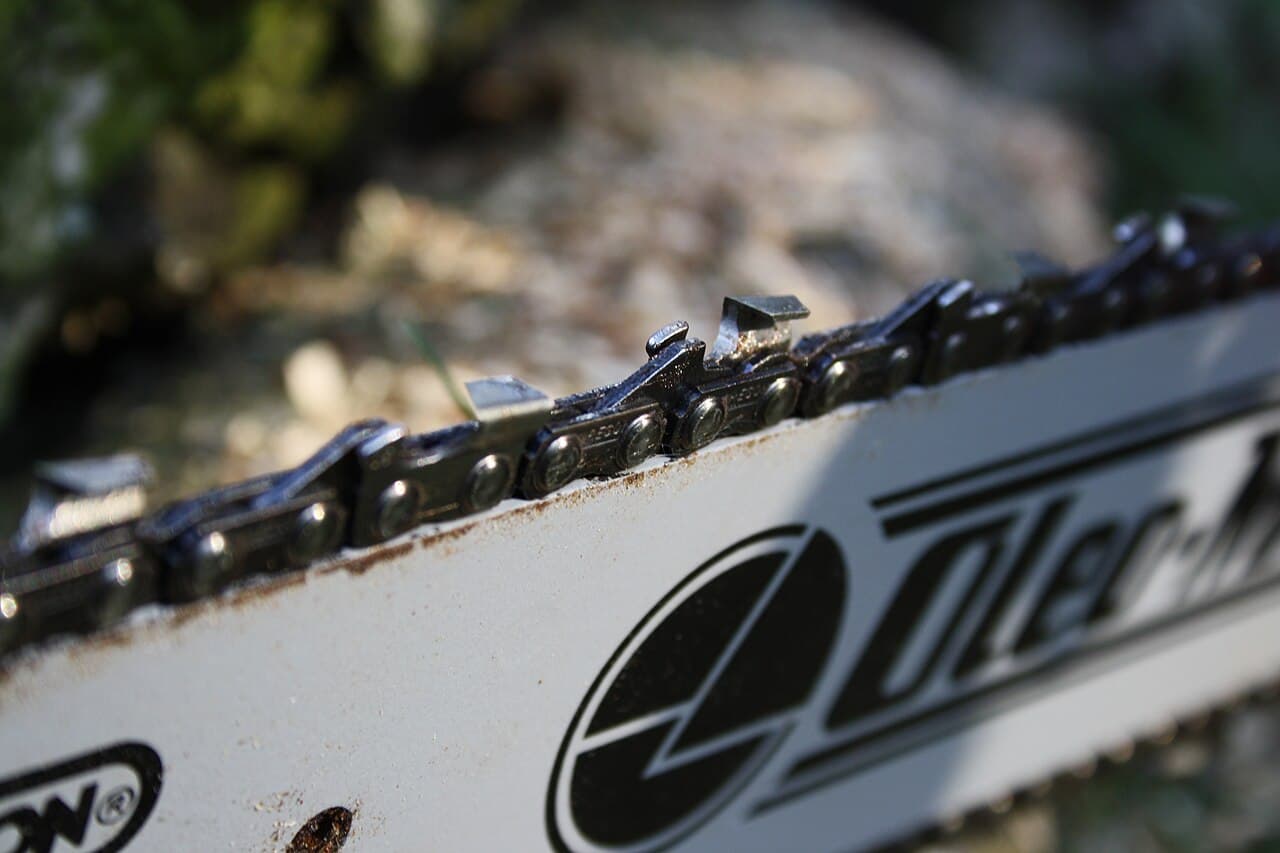
Take the bar off, clear sawdust from the groove and the oil hole, and wipe the bar and chain with a rag. A light film of oil keeps the chain from rusting. If the chain is dull, sharpen the chain now so the saw is ready in spring.
Store it somewhere dry
Fit the bar cover or scabbard and hang the saw or lay it flat in a dry, ventilated spot, away from a furnace, water heater or other source of ignition, and out of reach of children. Garages that swing from freezing to humid are hard on bar, chain and carburetor, so a shelf in a dry shed or a cabinet inside is better. Keep the fuel can well away from the saw.
Top up the bar-oil tank only if your manual says so; some makers advise emptying it to prevent leaks. Do not use waste crankcase oil in the bar-oil tank.[4]
Wake it up in spring
When you take it out, check the chain tension against the guidance in how to adjust chainsaw chain tension. Extension notes that you should check the oiler by holding the tip above a light-colored surface and accelerating the engine, where oil should splatter on the surface.[1] Use fresh fuel mix. If the saw will not start, see why a chainsaw will not start.
Stop and call a pro if
- The saw leaks fuel or oil in storage or when tilted.
- The chain brake, chain catcher or hand guard is cracked or loose. Extension says chain brake repairs should be done by properly trained service technicians.[4]
- The saw will not start on fresh fuel after an otherwise normal storage season.
- The fuel has turned dark or gummy and the carburetor looks clogged. Cleaning a carburetor properly is a shop job unless you know the saw.
Getting help in Virginia
Costs for a spring tune-up are in what chainsaw repair costs in Virginia. See chainsaw repair or more small engine repair answers.
When you are ready, post a chainsaw repair job and local shops can quote it.
Common questions
- Should I drain the gas from my chainsaw before storing it?
- University of Missouri Extension says to drain the tank and add stabilizer if you run the saw infrequently. Briggs & Stratton says a stabilizer removes the need to drain for its engines. Follow your saw maker's manual.
- How long does gas last in a chainsaw?
- Briggs & Stratton says gas begins to degrade in as little as 30 days and that stabilizer keeps fuel fresh for up to 24 months.
- Why are chainsaws hard to start after storage?
- Penn State Extension says rarely or seasonally used engines such as chainsaws are especially prone to trouble with ethanol-blended fuel, which can pick up contaminants and deposit them in the engine.
- Where is the best place to store a chainsaw?
- Somewhere dry and ventilated, with the bar covered and away from ignition sources, and with fuel in an approved safety can kept separate from the saw.
- Do I need to clean the chainsaw before storing it?
- Yes. Extension's maintenance table lists cleaning the air filter, cooling inlets and cylinder fins, so sawdust does not hold moisture or block airflow.
Sources
- [1] Selecting and Maintaining a Chain Saw (G1954), University of Missouri Extension. Checked October 28, 2026.
- [2] The Importance of Fuel Stabilizer, Briggs & Stratton. Checked October 28, 2026.
- [3] Fuel Ethanol: Hero or Villain?, Penn State Extension. Checked October 28, 2026.
- [4] Basic Chain Saw Safety and Use (G1959), as posted by Henrico County, University of Missouri Extension. Checked October 28, 2026.
Want a pro to handle it?
Describe the job once. Licensed local businesses send quotes, and you pay only when you book one.
Get a quote for Small Engines