How do I winterize a sprinkler system?
Shut off the sprinkler mainline, set the controller to rain mode, then get the water out of the pipes: open the manual drain valves, let automatic drains open on their own, or blow the lines out with a compressor limited to 50 psi while wearing eye protection. Insulate an exposed shut-off valve, protect the backflow device from freezing as your water utility allows, and leave the device itself alone.
Free to ask. Local shops send quotes, and you pay only when you book one.
By Kasra Taheri, Founder, LoclisPublished
Researched and drafted with AI, then checked claim by claim against the sources listed below before it was published. Prices and rules change; the dates beside each source say when it was last checked.
Step by step
Read when to stop and call a pro, further down this page, before you start.
Step 1: Shut off the sprinkler water
Close the sprinkler system's mainline shut-off valve, usually near the water meter or in a basement or crawl space.[4]
Step 2: Put the controller on rain mode
Set the controller to rain mode to keep your settings, or unplug it and reset the time and date in spring.[4]
Step 3: Relieve the pressure
Open one zone valve, from the controller or by hand, so the mainline is no longer under pressure.[3]
Step 4: Open the manual drain valves
If you have manual drain valves at the low points, wearing eye protection, open them slowly and close them again once they stop running.[3]
Step 5: Let automatic drains work
If you have automatic drain valves, run one zone briefly after the water is off and they release the water on their own.[4]
Step 6: Blow out the lines if you have the right compressor
With a regulated compressor set to no more than 50 psi, one zone valve open and eye protection on, blow each zone for no more than 2 minutes at a time and repeat until only a fine mist comes from the heads.[3]
Step 7: Protect what stays outside
Wrap an exposed shut-off valve in foam insulation or a towel inside a plastic bag, and bring hoses indoors.[4]
Shut off the water to the system, switch the controller off, and then get the water out of the pipes, valves and heads before the first hard freeze. Water left in sprinkler lines, valves or the backflow device freezes and expands, and that can split or crack pipes, even buried ones.[4] Richmond Public Utilities says that in most yards sprinkler lines are not buried deep enough to be protected from the cold.[4]
Which of the three ways to clear the lines applies depends on how your system was built. Rain Bird's homeowner guide names three ways to clear the water: manual drain valves, automatic drain valves, or an air blow-out.[3] Check your yard, basement or crawl space for drain valves before you rent anything.
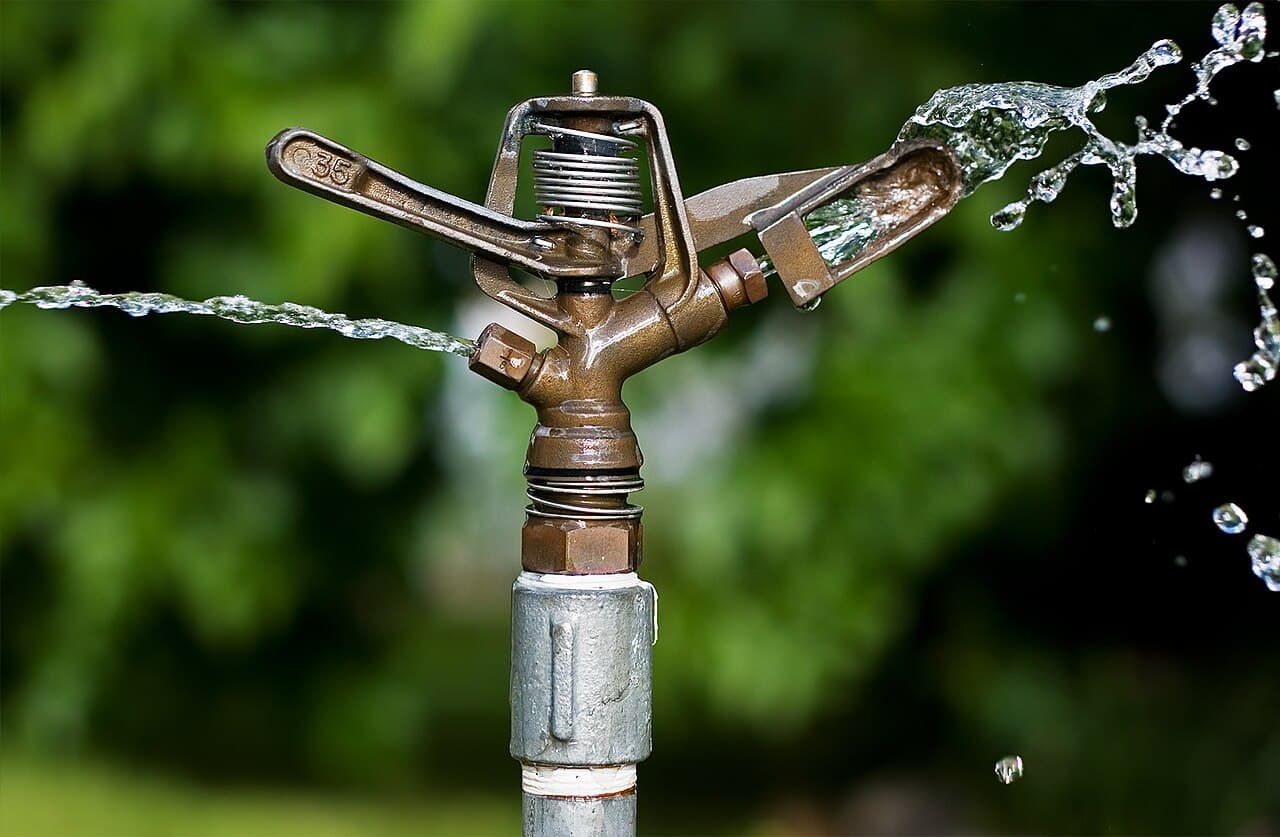
Start with the water and the controller
Close the sprinkler system's mainline shut-off valve, usually near the water meter or in a basement or crawl space.[4] Then set the controller to rain mode to keep your settings, or unplug it and reset the time and date in spring.[4] An outdoor shut-off valve is worth wrapping: Richmond says to wrap an outdoor shut-off valve in foam insulation or a towel inside a plastic bag, and to bring hoses indoors.[4]
Before touching a drain valve, take the pressure off. Open one zone valve, from the controller or by hand, so the mainline is no longer under pressure.[3]
If you have drain valves
Manual drain valves sit on the mainline at its lowest point, and the valve is under pressure until you relieve it, so wear eye protection.[3] Open each one slowly, let it run until it stops, then close it. Put the water where it will soak into the ground or run into a floor drain, not against the foundation.
Automatic drain valves open when water pressure drops, so after the water is off, run one zone briefly and they release the water.[4] There is nothing else to do except look for a spot that stays soggy, which can mean a valve is stuck open.
If you blow the lines out
Compressed air pushes the water out through the sprinkler heads. It is the usual choice when a system has no drain valves at its low points. It is also the one that can hurt people and equipment, so follow the limits closely.
- Rain Bird says air pressure must not exceed 50 psi during a blow-out, and that a pressure regulating valve must be used.[3]
- Rain Bird says to rent or buy a compressor that delivers 10 to 25 cubic feet per minute, and warns that some small 2 hp shop compressors may not be adequate.[3]
- Rain Bird warns against using a high-pressure (120 psi), low-volume compressor to push water out.[3]
- Do not stand over pipes, valves or sprinklers during a blow-out.[3]
Connect the hose to the blow-out fitting on the mainline, with the shut-off closed and one zone valve open. Do not run the compressor unless at least one zone valve is open, and do not blow any zone for more than 2 minutes at a time.[3] Move from zone to zone, then go around again. Repeat the cycle two or more times until nothing more than a fine mist comes from the heads.[3] You are not chasing every drop.
Do not leave one zone running dry. Many sprinklers with plastic gear drives use water for lubrication and cooling, so running air alone for long can damage the drive.[3]
The backflow device is a separate job
Chesterfield County says its backflow assemblies cannot be wrapped with insulation and must be protected from freezing, with a freeze-resistant model or an approved insulated enclosure as options.[1] Rules vary by locality, so ask your water utility what yours allows. Your job is to keep the device from freezing and to leave its test cocks and internals to a certified tester; see what a backflow preventer is and how it is tested.
Where the air connection goes matters as well. In Chesterfield County a blow-off connection used to pump air into the pipes is not allowed upstream of the backflow prevention assembly.[1] If antifreeze is used to winterize a lawn irrigation system, Prince William County says an ASSE 1013 reduced pressure (RPZ) device is the only approved backflow preventer.[2]
Stop and call a pro if
- You do not have a 10 to 25 cubic feet per minute compressor. Rain Bird says to rent or buy one of that size, and a small shop compressor may not be adequate.[3] A contractor arrives with the right one.
- The backflow device needs to be opened or tested. That belongs to a certified tester, and some localities want the freeze protection to be an approved enclosure.[1]
- A pipe, valve or fitting leaks or hisses once air is on. Shut the compressor off first, then call a licensed irrigation contractor.
- There is no blow-out fitting on the mainline, or it sits upstream of the backflow assembly. In Chesterfield County that placement is not allowed.[1]
- You are not sure which valves are drains and which are shut-offs. Guessing under pressure is how fittings blow apart.
Getting help in Virginia
If you would rather pay for it, read what a sprinkler blowout costs in Virginia and whether to hire someone to blow out your lines. Browse more irrigation answers or irrigation businesses.
When you are ready, describe the sprinkler job once and licensed local contractors can quote it.
Common questions
- Do I have to blow out my sprinkler lines, or can I just drain them?
- Either can work. Rain Bird's homeowner guide names three ways to clear the water: manual drain valves, automatic drain valves, or an air blow-out. Drain valves only help if they were installed at every low point of the system. Without them, compressed air is how the water gets out.
- What size air compressor do I need?
- Rain Bird says to rent or buy a compressor that delivers 10 to 25 cubic feet per minute, and warns that some small 2 hp shop compressors may not be adequate. Volume matters more than pressure: a small compressor that builds up to high pressure is the wrong tool. If you cannot get the right one, a contractor has it.
- What air pressure is safe for sprinkler pipes?
- Rain Bird says air pressure must not exceed 50 psi during a blow-out, and that a pressure regulating valve must be used. Its guide also says not to assume air is as forgiving as water, because air is far less viscous and produces higher stresses on the system.
- Do I need to winterize if my pipes are buried?
- Yes. Richmond Public Utilities says that in most yards sprinkler lines are not buried deep enough to be protected from the cold, and that water left inside lines, valves or the backflow device can split pipes even underground.
- Can I drain the backflow preventer myself?
- Insulating or covering it is one thing; opening or testing it is another. In Chesterfield County the assembly cannot be wrapped with insulation and must be protected from freezing in other ways. Opening the device or its test cocks is a job for a tester who tests backflow assemblies, so call one.
- Is antifreeze an option for winterizing?
- Only in places that allow it. If antifreeze is used to winterize a lawn irrigation system, Prince William County says an ASSE 1013 reduced pressure (RPZ) device is the only approved backflow preventer. Ask your water utility before adding any chemical to a system.
Sources
- [1] A Guide to Selecting, Installing and Maintaining Backflow Preventers in Residential Irrigation Systems, Chesterfield County Utilities Department. Checked October 27, 2026.
- [2] Lawn Irrigation System Requirements, Prince William County Building Development Division. Checked October 27, 2026.
- [3] Homeowner's Guide to Winterization, Rain Bird Corporation (manufacturer). Checked October 27, 2026.
- [4] Winterize Your Sprinkler System Before It's Too Late (posted October 29, 2025), City of Richmond Department of Public Utilities. Checked October 27, 2026.
Want a pro to handle it?
Describe the job once. Licensed local businesses send quotes, and you pay only when you book one.
Get a quote from a local pro