Should I repair or replace my sump pump?
Repair it when the fault is outside the motor: a stuck or worn float switch, a failed check valve, a clogged inlet screen or a blocked discharge pipe. Replace it when the motor, bearings or impeller have failed, when it trips its outlet, when it is past its expected life, or when it is too small for the water coming in.
Free to ask. Local shops send quotes, and you pay only when you book one.
By Kasra Taheri, Founder, LoclisPublished
Researched and drafted with AI, then checked claim by claim against the sources listed below before it was published. Prices and rules change; the dates beside each source say when it was last checked.
Step by step
Read when to stop and call a pro, further down this page, before you start.
Step 1: Find the model and purchase date
Read the model number off the pump's label or manual and find the receipt, because warranty length depends on the model.[1]
Step 2: Check the easy fixes first
With the pump unplugged, free the float, clear the inlet screen and stand the pump upright, since those faults need no new parts.[1]
Step 3: Test it with water
Plug it back in and pour a bucket of water into the pit to see whether it starts on its own and drains the pit quickly.[1]
Step 4: Listen and watch
Note grinding or heavy vibration, humming with no water moving, or starting and stopping on its own, and tell the plumber exactly what you saw.
Step 5: Call the maker if it is under warranty
If the pump is within its warranty period, contact the manufacturer before paying for a new pump.[1]
Step 6: Get written quotes for both options
Ask each licensed plumber to quote the repair and the replacement in writing, on the same scope, so you can compare.[4]
The short answer
Repair a sump pump when the problem is outside the motor: the float switch, the check valve, a clogged inlet screen or a blocked discharge pipe. Replace it when the motor, bearings or impeller have failed, when it trips its outlet, when it is old enough that its maker no longer expects it to last, or when it cannot keep up with the water coming in. The repair is usually small; when the motor itself has failed, the fix is a new pump.
What can be repaired
These faults can be fixed without buying a new pump.
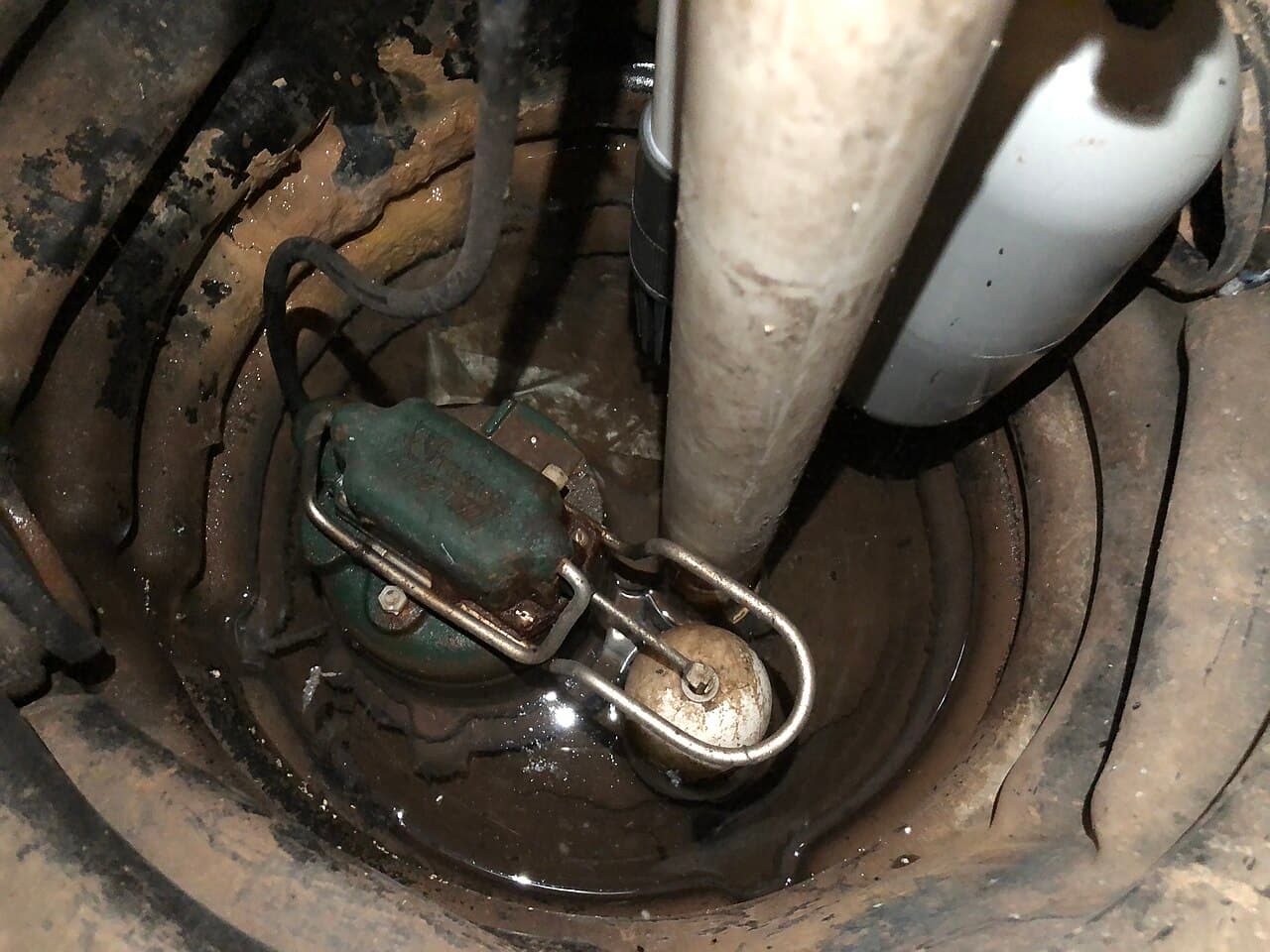
The float switch. For a pump that will not start, will not stop, or cycles too often, the remedy for a failed switch is to replace the tether switch or replace the pump.[1] On a pump with a separate float switch, ask the plumber to quote the switch and labour on its own, by brand and model, next to the price of a new pump. If the float is only stuck, not broken, nothing needs replacing; see how to fix a stuck sump pump float switch.
The check valve. If water rushes back into the pit after the pump stops and the pump starts again too soon, Wayne says a check valve that is not working or is leaking should be removed and examined, and replaced if necessary.[1]
Clogs. In the same chart, a clogged inlet screen and an obstruction in the discharge pipe are cleared, not replaced.[1]
When replacing is the right call
The motor or pump end has failed. In Wayne's chart, a failed motor, worn bearings and a broken impeller are each answered with replace pump.[1] Grinding, heavy vibration or a hum with no water moving are the usual signs.
It trips the outlet. In Wayne's chart, a pump that trips its GFCI outlet has either a bad GFCI, for an electrician to replace, or a bad pump.[1] If an electrician finds the outlet sound, the pump is the problem.
It keeps overheating, and the circuit checks out. Wayne's pump motor has an automatic resetting thermal protector,[1] so an overheated pump shuts off and then restarts on its own. Wayne explains: "Protector tripping is an indication of motor overloading as a result of operating the pump at low heads, excessively high or low voltage, inadequate wiring, incorrect motor conditions, or at the end of product life."[1] Only the last of those is a reason to buy a new pump. Voltage and wiring are an electrician's job; Wayne's chart lists low supply voltage, for which the remedy is to contact an electrician.[1] Have the circuit checked first, then ask the plumber whether the pump is set up wrong or simply worn out.
It is the wrong size. For a pump that will not shut off or moves too little water, one of Wayne's remedies is to recheck the sizing calculations to determine the proper pump size.[1] A pump that was marginal when installed does not get better with a new switch. When installing a backup pump, Wayne's manual tells owners to verify that the existing AC pump is in good working order and says: "If the AC pump is questionable, it is typically recommended that the unit be replaced with a 1/3 HP or 1/2 HP pump."[2]
Age and warranty
Warranty length is a fair guide to how long a maker expects a pump to last. Wayne's warranties run one year for some models and up to five years for its stainless steel and cast iron models.[1] Wayne's backup-pump manual, for its own pumps, ties expected life to warranty length: a pump with a one- or two-year warranty should give approximately three years of service, and one with a three- or five-year warranty approximately six,[2] if properly installed, maintained and operated according to its instructions.[2]
If your pump is still under warranty, call the maker before buying a new one. Three things to know:
- The clock does not restart. Wayne says the warranty period is not extended if Wayne repairs or replaces the product.[1]
- Maintenance matters. Wayne's manual states: "Lack of proper routine maintenance will void warranty."[1]
- Labour may be on you. Goulds' warranty says the seller is not obligated to remove or pay for removing the defective product, or to install or pay for installing the replacement.[3]
For more on age, see when should a sump pump be replaced.
Hiring the work out
A float or check valve swap on a plug-in pump is within reach of many homeowners. A new pump that needs the discharge piping changed, a new outlet, or a pit cleaned out after a flood is a plumber's job, with an electrician for anything wired.
Permits depend on where you live. Pittsylvania County lists sump pumps among the work that needs a building permit,[6] so ask your county or city building office before the work starts.
Check the licence. Virginia's contractor law defines its smallest licence class, Class C, as work where "the total value referred to in a single contract or project is over $1,000 but less than $30,000."[5] DPOR's consumer guide puts the line at work valued at $1,000 or more;[4] where the two differ, the statute is the rule, so the line is anything over $1,000. Virginia law also requires a master tradesman license as a condition of licensure for plumbing, electrical and HVAC contractors.[5] DPOR's advice is to check the contractor's license with the Board for Contractors at (804) 367-8511 or on its website.[4] On Loclis, plumbing work needs a licence at any job size, and an unlicensed quote is refused.
Compare quotes on the same scope. DPOR advises that you get at least three written bids or estimates using identical plans and specifications.[4] Ask each plumber to price both the repair and the replacement, so you can see the difference. And get it in writing: "Virginia law requires all licensed contractors to provide a written contract for residential work."[4]
For prices and what drives them, see how much sump pump repair costs in Virginia and how much sump pump installation costs.
Stop and call a pro if
- The pump is hardwired, the outlet trips as soon as the pump starts, or the cord is damaged.
- There is standing water on the floor near the pump or the electric panel.
- The pump grinds, vibrates hard, or hums without moving water.
- The discharge pipe needs to be cut, rerouted or replaced to fit a new pump.
- The pit keeps filling faster than the pump can empty it.
Browse more plumbing repair answers, see sump pump repair on Loclis, or find licensed plumbers near Blacksburg. When you are ready, describe the job once and get quotes from licensed plumbers.
Common questions
- Is it worth repairing a sump pump motor?
- Usually not. Wayne's troubleshooting chart answers a failed motor, worn bearings or a broken impeller with the same remedy: replace the pump. The parts worth repairing are the ones outside the motor, such as the float switch and the check valve.
- Does a sump pump warranty cover the plumber's labour?
- Often not. Goulds' warranty, for example, says the seller is not obligated to remove the defective product or pay to install the replacement. Read your own pump's warranty, and remember that skipping routine maintenance can void it.
- Do I need a permit to replace a sump pump in Virginia?
- It depends on the locality. Pittsylvania County lists sump pumps among the work that needs a building permit. Ask your county or city building office before the work starts, and expect a licensed plumber to know the local rule.
- Should I replace a working sump pump just because it is old?
- Many owners do once a pump passes the age its maker expects. Wayne's backup-pump manual ties expected life to warranty length, about three years for a pump with a one- or two-year warranty and about six for a three- or five-year one. If yours is past that and you depend on it, replacing it before a storm is cheaper than replacing it during one.
- Can a handyman replace my sump pump?
- On Loclis, plumbing work needs a licensed plumber at any job size. Virginia's contractor law starts its smallest licence class, Class C, at work over $1,000 in a single contract or project, and plumbing contractors must hold a master tradesman license. Check any licence with DPOR before you hire.
Sources
- [1] Submersible Sump Pumps: Operating Instructions and Parts Manual (600002W-001 J, 06/25), WAYNE Water Systems. Checked October 26, 2026.
- [2] ESP25n Battery Backup Sump Pump: Operating Instructions and Parts Manual (600005W-001 J), WAYNE Water Systems. Checked October 26, 2026.
- [3] Battery Backup Sump Pump: Installation, Operation and Parts Manual (IM186R04), Goulds Water Technology (Xylem). Checked October 26, 2026.
- [4] What You Should Know Before You Hire a Contractor, Virginia Department of Professional and Occupational Regulation, Board for Contractors. Checked October 26, 2026.
- [5] Code of Virginia § 54.1-1100. Definitions, Virginia General Assembly (Legislative Information System). Checked October 26, 2026.
- [6] Do I Need a Permit, Pittsylvania County Building Inspections. Checked October 26, 2026.
Want a pro to handle it?
Describe the job once. Licensed local businesses send quotes, and you pay only when you book one.
Get a quote for Plumbing Repair