What does a commercial snow plowing contract cost in Virginia?
There is no standard Virginia price. Commercial plowing is quoted per site, from the lot's size and layout, the pricing model (per push, per storm or seasonal), the trigger depth, de-icing, sidewalks and response time. Ask two or three companies to quote the same written scope, then compare the models and the terms rather than one headline number.
Free to ask. Local shops send quotes, and you pay only when you book one.
By Kasra Taheri, Founder, LoclisPublished
Researched and drafted with AI, then checked claim by claim against the sources listed below before it was published. Prices and rules change; the dates beside each source say when it was last checked.
Step by step
Read when to stop and call a pro, further down this page, before you start.
Step 1: Measure and map the site
Sketch the lot, drive lanes, loading areas, walks, ramps and entrances, and mark where snow can be piled without blocking drainage, sight lines or parking.
Step 2: Decide what you need
List whether you want plowing only or also sidewalks and de-icing, the hours the site must be open, and the depth at which service should start.
Step 3: Check what your city or county requires
Look up the local rule for clearing sidewalks next to your property and its deadline.[4]
Step 4: Ask for the same quote from each company
Give two or three companies the same written scope and ask each to state the pricing model, trigger depth, de-icing and response time.
Step 5: Ask for proof of insurance
Request a certificate of insurance covering the vehicles and the work.[2]
Step 6: Compare the contracts
Put the quotes side by side and compare the terms, not just the price, including damage, missed visits and cancellation.
Step 7: Sign a written agreement
Get the agreed scope, price, trigger depth and start and end dates in one signed document before the season begins.
There is no standard Virginia price for a commercial snow plowing contract. Each company quotes each site on its own, from the size and layout of the lot, how the work is priced, how deep snow must be before it comes, and what else is included. The reliable way to find your number is to give two or three companies the same written scope and compare the quotes line by line.
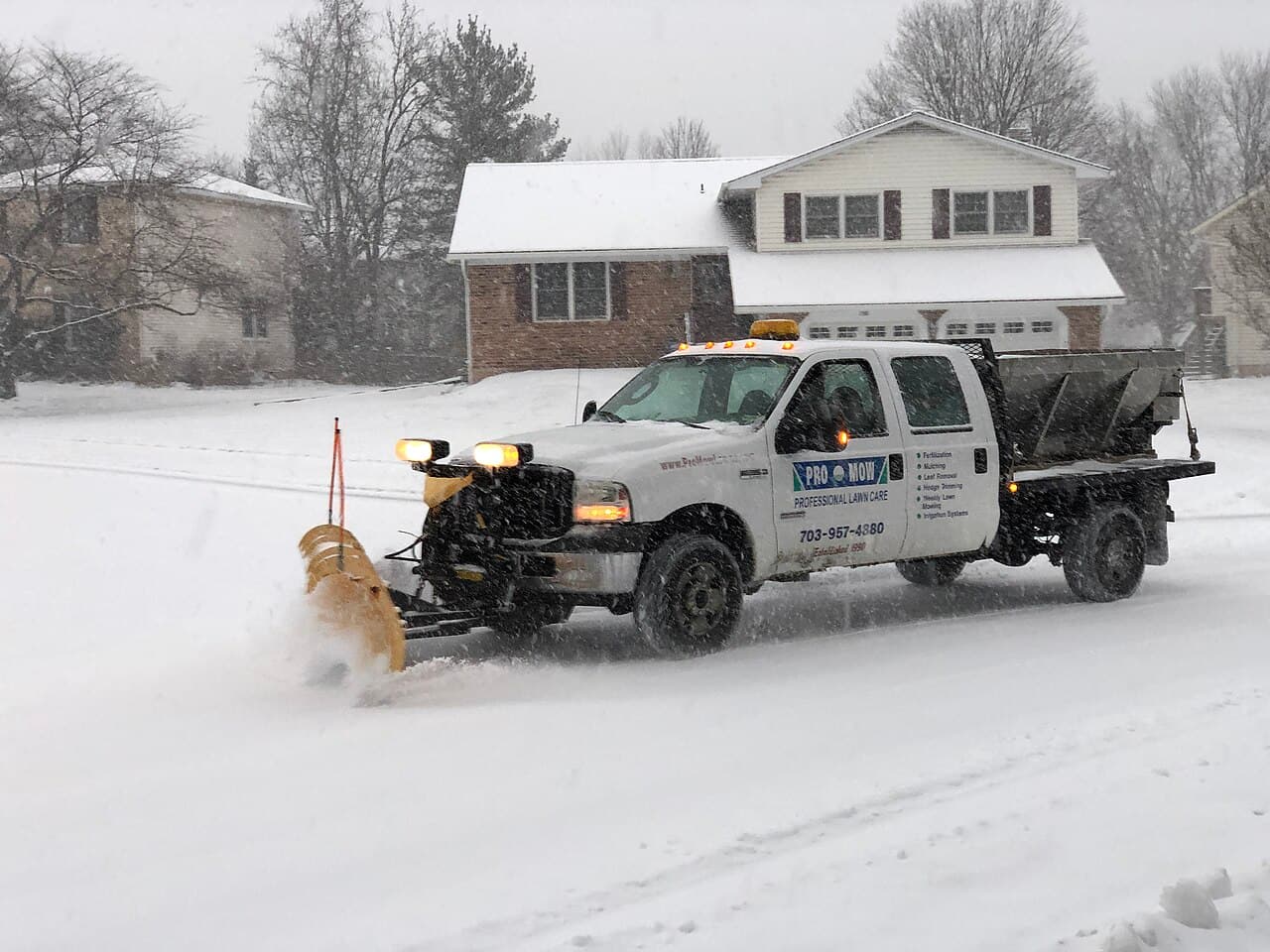
How commercial plowing is priced
Most proposals use one of these models:
- Per push (per visit). You pay each time the crew clears the site. A long storm may need several visits, each billed.
- Per storm. One price for everything a storm needs, sometimes capped by depth or visits.
- Per inch or depth tier. The price steps up as snow gets deeper. Read where the tiers break and who measures the depth.
- Seasonal. A fixed fee for the winter, sometimes with a visit cap. It protects you in a heavy winter and costs you in a mild one.
- Time and materials. An hourly rate for trucks and operators, plus materials. This suits irregular sites but is the hardest to budget.
Ask how each price changes in a 14-inch storm, not only in a 3-inch one.
What drives the price
The site. Lot area, number of entrances, loading docks, tight corners, islands and speed bumps all slow a plow. A site with nowhere to stack snow may need it hauled off, which is a separate service; see snow hauling.
The trigger depth. Companies start plowing at a stated depth. On Virginia's state roads, plowing generally begins when 2 inches or more of snow has accumulated.[1] The City of Richmond says that when snowfall is less than 2 inches, or the accumulation is mostly ice, plow blades are not as effective.[3] Below the trigger, the job is usually de-icer, priced separately.
Sidewalks and entrances. Walks, ramps and steps are done by hand or small machines and are often priced apart from the lot.
De-icing. Salt or other product is usually charged per application or by weight. It also affects landscaping: Virginia Cooperative Extension notes that salt accumulation in the soil usually occurs within 30-50 feet of roads.[6] Ask what is spread and keep it off beds and new concrete.
Response time and hours. A promise that the lot is open by 6 a.m., or plowing during the storm instead of after it, costs more because the company can only be in one place at a time.
Equipment and insurance. Insured, well-kept equipment costs money to run. Even VDOT requires vehicle insurance for each piece of equipment from contractors who plow for the state.[2]
Why you cannot leave the sidewalk to chance
Cities and counties put clearing duties on the owner or occupant, and those duties shape what you buy. Richmond says residents, property owners, and business owners have the responsibility to clear their own driveways, parking lots, and sidewalks, and that City Code requires sidewalks to be cleared within 6 hours of snow stopping or by 11 a.m. the next day if snow falls through the night.[3]
Alexandria's City Code makes the adjacent property owner, occupant, community association or business responsible for snow removal on sidewalks, driveways and entrances, within 24 to 72 hours of the end of the snowfall, depending on the storm response level.[4] A failure can bring a $50 fine, or the city can have the work done and charge the owner.[4] Alexandria also says owners who cannot clear the sidewalks themselves are responsible for arranging to have the work done.[4]
State law allows this in other places too: any county in Northern Virginia Planning District 8, or any county outside it that has the county executive form of government, may set reasonable criteria by ordinance for clearing snow and ice from public sidewalks.[5] Civil penalties under that law may not exceed $100.[5] Check your own locality for its deadline, and make sure the contract covers the sidewalk within that time.
Steps to get comparable quotes
- Map the site and mark snow storage areas.
- Decide the service level: plowing only, or also walks and de-icing, and the hours the site must be open.
- Look up your locality's sidewalk rule and deadline.
- Send the same written scope to two or three companies.
- Ask for proof of insurance.
- Compare terms, not just price.
- Sign one written agreement before the season.
What to compare in each contract
- The pricing model, trigger depth and what happens above it.
- Which areas are covered, and whether sidewalks and ramps are included.
- De-icer type and how it is billed.
- Response time and whether crews return during long storms.
- Who pays for damage to curbs, lights, landscaping or pavement.
- What happens if the company misses a visit, and how to cancel.
- Whether the company will keep a log of visits you can check against the invoice.
For the full list of clauses, see what a snow plowing contract should include and whether a seasonal contract is worth it.
Stop and call a pro if
- The site is large, has loading docks or multiple entrances, and your own staff cannot clear it before opening.
- Snow has nowhere to go and has to be hauled away.
- A storm has already left ice on walks or ramps that people must use.
- You are unsure what your locality requires of you after a storm.
- A company's quote will not put the scope, trigger depth and price in writing.
Getting help in Virginia
Browse commercial services and commercial answers, or read about what a janitorial service contract should include, since many of the same terms apply.
To get prices for your own site, describe the job once and local businesses quote it.
Common questions
- Is a seasonal contract cheaper than paying per push?
- It depends on the winter. A seasonal fee is fixed whether it snows a lot or a little, so it protects you in a heavy year and costs you in a mild one. Per-push pricing follows the weather. Ask whether the seasonal fee has a cap on visits or depth.
- At what snow depth do plow companies come out?
- Most set a trigger depth in the contract. On Virginia's state roads, plowing generally begins when 2 inches or more of snow has accumulated, and the City of Richmond says blades are less effective on lighter snow or mostly ice. Light snow and ice are usually handled with de-icer instead, priced separately.
- Who is responsible for clearing the sidewalk at my business?
- Usually you are, as the owner or occupant. Richmond says residents, property owners and business owners must clear their own parking lots and sidewalks, and Alexandria makes the adjacent property owner, occupant or business responsible. Check your own locality's rule and deadline.
- Is de-icing included in a plowing price?
- Not necessarily. Salt and sand are often charged per application or by the ton. Ask what is spread and how often, and keep it off planting beds, since Virginia Cooperative Extension notes salt builds up in soil near roads.
- What should I ask a plow company to show me?
- A certificate of insurance for the vehicles and the work. Even VDOT requires vehicle insurance for each piece of equipment from the contractors who plow for the state.
Sources
- [1] Winter weather: snow removal and treatment, and frequently asked questions, Virginia Department of Transportation. Checked October 27, 2026.
- [2] Snow contractors, Virginia Department of Transportation. Checked October 27, 2026.
- [3] Snow Removal, City of Richmond, Department of Public Works. Checked October 27, 2026.
- [4] Snow and Ice Control, City of Alexandria, Virginia. Checked October 27, 2026.
- [5] Code of Virginia § 15.2-2025. Removal of snow and ice; civil penalty, Virginia General Assembly, Legislative Information System. Checked October 27, 2026.
- [6] Trees and Shrubs that Tolerate Saline Soils and Salt Spray Drift (430-031), Virginia Cooperative Extension, Virginia Tech. Checked October 27, 2026.
Want a pro to handle it?
Describe the job once. Licensed local businesses send quotes, and you pay only when you book one.
Get a quote from a local pro