What does installing a gas range involve?
A finished gas range install should leave you with a new flexible connector, the range's own pressure regulator in the line, every gas joint leak-tested, a grounded outlet, and the range engaged in its anti-tip bracket. In Virginia the gas hookup is licensed trade work, and the building code's appliance exemption excludes gas appliances, so a permit is usually part of the job.
Free to ask. Local shops send quotes, and you pay only when you book one.
By Kasra Taheri, Founder, LoclisPublished
Researched and drafted with AI, then checked claim by claim against the sources listed below before it was published. Prices and rules change; the dates beside each source say when it was last checked.
This is a job for a licensed pro in Virginia
This page explains what the work involves, the permits, what a licensed pro does and what drives the cost. It does not give step-by-step instructions, because this work needs a licence, a permit or both, and doing it wrong can injure someone. Before you hire, check the licence on Virginia's DPOR record.
Installing a gas range is a short job when everything lines up, but most of it is gas work, and in Virginia that belongs to a licensed tradesperson. What you should end up with is a range on a new connector, with its own pressure regulator in place, leak-tested, plugged into a grounded outlet and held by an anti-tip bracket. A permit is usually part of the job.
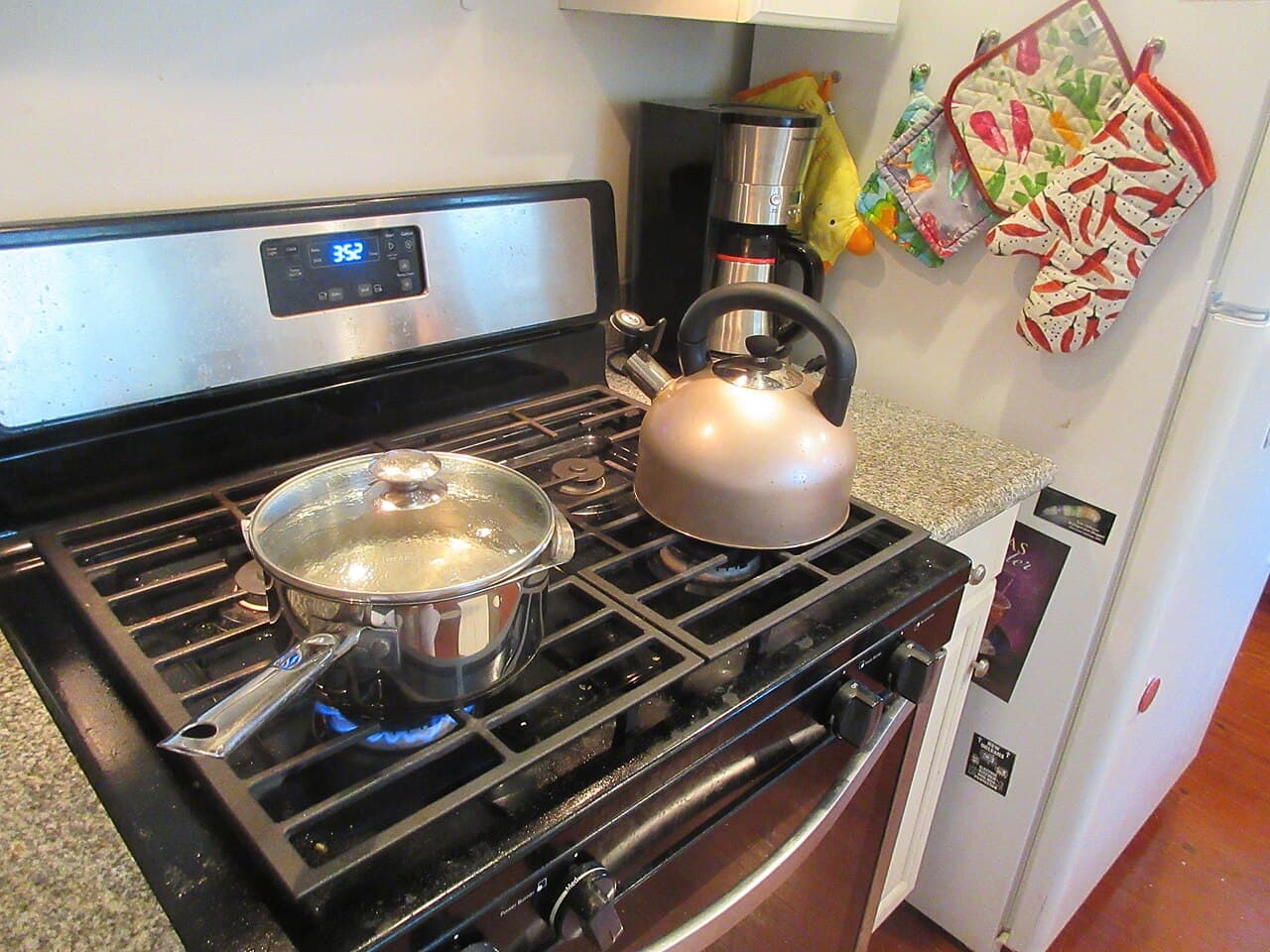
What a finished installation looks like
Use this as a checklist when the installer is done, and to read a quote for anything left out.
- A new connector. GE's instructions call for a new flexible metal connector and say never to use an old one with a new range.[1] The Consumer Product Safety Commission puts it plainly: "Connectors should always be replaced whenever the appliance is replaced or moved from its location."[2] Columbia Gas of Virginia gives the same advice: flexible appliance connectors should not be reused.[4]
- The range's own regulator in place. The range comes with its own gas pressure regulator, and GE says that regulator must be used.[1]
- A leak test on the gas connections. GE's instructions require the appliance to be leak-tested,[1] so ask the installer to confirm it was done before the range goes into use.
- You know where the shut-off valve is. GE tells the installer to show you where the gas shut-off valve is,[1] which is worth knowing long after installation day.
- A grounded outlet. A gas range still plugs in, and GE says the range must be electrically grounded in accordance with local codes.[1] Virginia's definition of a tradesman covers electrical work,[9] so an outlet behind the range that is missing, worn or the wrong type is a job for a licensed electrician.[10]
- Burners with a clean flame. Each burner should light and burn steadily before the installer leaves. Columbia Gas notes that a yellow flame or soot around a burner is a sign to call a qualified professional.[4]
- The range held by its anti-tip bracket. More on that below.
Natural gas or propane
This range leaves the factory set for use with natural gas, and GE says a conversion to propane "must be performed by a qualified propane gas installer."[1] If your house runs on a propane tank, say so when you ask for quotes, so the conversion parts and labour are priced in.
The anti-tip bracket is not optional
GE's warning label says it directly: "A child or adult can tip the range and be killed."[1] Voluntary safety standards for gas and electric ranges require manufacturers to supply anti-tip brackets with new ranges,[3] and if your range did not come with one, check with the manufacturer, since some will send a replacement bracket at no charge.[3] The bracket has to be re-engaged any time the range is moved,[1] for cleaning or a floor repair, so ask the installer to show you how it sits.
Permits in Virginia
Virginia's building code requires a permit before work on fuel supply systems,[5] and its exemption for swapping appliances covers only the "Replacement of mechanical appliances provided such equipment is not fueled by gas or oil".[5] Fairfax County reads that to mean any gas appliance installation or replacement needs a permit, even a like-for-like one.[6] If new gas piping goes in with the range, Fairfax asks for a residential plumbing permit instead of its household appliance permit.[6] Other counties and towns run their own permit desks, so ask yours what it wants before the range is delivered.
DPOR's consumer guide says the contractor should apply for and obtain any necessary building permits, and that this should be spelled out in the contract.[11]
Who is allowed to do the gas hookup
Virginia's licensing rules define a gas fitter as a tradesman whose work includes installing gas piping, equipment and appliances,[7] and no individual may work as a tradesman without a licence.[10] On the business side, the gas fitting (GFC) specialty covers the installation of gas piping and appliances,[8] while the home improvement (HIC) specialty does not cover electrical, plumbing, HVAC or gas fitting work.[8] A handyman can carry out the old range and level the new one, but the gas connection belongs to someone licensed for it. The full answer is in who can hook up a gas dryer or range in Virginia.
When to call a licensed pro
For a gas range, the answer is every time the gas line is touched. Call one, and do not wait, when:
- You smell gas. Columbia Gas of Virginia tells its customers to "go outside and call 911 and then call us at 1-800-544-5606 (24/7)."[4] The CPSC adds: leave the house immediately and do not light a match, turn on a light or switch on anything electrical.[2]
- The old connector is uncoated brass. The CPSC warns that moving an appliance, even slightly, can make one of these weakened connectors fail completely,[2] so leave the old range in place until the installer arrives.
- There is no gas line where the range will go. Running one is new gas piping. Fairfax County requires a Residential Plumbing permit when new gas piping goes in with an appliance,[6] and other localities set their own rules, so ask your building department.
- The shut-off valve is missing, corroded or hard to reach.
- You are converting from electric to gas or from natural gas to propane.
- A burner burns yellow, leaves soot, or will not stay lit after the install.
What to ask for in the quote
- The installer's DPOR licence number and specialty, which you can check by following how to check if a contractor is licensed in Virginia.
- Who pulls the permit, and whether the inspection is included.
- A new connector, shut-off valve work if needed, the leak test and the anti-tip bracket, itemised.
- Haul-away of the old range, and any outlet or circuit work priced separately.
Browse more handyman answers, see handyman services, or find licensed plumbers in Blacksburg. When you are ready, describe your range installation once and licensed businesses will quote.
Common questions
- Can I reuse the gas connector from my old range?
- No. The Consumer Product Safety Commission says connectors should always be replaced whenever the appliance is replaced or moved, and GE's range instructions say never to use an old connector with a new range. A new connector is a small part of the bill; ask for it in the quote.
- Do I need a permit to replace a gas range in Virginia?
- Usually, yes. The building code's exemption for replacing mechanical appliances does not apply to equipment fueled by gas or oil, and Fairfax County requires a permit for any gas appliance replacement, even like for like. Ask your local building department what it requires, and have your installer pull the permit.
- Can an appliance delivery crew hook up my gas range?
- Only if the person doing the gas connection is licensed for it. Virginia licenses gas fitting as trade work, and a home improvement licence does not cover it. Ask the store who makes the gas connection and for that person's DPOR licence number before delivery day.
- What is an anti-tip bracket and does my range need one?
- It is a bracket attached to the wall or floor that holds the range so it cannot tip forward. According to the CPSC, voluntary safety standards require manufacturers to supply one with new gas and electric ranges, and some manufacturers will send a replacement at no charge if yours is missing.
- Can I switch my gas range from natural gas to propane?
- Many ranges can be converted with a kit, but GE says the conversion must be done by a qualified propane gas installer. It involves swapping the burner orifices, so it belongs in the installer's scope, not a weekend project.
- What should I do if I smell gas after the new range goes in?
- Leave the house without switching anything on or off, and call 911 and your gas utility from outside. Columbia Gas of Virginia customers can reach the utility at 1-800-544-5606, 24 hours a day. Then call the installer back; a leak after an install is theirs to fix.
Sources
- [1] Installation Instructions, Range (31-2000747 Rev. 1), GE Appliances. Checked October 26, 2026.
- [2] Certain Older Gas Connectors May Be Dangerous (Publication 5135), U.S. Consumer Product Safety Commission. Checked October 26, 2026.
- [3] Range Tipover Safety Alert (Publication 5007), U.S. Consumer Product Safety Commission. Checked October 26, 2026.
- [4] Safe Appliance Installation, Columbia Gas of Virginia. Checked October 26, 2026.
- [5] 13VAC5-63-80, Virginia Uniform Statewide Building Code, Section 108 Application for permit, Virginia Administrative Code, Legislative Information System. Checked October 26, 2026.
- [6] Household Appliance (HAPL) permit, Residential, Fairfax County Land Development Services. Checked October 26, 2026.
- [7] 18VAC50-30-10, Definitions (Individual Licensing and Certification Regulations), Virginia Administrative Code, Legislative Information System. Checked October 26, 2026.
- [8] 18VAC50-22-30, Definitions of specialty services, Virginia Administrative Code, Legislative Information System. Checked October 26, 2026.
- [9] Va. Code § 54.1-1128, Definitions, Code of Virginia, Virginia General Assembly. Checked October 26, 2026.
- [10] Va. Code § 54.1-1129, Necessity for licensure, Code of Virginia, Virginia General Assembly. Checked October 26, 2026.
- [11] What You Should Know Before You Hire a Contractor, Virginia Board for Contractors, DPOR. Checked October 26, 2026.
Want a pro to handle it?
Describe the job once. Licensed local businesses send quotes, and you pay only when you book one.
Get a quote from a local pro