What does a plumber check when a water heater stops working?
A plumber starts with the energy supply: the breaker and high-limit reset on an electric heater, the pilot, gas supply and control valve on a gas one. Then come the parts that fail most often, such as heating elements, thermostats and the thermocouple or thermopile, followed by sediment, water pressure, the relief valve, leaks and the heater's age, which decide between repair and replacement.
Free to ask. Local shops send quotes, and you pay only when you book one.
By Kasra Taheri, Founder, LoclisPublished
Researched and drafted with AI, then checked claim by claim against the sources listed below before it was published. Prices and rules change; the dates beside each source say when it was last checked.
This is a job for a licensed pro in Virginia
This page explains what the work involves, the permits, what a licensed pro does and what drives the cost. It does not give step-by-step instructions, because this work needs a licence, a permit or both, and doing it wrong can injure someone. Before you hire, check the licence on Virginia's DPOR record.
When a water heater stops working, a plumber works from the simplest causes to the most expensive. First the energy supply, then the parts that fail most, then the tank itself, and finally the age and condition that decide whether a repair is worth paying for. Knowing the order helps you describe the problem on the phone and read the quote that follows.
The first questions on the call
Expect to be asked whether the heater is gas or electric, whether you have no hot water or just not enough, whether there is water on the floor, and how old the heater is. The answers point to different parts. No hot water at all usually means power, ignition or a failed component. Hot water that runs out early points more to elements, thermostats, sediment or a dip tube. Water on the floor is a leak call, which changes the order of everything.
On an electric heater
The technician treats the heater as live wiring, because it is. A. O. Smith warns: "High-voltage electricity can kill, and water heater components remain live even when the unit isn't actively heating."[1]
- The breaker. For an electric tank that is not heating, A. O. Smith says "The most common reason is a tripped circuit breaker".[1] A breaker that trips again points to a short somewhere in the heater.
- The high-limit switch. The red reset button sits by the upper thermostat. A. O. Smith explains that a tripped red reset button means the heater overheated, and that "repeated tripping indicates serious problems like shorted elements or faulty thermostats."[1]
- Thermostats. A bad thermostat can trip the high-limit switch, and A. O. Smith says a grounded element or a faulty lower thermostat is often behind it.[1]
- Heating elements. Elements are the parts that heat the water, and they tend to corrode or wear out over the heater's life.[2] A multimeter is the tool A. O. Smith names for testing heating elements,[2] which matters because a single failed element can leave you with some hot water, but not enough.[2]
- Scale. Hard water leaves scale, and A. O. Smith notes that scale on electric elements can cause crackling, popping or hissing sounds.[1] Mention any such noise when you call.
On a gas heater
On a gas model that will not heat, A. O. Smith points to three likely culprits: the fuel supply, the thermopile and a dirty inlet air screen.[2]
- The pilot and control valve. On many A. O. Smith models, the status light on the gas control valve flashing once every 3 seconds means the pilot is lit, and a light that flashes more than once every 3 seconds is a reason to call a plumbing contractor.[3] The flash pattern is useful to report on the phone; your manual explains the codes for your model.
- The gas control valve. If it is faulty, A. O. Smith says: "This component requires precise calibration and should be inspected and replaced by a professional if found to be defective."[1]
- The burner. A. O. Smith notes that dirt, debris or rust in the burner assembly hurts the flame and the heater's efficiency.[1] A technician also looks at the flame and the vent while the burner runs.
A. O. Smith's advice to owners is plain: "For safety reasons, do not try to dismantle any components on the gas water heater; always contact a plumbing contractor for assistance."[3]
Checks that apply to every tank
- Water-side faults. GE Appliances lists causes that are not about heat at all: a damaged dip tube, and water connections to the heater that were reversed.[5] It also notes that colder inlet water in winter takes longer to heat, which is normal.[5]
- Pressure and expansion. A. O. Smith recommends water pressure of 50 to 60 PSI and never above 80 PSI,[1] and a plumber may test it with a gauge and check for an expansion tank.
- The temperature and pressure relief valve. This is the tank's safety device. "If the valve doesn't operate correctly, the tank can over-pressurize and explode."[4] A valve that drips or will not open is replaced, not ignored.
- The tank itself. A plumber looks for rust, damp insulation and water in the pan. A. O. Smith says a leaking tank usually means replacing the whole heater.[1]
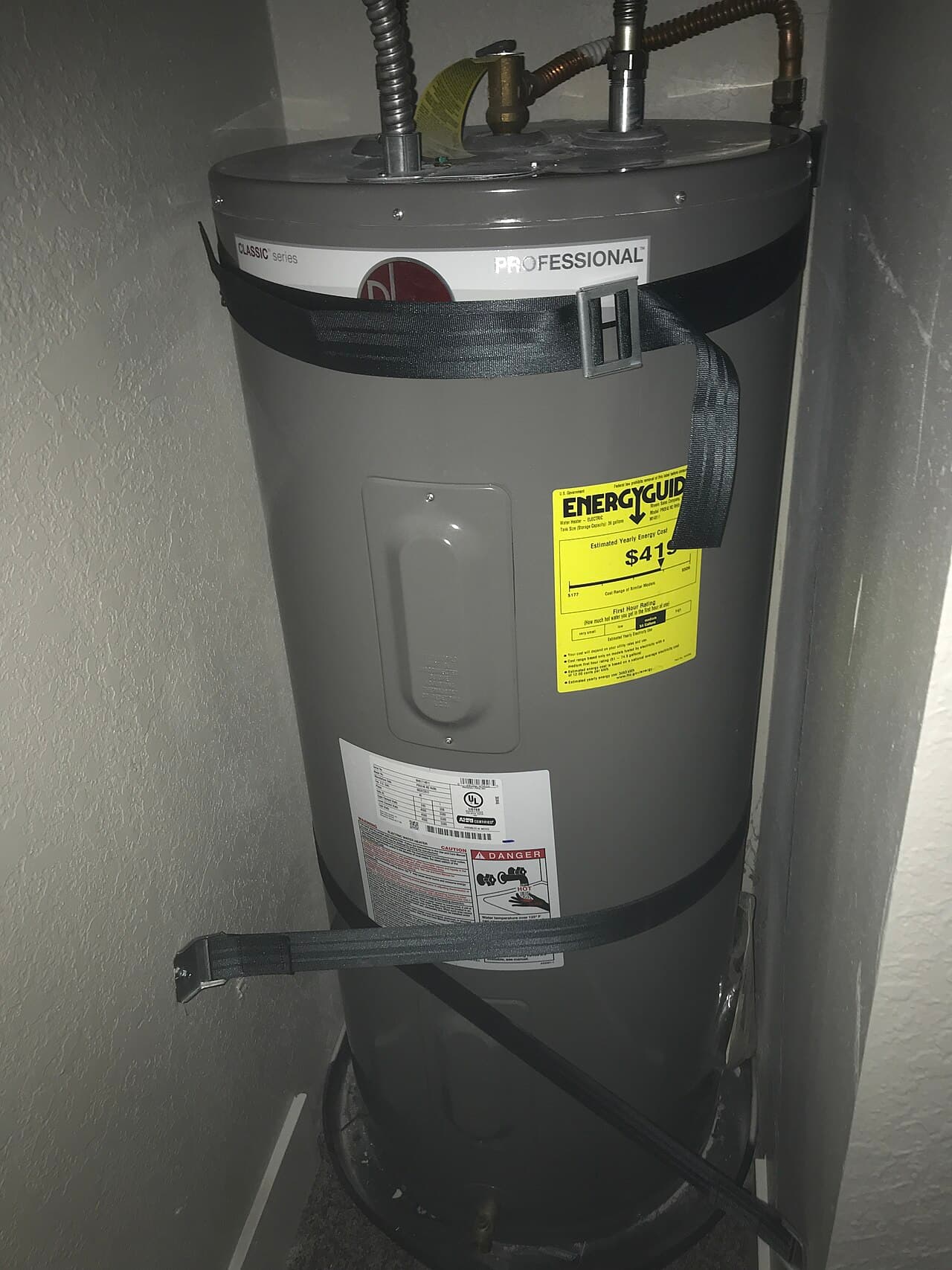
- The nameplate. The label on the side gives the facts a technician needs: the nameplate lists the tank capacity, working pressure, model and serial number, and on electric models the wattage and voltage of the heating elements.[2]
How the visit ends: repair or replace
Once the fault is found, age and condition decide the advice. A. O. Smith puts the average life expectancy of a water heater at about 8 to 12 years,[2] and adds: "If your water heater is more than 10 years old, leaks around the base of the tank or operates erratically, it's probably time to replace your water heater."[2] A failed element, thermostat or valve on a younger heater is usually a repair. Our repair-or-replace answer goes further.
A replacement can need a permit. In Virginia, the building code's permit exemption for replacing mechanical appliances in single-family homes covers only equipment not fueled by gas or oil,[10] so a gas heater swap falls outside it; ask your building department about an electric one, and see water heater permits in Virginia.
After a repair, give the tank time before judging it. A. O. Smith gives recovery times of 30 to 40 minutes for a gas tank and 60 to 90 minutes for an electric one.[1]
What you can do before the plumber arrives
Note the heater's make, model and age from the label, whether it is gas or electric, any status-light pattern, and whether the problem started suddenly or slowly. Look for water around the base without touching the relief valve or opening any panels. Have the warranty papers handy, since warranty coverage can change the price of a repair.
If you smell gas, leave first and do not try to diagnose anything. Columbia Gas of Virginia tells its customers to "go outside and call 911 and then call us at 1-800-544-5606 (24/7)."[6] If another company supplies your gas, use its emergency number.
When to call a licensed pro
Call as soon as the simple supply checks on the phone do not explain the problem, and right away for a leak, a dripping relief valve, a reset button that keeps tripping, or any gas smell. Diagnosing elements, thermostats, gas valves and burners is licensed work in Virginia. Under the Code, no individual may work as a tradesman without a licence, and the Code's definition of a tradesman covers electrical, plumbing and heating, ventilation and air conditioning work done for the public for pay.[7][8] Virginia's tradesman regulations list water heaters as plumbing work,[9] and gas fitting work includes the repair of gas equipment and appliances.[9] The Code's definition of a liquefied petroleum gas fitter is narrower: it covers LP gas piping, tanks and appliances, "excluding hot water heaters, boilers and central heating systems which require a heating, ventilation and air conditioning or plumbing certification".[8] So on a propane heater, ask what licence the technician holds. Check any business on DPOR's License Lookup[11] before it starts, and read how to check a contractor's licence.
Getting it fixed in Virginia
Loclis lists DPOR-licensed businesses with their licence number and class. Look up plumbers in Blacksburg, browse water heater repair, or read more plumbing repair answers.
Describe what your water heater is doing and licensed local businesses quote the repair.
Common questions
- What is the most common reason a water heater stops working?
- On an electric tank, A. O. Smith names a tripped circuit breaker as the most common reason, followed by failed heating elements and thermostats. On a gas tank, the usual suspects are the pilot or ignition, the gas supply, the thermocouple or thermopile and a dirty air screen.
- Why does my water heater's reset button keep tripping?
- The red reset button is a high-limit safety switch. It trips when the water overheats, and A. O. Smith says repeated tripping points to a shorted element or a faulty thermostat. That needs a licensed plumber with a meter, not repeated resets.
- How long does a plumber take to diagnose a water heater?
- It varies with the fault and the heater. A plain electrical or pilot fault is often found quickly. Ask when you book whether the diagnostic fee is credited against the repair if you go ahead.
- Will the plumber tell me to replace it instead of repairing it?
- Only if the evidence points that way. A leaking tank usually means replacement, and A. O. Smith treats a heater over 10 years old that leaks at the base or runs erratically as one to replace. A failed element, thermostat or valve on a younger heater is usually a repair.
- Can a plumber work on a gas water heater in Virginia?
- Yes, if licensed. Virginia's tradesman regulations list water heaters as plumbing work, and a gas fitter's licence covers gas piping, equipment and appliances. Check the business and its licence class on DPOR's License Lookup before the visit.
Sources
- [1] Is Your Hot Water Not Getting Hot? Common Causes & What To Do About Them, A. O. Smith. Checked October 26, 2026.
- [2] When to Repair or Replace Your Water Heater, A. O. Smith. Checked October 26, 2026.
- [3] How to Adjust Temperature on Gas Water Heater Safely, A. O. Smith. Checked October 26, 2026.
- [4] Water Heater Maintenance, A. O. Smith. Checked October 26, 2026.
- [5] Water Heater: Not Enough or No Hot Water, GE Appliances. Checked October 26, 2026.
- [6] Natural Gas Safety, Columbia Gas of Virginia. Checked October 26, 2026.
- [7] Va. Code § 54.1-1129, Necessity for licensure, Code of Virginia, Virginia General Assembly. Checked October 26, 2026.
- [8] Va. Code § 54.1-1128, Definitions, Code of Virginia, Virginia General Assembly. Checked October 26, 2026.
- [9] 18VAC50-30-10, Tradesman Rules and Regulations, Definitions, Virginia Administrative Code, Virginia General Assembly. Checked October 26, 2026.
- [10] 13VAC5-63-80, Virginia Uniform Statewide Building Code, Section 108 Application for permit, Virginia Administrative Code, Virginia General Assembly. Checked October 26, 2026.
- [11] License Lookup, Virginia Department of Professional and Occupational Regulation. Checked October 26, 2026.
Want a pro to handle it?
Describe the job once. Licensed local businesses send quotes, and you pay only when you book one.
Get a quote for Plumbing Repair