Why is my water heater leaking?
Where the water appears tells you most. From the top it is often a loose pipe connection; from the side, the temperature and pressure relief valve; from the drain valve, a valve not fully shut or worn out. Water from the base often means a corroded tank, which cannot be repaired. Shut off the heater's power or gas and its cold water supply, and call a licensed plumber.
Free to ask. Local shops send quotes, and you pay only when you book one.
By Kasra Taheri, Founder, LoclisPublished
Researched and drafted with AI, then checked claim by claim against the sources listed below before it was published. Prices and rules change; the dates beside each source say when it was last checked.
This is a job for a licensed pro in Virginia
This page explains what the work involves, the permits, what a licensed pro does and what drives the cost. It does not give step-by-step instructions, because this work needs a licence, a permit or both, and doing it wrong can injure someone. Before you hire, check the licence on Virginia's DPOR record.
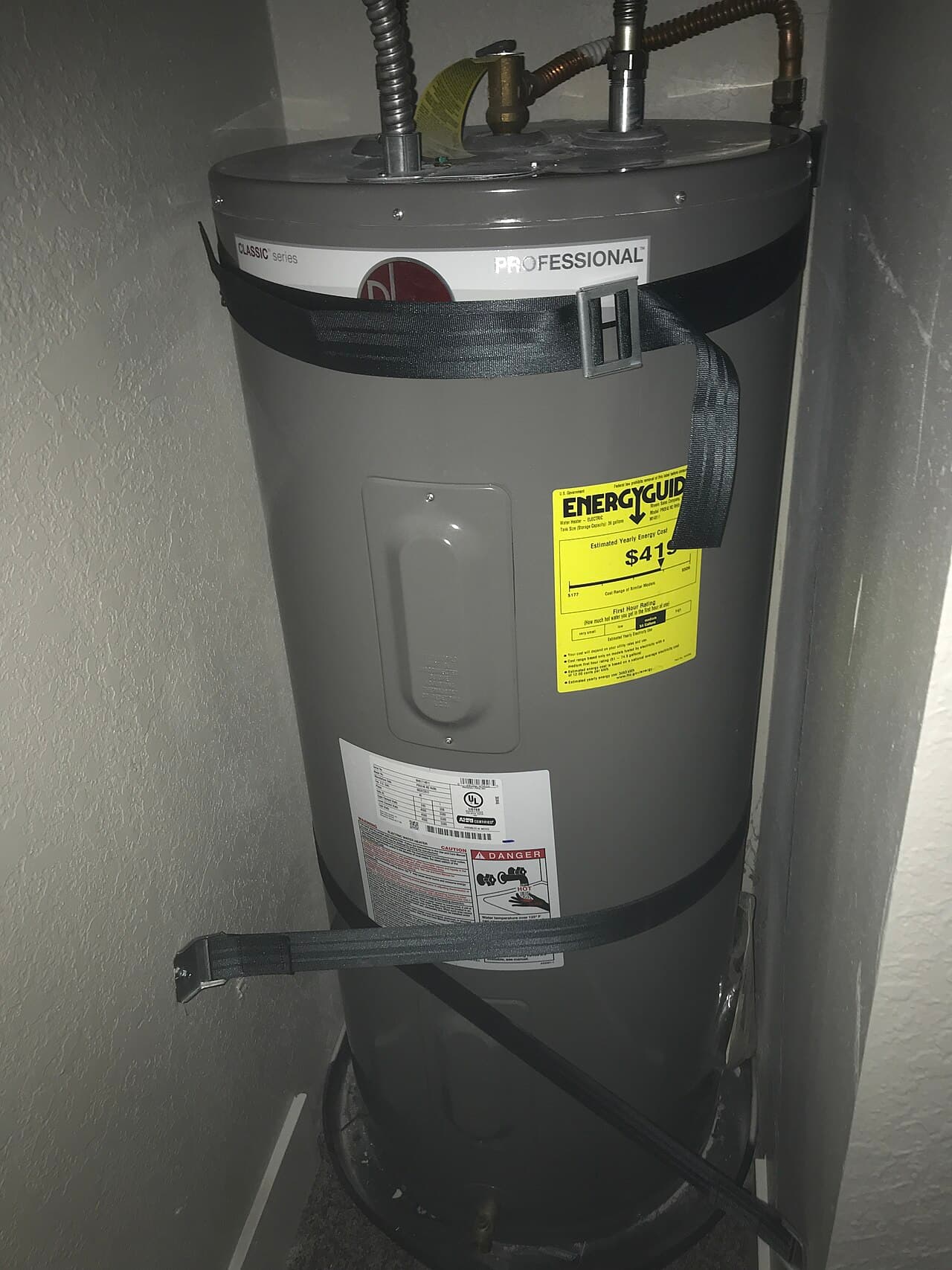
A water heater leak usually comes from one of a handful of places, and where the water appears points to which one. Fittings at the top, the relief valve on the side, the drain valve near the bottom and element gaskets on electric models can usually be repaired. A leak from the tank itself cannot. Before working out the cause, stop the damage: A. O. Smith's answer to whether you can keep using a leaking heater is "No, you should not continue using a leaking water heater."[1]
First, limit the damage
A slow drip is still worth acting on today. A. O. Smith warns that even a small leak can, over time, damage floors and walls and give mold a place to grow.[1] A. O. Smith's advice is switching off the breaker for an electric model or closing the gas shut-off valve for a gas one, then turning off the water supply at the shut-off valve on the cold water line.[1] Only close the gas valve if you can reach it safely and are confident doing so; otherwise leave it to the plumber. Move stored things away from the heater and put towels down.
Keep your hands off the relief valve and its pipe. A. O. Smith warns: "If you touch the pressure relief valve while the water heater is running, scalding water can shoot out, causing serious burns."[2] If you smell gas at any point, leave the house first. Columbia Gas of Virginia tells its customers to "go outside and call 911 and then call us at 1-800-544-5606 (24/7)."[7] If another company supplies your gas, use its emergency number.
Is it a leak or condensation?
Some water near a heater is not a leak at all. On gas models, A. O. Smith explains that condensation can appear when cold water comes into the tank or when the burner fires after sitting idle, and it usually passes.[1] "A gas water heater may produce condensation the first time it is lit."[4] Humid basements and heavy hot water use make it more likely. If the water keeps coming once the tank is up to temperature, or the floor is wet when nobody has used hot water for hours, treat it as a leak.
Where the water is coming from
- The top. A. O. Smith says a leak at the top often traces back to a loose pipe connection, so the fittings and connections are the first thing to inspect.[1] "Loose pipe connections can occur over time due to thermal expansion and general wear and tear."[1] This is often one of the smaller repairs.
- The side, or the relief valve pipe. "Leaks coming from the side of your system often originate from the T&P relief valve."[1] A. O. Smith links a leaking relief valve to high pressure or thermal expansion.[2] It recommends water pressure of 50 to 60 PSI and never above 80 PSI,[2] and when expansion is the cause, "The addition of a properly sized and charged expansion tank is the solution to this issue."[1] A plumber checks pressure before simply swapping the valve.
- The drain valve. A drain valve that leaks may not be fully shut, or it may be faulty.[2] A worn valve is replaced.
- Around an element (electric). On electric heaters, a failed gasket can let water out around a heating element.[2]
- The gas control (gas). A. O. Smith notes that a leaking gas control valve is rare and is a job for a professional.[2]
- The base of the tank. "A water leak coming from the base of the heater is often the first indication of a serious problem."[1] Water from under the jacket with no dripping fitting or valve above it points to the tank, and A. O. Smith says a leak at the base usually signals serious tank damage that needs a replacement.[1]
Why tanks fail from the inside
A tank can fail in more than one way. A. O. Smith explains: "The minerals in hard water can accumulate over time, causing corrosion and leaks. This type of corrosion cannot be repaired and will eventually require tank replacement."[1] It also notes: "Tanks can develop cracks due to corrosion or stress from water pressure."[1] Pressure matters on its own as well: water pressure that is too high can stress the heater enough to cause leaks in the tank or at plumbing connections.[1] And sediment plays a part: "Hard water contains minerals that can collect at the bottom of your tank and cause overheating, cracks and leaks."[1]
Hard water is worth knowing about for the heater's overall life as well. Virginia Cooperative Extension notes that "Hard water can also reduce the efficiency and life span of water heaters."[6]
The tank's defence is its anode: A. O. Smith explains that the anode rod is a sacrificial part that corrodes over time so the tank does not rust, and "These rods usually last 3-5 years before they need to be replaced."[1] Once the rod is used up, the steel corrodes instead, and rusty hot water is an early warning: ENERGY STAR says rust in the water usually means the inside of the heater is corroding.[5]
When the tank is the source, the answer is replacement. A. O. Smith is clear that a leaking tank cannot be repaired and the heater has to be replaced.[3] Our repair-or-replace answer covers that decision, and water heater permits in Virginia explains what a replacement needs.
What to tell the plumber
Say where the water appears (top, side, relief valve pipe, drain valve, base), how much there is, whether it is constant or only when the heater runs, the heater's fuel and age from its label, and whether you have shut off its power or gas and water. Photos of the top of the tank and the base help a technician bring the right parts.
When to call a licensed pro
Call as soon as you have shut the heater down, and right away if water is reaching finished floors, the relief valve keeps discharging, or the leak is from the base of the tank. Repairs to fittings, valves, elements and gas controls, and any replacement, are licensed work in Virginia. Under the Code, no individual may work as a tradesman without a licence, and the Code's definition of a tradesman covers electrical, plumbing and heating, ventilation and air conditioning work done for the public for pay.[8][9] Check any business on DPOR's License Lookup[10] before it starts.
Getting it fixed in Virginia
Loclis lists DPOR-licensed businesses with their licence number and class. Find plumbers in Blacksburg, browse water heater repair, see what a water heater repair costs, or read more plumbing repair answers.
Describe the leak and licensed local businesses quote the repair.
Common questions
- Is a leaking water heater an emergency?
- Treat it as urgent. A. O. Smith says not to keep using a leaking heater, because even a small leak can cause water damage and mold over time. Shut off its power or gas and its cold water supply, then call a licensed plumber.
- Why is my water heater leaking from the bottom?
- Water at the base can come from the drain valve, from the relief valve's discharge pipe, or from the tank itself. A. O. Smith says a leak from the base is often the first sign of a serious problem such as a corroded tank, and a tank leak cannot be repaired.
- Why is water coming out of the relief valve pipe?
- The temperature and pressure relief valve opens when pressure or temperature is too high, and A. O. Smith links dripping to high water pressure or thermal expansion. A plumber checks your water pressure and expansion tank before replacing the valve.
- Can condensation look like a water heater leak?
- Yes. A gas heater can produce condensation the first time it is lit, when a lot of cold water comes in, or when the burner fires after sitting idle. It normally fades as the tank warms. Water that keeps coming is a leak.
- Can a leaking water heater tank be fixed?
- No. A. O. Smith states that a leak in the tank cannot be repaired and the heater must be replaced. Leaks from fittings, the drain valve, the relief valve or element gaskets are usually repairable.
Sources
- [1] How to Diagnose, Fix, and Prevent Water Heater Leaks, A. O. Smith. Checked October 26, 2026.
- [2] Is Your Hot Water Not Getting Hot? Common Causes & What To Do About Them, A. O. Smith. Checked October 26, 2026.
- [3] How to Adjust Temperature on Gas Water Heater Safely, A. O. Smith. Checked October 26, 2026.
- [4] Water Heater Maintenance, A. O. Smith. Checked October 26, 2026.
- [5] ENERGY STAR Certified Heat Pump Water Heaters fact sheet, ENERGY STAR, U.S. Environmental Protection Agency. Checked October 26, 2026.
- [6] Virginia Household Water Quality Program: Hardness in Household Water (publication 442-664), Virginia Cooperative Extension, Virginia Tech. Checked October 26, 2026.
- [7] Natural Gas Safety, Columbia Gas of Virginia. Checked October 26, 2026.
- [8] Va. Code § 54.1-1129, Necessity for licensure, Code of Virginia, Virginia General Assembly. Checked October 26, 2026.
- [9] Va. Code § 54.1-1128, Definitions, Code of Virginia, Virginia General Assembly. Checked October 26, 2026.
- [10] License Lookup, Virginia Department of Professional and Occupational Regulation. Checked October 26, 2026.
Want a pro to handle it?
Describe the job once. Licensed local businesses send quotes, and you pay only when you book one.
Get a quote for Plumbing Repair